






Manila Bulletin
 Business
Trade & Industry
Global airline profits halve as PAL, Cebu Pacific cut routes
Business
Trade & Industry
Global airline profits halve as PAL, Cebu Pacific cut routes
Business
Trade & Industry
Global airline profits halve as PAL, Cebu Pacific cut routes
Global airline profits halve as PAL, Cebu Pacific cut routes
Published Jun 8, 2026 02:03 pm


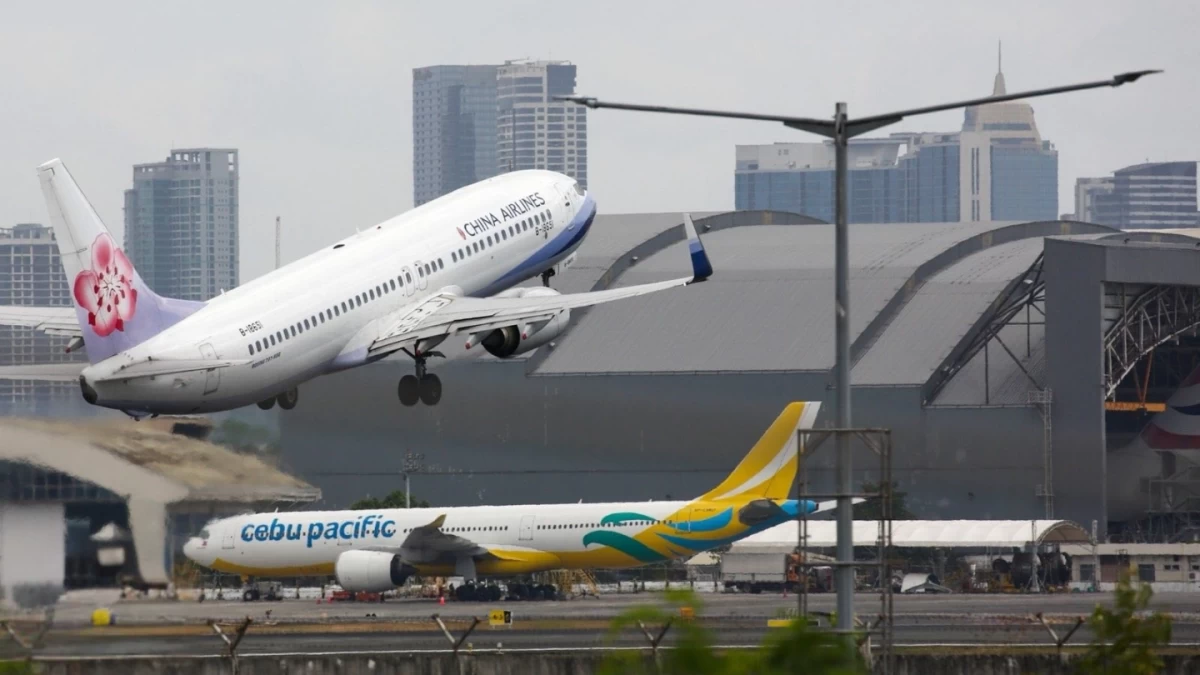
Planes taxi and depart from an air taxi terminal at an airport in Pasay City on Sunday, March 15. To combat rising jet fuel costs and keep air travel accessible, the Department of Transportation (DOTr) has ordered a reduction in passenger service charges and navigation fees at all CAAP-operated airports. (Photo by John Louie Abrina I MB)
Airlines are projected to see their combined profits cut in half to $23 billion this year as margins tighten further amid higher jet fuel costs, whose prices have soared due to the ongoing conflict in the Middle East, according to the International Air Transport Association (IATA).
Based on its outlook, the IATA said total net income for the year is down by 45 percent from its initial estimate of $41 billion. The latest projection is nearly half of the $45 billion in profits recorded in 2025.
IATA expects the already thin profit margin of airlines to be cut in half to two percent from 4.2 percent last year, lower than its original forecast of 3.9 percent.
While airlines’ overall revenues are expected to expand by 9.4 percent to $1.17 trillion, profitability is expected to lag as operating expenses rise by 13 percent to $1.12 trillion.
IATA Director General Willie Walsh attributed the higher operating costs to fuel prices, which are expected to increase by nearly 40 percent to $350 billion this year from $252 billion a year ago.
Based on IATA estimates, jet fuel prices are expected to average $152 per barrel this year, an increase of 70 percent from $90 per barrel last year.
“War-related disruptions in the Middle East and rising fuel costs have shifted the outlook for airlines to the worse,” said Walsh.
He said some of the additional costs are being recovered by airlines through fare adjustments, although this would not be sufficient to maintain profitability at the previous year’s level.
Walsh said the impact of higher airfares is already apparent in airlines’ bottom lines, as net profit per passenger transported is projected to reach $4.50 this year, half of last year’s $9.10.
“Under the circumstances, that shows resilience. But it won’t even buy you a hot dog at most of the FIFA World Cup venues and it does not leave much of buffer should other costs or taxes start rising,” he said.
In the Asia-Pacific region, IATA expects airlines to post a combined net profit of $6.6 billion, 33 percent lower than the $9.8 billion recorded last year.
Since the region relies heavily on crude oil imports from the Middle East, IATA said supply constraints related to the war are resulting in fuel shortages and steeper price increases compared to other regions.
“This environment is already prompting capacity adjustments, and longer routings, caused by airspace restrictions, lead to increased fuel burn, tighter effective capacity, and higher unit costs,” it said.
Locally, the country’s leading carriers, Philippine Airlines (PAL) and Cebu Pacific, were left with no choice but to cut some routes, especially those to the Middle East.
PAL earlier reported that its net income slipped to ₱4.28 billion in the first quarter, while Cebu Pacific swung to a net loss of ₱400 million.
Travelers are feeling the brunt as well, with the government allowing airlines to collect fuel surcharges of up to ₱1,237 for domestic flights and up to ₱10,385.42 for international flights.