







Filipino ideas meet Swiss industry
Published Jun 6, 2026 12:26 pm


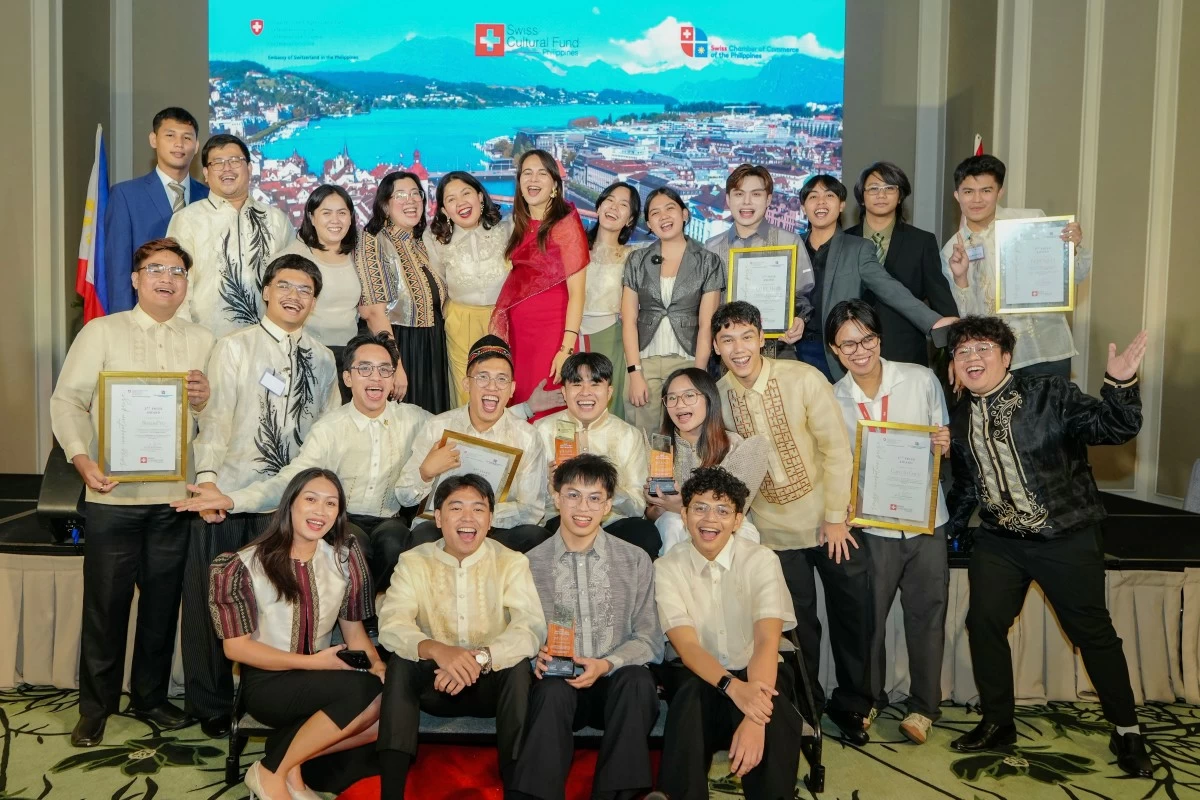
The 2026 Batch of Innovation Prize winners, together with the Swiss Embassy and the Swiss Chamber Innovation Team (Photo: Swiss Embassy)
The most interesting student competitions are rarely about the prize money. They are about access—to mentors, industries, decision-makers, and the kinds of real-world problems that rarely appear in textbooks.
That was the premise behind the Swiss Innovation Prize Competition 2026, which recently brought together some of the country's most promising young innovators and connected them directly with Swiss companies operating in the Philippines.
Now in its third year, the initiative is organized by the Embassy of Switzerland in the Philippines in partnership with the Swiss Chamber of Commerce and a network of Swiss companies operating in the country. More than 140 applications were submitted from across the Philippines, reflecting growing interest in the program and a widening pool of young innovators tackling challenges in technology, healthcare, construction, and manufacturing.
This year's edition also introduced a new format. Instead of innovation strands, participants competed across three industry clusters that more closely mirror today's business landscape: IT-BPM, Life Sciences and Digital Health, and Manufacturing and Construction.
The finalists represented universities and institutions from across the country, with particularly strong participation from schools in the Visayas and Mindanao. That geographic diversity may be one of the competition's most encouraging developments. Talent has never been confined to Metro Manila, but opportunities for exposure to industry leaders have often been concentrated there. Programs such as the Swiss Innovation Prize help narrow that gap.
More importantly, the competition extends beyond the final pitch.
Over three days, participants took part in workshops, mentoring sessions, and company visits hosted by Swiss organizations including Zuellig Pharma, Avaloq Philippines, Base Bahay Foundation, Nestlé's Tanauan factory, Franke Foodservice Systems, and SGS Philippines. The experience allowed students to engage directly with industry practitioners and gain a clearer understanding of how innovation moves from concept to implementation.
The winners were announced during the awarding ceremony held at Makati Diamond Residences on May 21, which capped three days of workshops, mentoring sessions, company visits, and final presentations. The results reflected both the diversity of ideas and the breadth of institutions represented.
In the IT-BPM cluster, first place went to Skill Bridge PH by Daniel Hans and Karelle Martinez of Ateneo de Manila University. The Life Sciences and Digital Health category was won by STEMI Flow, developed by Thomas Manulat, Malt John Solon, and Simon Escaño of Cebu Institute of Technology-University. In the Manufacturing and Construction category, top honors went to SIBOLution by Harvey Melendrez, Rodric Luceno, and Edison Limbaga of Mindanao State University–Iligan Institute of Technology.
The strong showing from universities outside the capital underscores a broader trend in Philippine innovation. Increasingly, promising ideas are emerging from campuses across the regions, supported by local ecosystems that are becoming more active and more connected to industry.
For Switzerland, supporting initiatives like these aligns naturally with its approach to economic diplomacy. Swiss engagement in the Philippines has long extended beyond trade and investment. Increasingly, it also focuses on knowledge exchange, skills development, and strengthening links between industry and academia.
The competition offers cash awards—P100,000 for first place, P15,000 for second, and P10,000 for third in each category—but its value lies less in the prizes themselves and more in the connections it creates. For many participants, the opportunity to engage directly with companies, mentors, and industry experts may prove more consequential than any cheque.