






Manila Bulletin
 Environment and Sustainability
Earth-balling explained: 6 things you need to know about relocating trees
Environment and Sustainability
Earth-balling explained: 6 things you need to know about relocating trees
Environment and Sustainability
Earth-balling explained: 6 things you need to know about relocating trees
Earth-balling explained: 6 things you need to know about relocating trees
Published Jun 4, 2026 04:30 pm
|
Updated Jun 4, 2026 02:17 pm


Hundreds of trees along Roxas Boulevard have become the focus of public debate. Around 245 have already been cut, while 355 more are scheduled for removal under a permit issued by the Department of Environment and Natural Resources (DENR) for the Southern Access Link Expressway (SALEX), a project meant to connect the northern and southern corridors of Metro Manila.
For now, implementation is on hold as stakeholders review the process. Part of that reassessment, DENR said, involves determining how many trees can still be relocated rather than cut. That is where earth-balling enters the conversation: the practice of moving a mature tree with a ball of soil around its roots so it can be transplanted elsewhere.
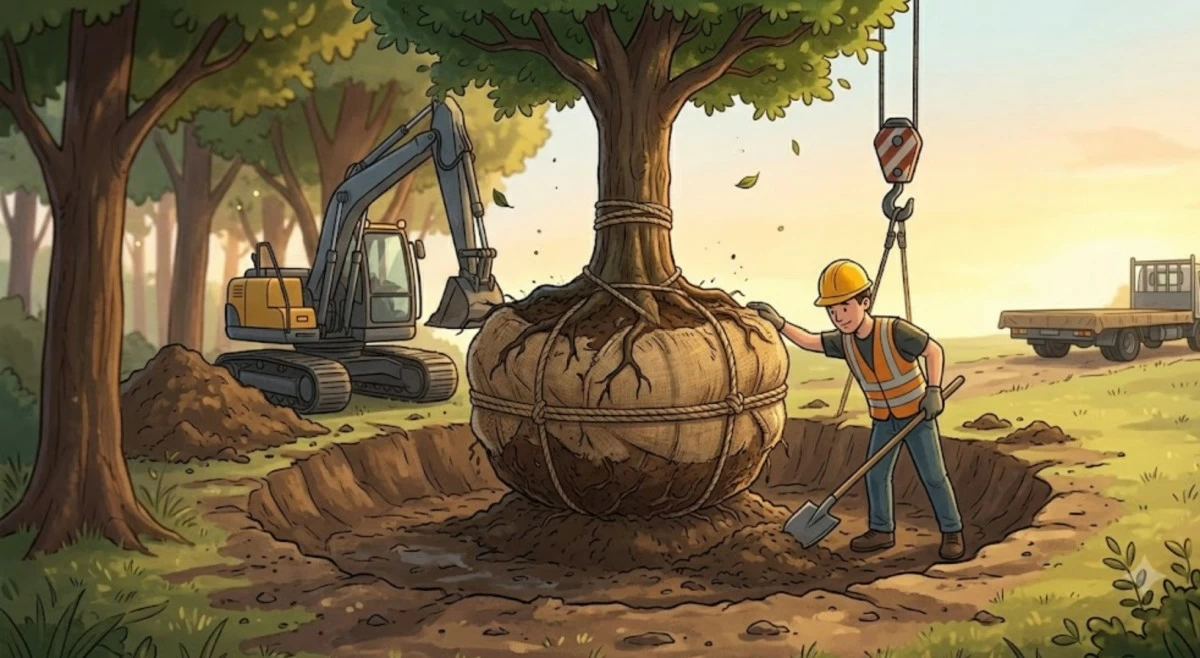
Image generated by Gemini
The benefits of having trees in urban areas are being highlighted by recent discussions about the remaining trees identified for transfer along Quirino Avenue in Manila. The debate has also renewed calls for more trees to be relocated through earth-balling so they can continue supporting life and providing environmental benefits.
Earth-balling will likely remain part of the public conversation in the coming weeks. Beyond the term itself, what exactly does the process involve? Has it been done locally before? And how successful is it? Here are six things to keep in mind.
• Why is it called earth-balling?
The term “balling” refers to the circular mass formed when digging out a tree’s root system together with the surrounding soil. The soil is wrapped into a ball-shaped form to keep it compact and protect the roots while the tree is transported to a new location. Once secured, the tree is lifted using cranes or a tree spade equipped with blades that encircle the tree during excavation and transfer.
• Has it been done locally before?
Several earth-balling activities have already been conducted in the Philippines over the years.
In Baguio City, more than 180 trees were identified for transfer to make way for a mall construction project. The plan was initially approved by the DENR but was permanently halted by the Supreme Court in 2019. However, some trees had already been cut before the ruling, drawing criticism from concerned citizens.
In 2020, at least 400 trees were earth-balled in Palawan as part of the development of the Balayong Tree Park, a tourism project of the local government.
Cebu also relocated 228 trees in 2023 to give way to the Cebu Bus Rapid Transit project.
• Is earth-balling successful in the Philippines?
While no comprehensive statistics are readily available, previous projects offer insight into the results of earth-balling efforts.
Reports indicated that some trees transferred in Baguio City did not survive or were not relocated at all. In Cebu, a local government official reported in 2023 that the 228 transferred trees eventually died after being moved to a quarantine area in the city.
On the other hand, Palawan continues to report positive results from the trees relocated to the 7.3-hectare Balayong Tree Park. The local government hopes to develop the area into a tourist attraction similar to Japan’s Sakura parks. The park’s pink blossoms are highlighted annually through festivals featuring parades, floral floats, street performances, and food fairs.
• Is it feasible in Metro Manila?
Several factors determine the viability of earth-balling, as every tree species requires specific conditions to survive after transfer.
Research shows that young or small-to-medium trees generally have better survival rates. Older and larger trees pose greater risks because their root systems are often too extensive or too deep to remain intact during relocation.
Some large trees in Metro Manila also have roots extending beneath concrete pavements, which may complicate excavation and affect nearby roads or walkways.
Aside from preserving the root system during transport, the new site must have suitable soil conditions and enough space for the roots to grow. Proper post-transport care is also necessary to help trees adjust to their new environment.
• How is the success of earth-balling measured?
Experts said a tree may take at least a year to recover after being transferred.
Signs of successful relocation include the growth of new leaves and twigs, stable moisture levels, and firm anchoring in the soil, indicating that the roots are adjusting to the new location.
Trees must also remain level with the ground, as sinking too deeply into the planting hole may suffocate the roots.
• What are the other risks involved in earth-balling?
Trees remain vulnerable throughout the earth-balling process.
Species with deep and complex root systems may suffer transplant shock or eventually die if not handled properly. Severe root damage can occur if structural and feeder roots are cut, preventing the tree from absorbing enough water and nutrients.
Wounds sustained during the process may also leave trees susceptible to fungal infections, root rot, and pest infestations.