






Manila Bulletin
 Business
The Stock Market
Stocks rise to 5,953 as ICTSI masks broader market anxiety
Business
The Stock Market
Stocks rise to 5,953 as ICTSI masks broader market anxiety
Business
The Stock Market
Stocks rise to 5,953 as ICTSI masks broader market anxiety
Stocks rise to 5,953 as ICTSI masks broader market anxiety
Published Jun 3, 2026 05:27 pm


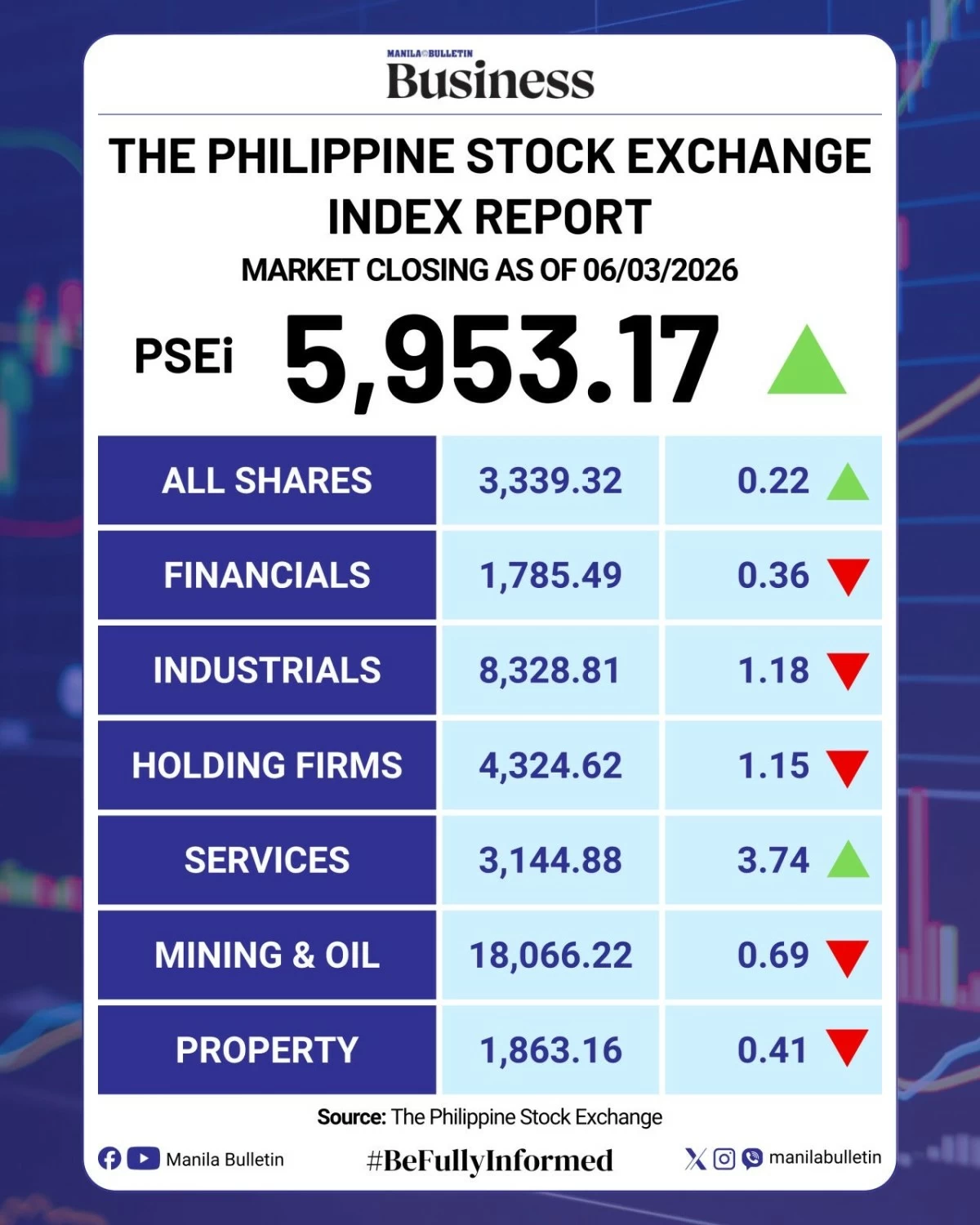
Local equities rose for the third consecutive session as International Container Terminal Services Inc. (ICTSI) single-handedly propelled the benchmark index higher, masking widespread weakness across the broader market.
The Philippine Stock Exchange index (PSEi) gained 40.48 points, or 0.69 percent, to finish at 5,953.17 on Wednesday, June 3. Despite the advance, market breadth was decisively negative, with only the Services sector managing a positive return among the exchange's six primary industry groups.
Trading volume increased to 452 million shares, translating to a total turnover value of ₱8.03 billion. Decliners handily outnumbered advances, 103 to 75, while 56 stocks remained unchanged.
ICTSI surged 5.42 percent to close at ₱875.00, according to Japhet Tantiangco, research manager at Philstocks Financial.
Tantiangco pointed out that just seven members of the elite 30-company PSE index posted gains, with the broader All Shares index reflecting a deeper, more cautious sentiment driven by unresolved geopolitical friction between the US and Iran.
Market observers are drawing parallels between ICTSI’s current market dominance and historical precedents. Nicky Franco, head of research at Abacus Securities Corp., noted that ICTSI's structural influence on the bourse is reminiscent of PLDT Inc.’s heavy footprint in the mid-to-late 2000s, when the telecommunications giant controlled nearly a quarter of the total index weight. ICTSI’s index weight has more than doubled in just over a year, exploding from 9.5 percent in May 2025 to 23.9 percent as of late May this year.
The local market's ability to maintain its green territory also received a boost from macroeconomic tailwinds and global cues. Bargain hunting and follow-through demand helped steady the market after a recent patch of vulnerability, according to Luis Limlingan, managing director at Regina Capital Development Corp.
Furthermore, Filipino equities mirrored a broader recovery across Asian trading floors, which were lifted by an influx of regional risk appetite and a strong lead-in from Wall Street, where US benchmarks recently touched historic highs, according to Michael Ricafort, chief economist at Rizal Commercial Banking Corp.