







The allure of the Orient
Published Jun 2, 2026 08:53 am


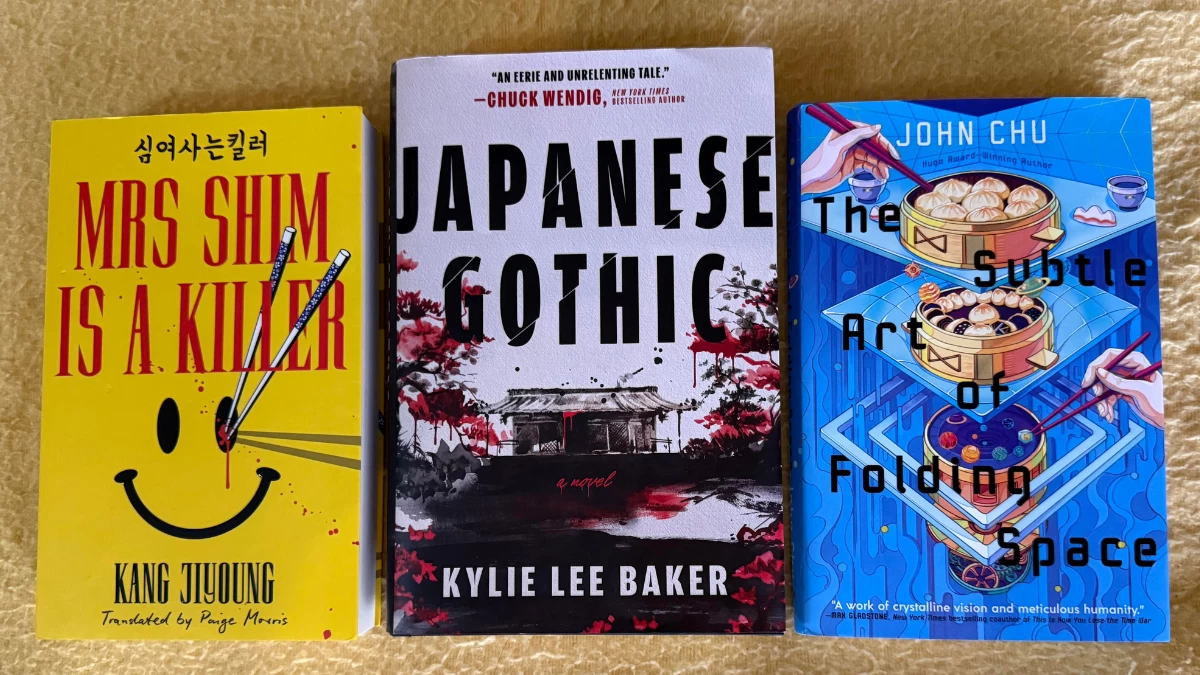
"Mrs. Shim Is A Killer" by Kang Jiyoung, "Japanese Gothic " by Kylie Lee Baker, and "The Subtle Art of Folding Space" by John Chu
Here are three novels - one a Crime Fiction adventure from a noted South Korean female author, the second is a Horror/Fantasy set in Japan. And the third is the first novel from a Chinese-American author whose short stories have won a Nebula and Hugo.
"Mrs. Shim Is A Killer" by Kang Jiyoung
This one hails from South Korea and has a crazy, alluring premise. What if the best contract killer of an agency that does covert hits for hire is an ajumma - your middle-aged Korean woman, typically called ‘Auntie’. That’s Mrs. Shim, an unemployed widow, with two grown children, in possession of insane butchering skills; and who knows how to keep secrets, handles business cleanly, and is as sharp as a blade. She prepares kimchi by day for her sick neighbor, while dispatching loan sharks or suspected rapists by night with her knife. The structure of the novel is to open with Mrs. Shim, then to devote each succeeding chapter to the different people who encounter Mrs. Shim and are part of her life. This results in our being provided an entertaining timeline of when she was involved with the Smile Detective Agency.
It’s a world of social misfits, of a trail of dead bodies, and quite tasty Korean food. The back stories of Mrs. Shim and the people who are part of her life - whether directly or indirectly- make for an engrossing saga of family, missed opportunities, and even unrequited love. Like a multiple helix narrative, the different strands begin to intersect at some point in the story, and towards the end, almost all the characters we’ve been introduced to are together in one location, with several dire decisions having to be made. Some may consider this to be too much of a coincidence, but the particular magic of this author is to make this convergence seem natural and something we look forward to. There is obviously some great, important reckoning that has to come to pass, and that we anticipate this with relish motivates our suspension of disbelief. No ordinary ajumma, we have a killer - and a sympathetic one.
"Japanese Gothic" by Kylie Lee Baker
Here’s an intriguing premise in the Horror-Fantasy genre. One house in Japan, two lives, from two time periods, and what happens when the two interface and begin to interact? In October of 2026, Lee Turner flees New York after his college roommate is murdered, and Lee can’t remember how or why he died. He ends up in his father’s new home in Japan, and one night, sees a woman holding a samurai sword in the garden. In October of 1877, in the same house, Sen is a young female samurai living in exile, after her father and his samurai clan have been disgraced and outlawed by the Emperor. While meditating on what choices in life are left to her, she spies a young foreign man outside her window. Regardless of the time period, no animals seem to come near the house, and there’s a window that isn’t always a window. Highly intriguing, right?
It’s a new take on the haunted house genre, throwing up questions of reality versus delusion, and whether we are on the same side of a strange coin. Japanese mythology, the burden of parental expectations, are just some of the underlying themes taken up by the novel to further humanize the plot developments. As a samurai, it's established early on that Sen is quite capable of killing in the name of duty, and upon the orders of her father. It is Lee who, in a confused state of mind, is never quite sure if his own hands are tainted with blood and has doubts about how to interact with his own father. The pressure these two are getting from their respective fathers connects the dimension-travelers in ways that are far too ominous and spell impending doom. We stay connected as the two main characters are well drawn and resonate, and we do want to discover how things will turn out for them.
"The Subtle Art of Folding Space" by John Chu
A noted SciFi author whose short stories have been awarded a Nebula and a Hugo, this is the first Chu full-length novel, and it’s brimming with his skewed multiverse ideas. It deftly mixes these highbrow, off-the-wall concepts with a saga of family, hurt feelings, and assassination attempts. Ellie is our main protagonist, working in the skunkworks as a maintainer. There are architects, builders, and verifiers at the skunkworks as well, keeping the law of physics intact in this world and in the other multiverses. At the book’s start, Ellie’s mother is languishing in a coma, and her sister Chris is something else, taking sibling rivalry to a whole new level, as Chris is behind the attempts on Ellie’s life. There’s a cousin named Daniel, who also works in the skunkworks, and has found an illicit device that destabilizes the physics we know. Why this device exists, and who is behind it, becomes the mission for both Ellie and Daniel.
The insane competition between the two sisters, their mother’s revered legacy, the generational trauma - these all make this slice of Science Fiction very real and human. It takes us beyond the Technology and the Multiverse orientation, elevating this novel above the genre. It’s to Chu’s credit that he makes us care for both Ellie and Daniel, and be curious about the reason that Chris is the way she is. Each time we encounter Chris, we get more intrigued and curious about her motivation. Wanting to look like the perfect caring daughter to the public is so important to Chris, so it places Ellie at such a disadvantage as she tries to explain the animosity that exists between the two - that in itself smacks of the truth we face in our world, when the person who’s well-loved and admired by all, is masking a rather different, more sinister ‘true nature’. There’s so much heart and compassion packed in this novel.