






Manila Bulletin
 Philippines
National
High Chinese presence rings alarm over possible new structure at Bajo de Masinloc
Philippines
National
High Chinese presence rings alarm over possible new structure at Bajo de Masinloc
Philippines
National
High Chinese presence rings alarm over possible new structure at Bajo de Masinloc
High Chinese presence rings alarm over possible new structure at Bajo de Masinloc
Published Jun 2, 2026 03:08 pm


At A Glance
- The Armed Forces of the Philippines (AFP) said it monitored a total of 82 People's Liberation Army Navy (PLA-N) and China Coast Guard (CCG) vessels across four key features in the West Philippine Sea throughout May.
- Bajo de Masinloc recorded the highest number with 39 vessels, consisting of 16 PLA-N and 23 CCG ships. Ayungin Shoal had 17 vessels, Escoda Shoal had 10, while Pag-asa Island had 16.
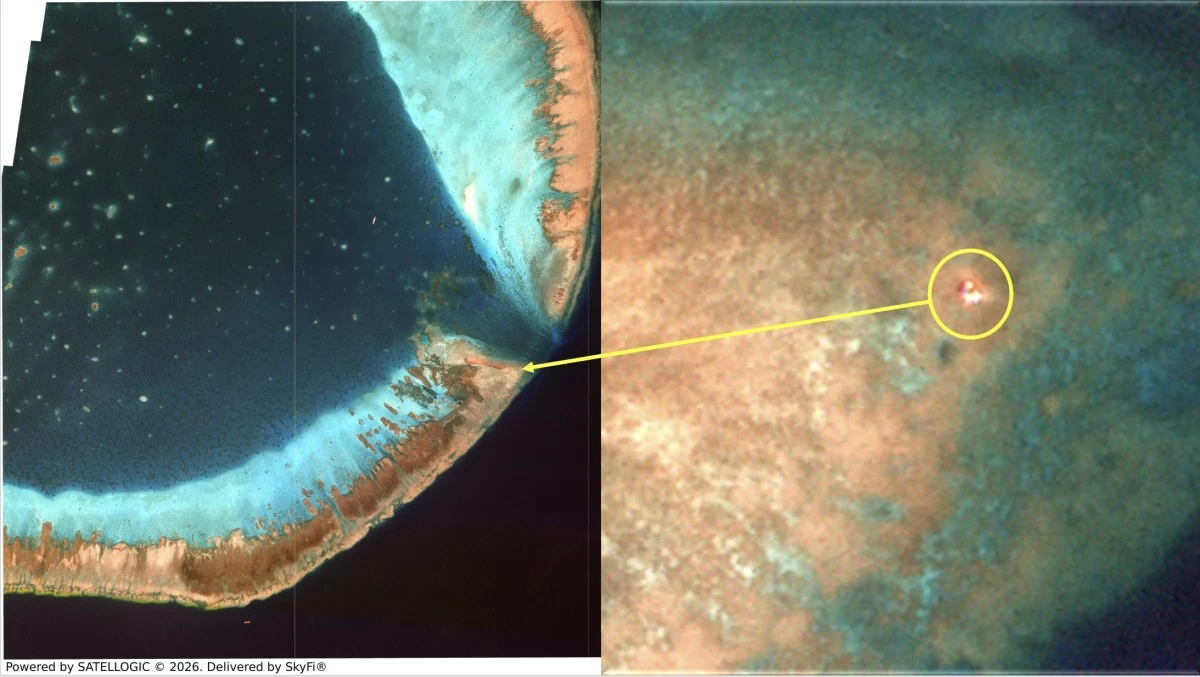
Commercial satellite imagery captured on May 28, 2026 by Satellogic and Sealight shows a small, reflective object near the lagoon entrance of Bajo de Masinloc (Scarborough or Panatag Shoal) in the West Philippine Sea. (Courtesy of Slight via Ray Powell / X (formerly Twitter)
A surge in the number of Chinese vessels monitored around Bajo de Masinloc (Scarborough or Panatag Shoal) in the West Philippine Sea (WPS) raised fresh concerns as defense and military officials said the national government is verifying reports of a possible structure or equipment spotted in the disputed shoal.
The Armed Forces of the Philippines (AFP) said it monitored a total of 82 People's Liberation Army Navy (PLA-N) and China Coast Guard (CCG) vessels across four key features in the West Philippine Sea throughout May.
Bajo de Masinloc recorded the highest number with 39 vessels, consisting of 16 PLA-N and 23 CCG ships. Ayungin Shoal had 17 vessels, Escoda Shoal had 10, while Pag-asa Island had 16.
Chinese maritime presence in Bajo de Masinloc continued to be unusually high during the period of May 26 to June 1, with 20 CCG vessels and seven PLA-N ships in the area.
“This is higher than the usual numbers of PLA Navy and Chinese Coast Guard in Bajo de Masinloc and we could only surmise that it is directly related to the conduct of the MCA. It is a reaction to the MCA,” AFP spokesperson for WPS retired admiral Roy Vincent Trinidad told reporters on Tuesday, June 2, referring to the recent Maritime Cooperative Activity between the Philippines and the United States.
According to maritime security analyst Ray Powell, satellite imagery showed a “small, reflective object” near the lagoon entrance of Bajo de Masinloc.
“If this object is confirmed to be a fixed installation, it would raise questions about compliance with the 2002 Declaration on the Conduct of Parties in the South China Sea, which calls for self‑restraint and avoiding actions that complicate disputes or alter the status quo on contested, uninhabited features,” said Powell, founder and director of SeaLight, a maritime transparency initiative at the Gordian Knot Center for National Security Innovation at Stanford University.
“Moreover, history shows that small structures on previously uninhabited features are rarely endpoints for China. If so, this would mark a serious new step at an especially sensitive location for the Philippines,” he added.
Department of National Defense (DND) Secretary Gilberto Teodoro Jr. confirmed that the National Task Force for West Philippine Sea (NTF-WPS) and National Maritime Council (NMC) are leading the verification with the AFP as rumors of new structures coincided with a sharp spike in Chinese deployment.
“I still don't know what it is, that's why it's still considered raw information. We are not even sure if it's a structure. That's why we cannot characterize it,” Teodoro said.
He noted that various objects have appeared in the shoal in the past, including floating buoys.
“Once in a while, they put up buoys and other things there. It is also possible that something from outside drifted into the area. We do not know because it is a shoal," Teodoro said,” he said.
Meanwhile, the AFP confirmed there had been no reports of dredging activity at Bajo de Masinloc.
Bajo de Masinloc, located 124 nautical miles west of Zambales, has long been one of the flashpoints in the WPS.
China seized effective control of the shoal after a standoff with Philippine vessels in 2012 despite it being located well within the country’s 200-nautical-mile exclusive economic zone (EEZ) under the 2016 arbitral ruling that invalidated China's sweeping claims in the South China Sea.
Teodoro previously described reclamation at Bajo de Masinloc as a potential trigger for a stronger government response.