







DuckDuckGo's 'No AI' search is surging
Published Jun 2, 2026 01:18 pm


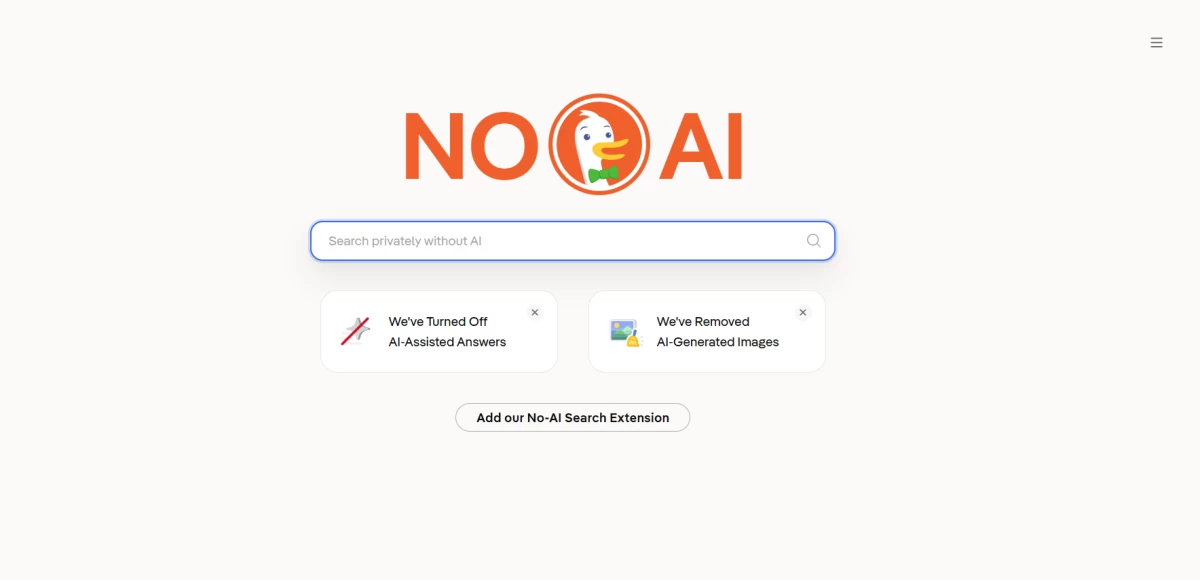
DuckDuckGo's no-AI search page tripled in traffic on May 28, 2026, and has stayed well above normal ever since. Visits are running about 84% higher than the previous average, U.S. iOS installs jumped nearly 70% week-over-week, and overall web visits are up around 30%. The trigger was Google's announcement at its I/O developer conference that it was making AI the center of its search experience.
What DuckDuckGo is offering
DuckDuckGo launched new Chrome and Firefox extensions that let users set noai.duckduckgo.com as their default search engine. There will be no AI results or any AI boxes to input prompts. AI images may still appear, but it should be significantly reduced.
DuckDuckGo is not an anti-AI company. It still offers its own AI chatbot and subscription tools. The no-AI page is simply a choice for users who don't want to bother going through so many hoops to simple disable.
How to access it
Go to noai.duckduckgo.com in any browser, or install DuckDuckGo's Chrome or Firefox extension to make it your default. AI search settings will also be added to the existing DuckDuckGo Privacy Essentials extensions for Chrome, Firefox, Edge, and Opera.
What Google changed at I/O 2026
At Google I/O on May 19, Google announced what it called the "biggest upgrade to Search in 25 years." The new search uses its Gemini 3.5 Flash AI model to answer questions directly at the top of the page, rather than returning a list of links. It also added conversational follow-up questions, AI autocomplete, and deeper personal context from Gmail and Google Photos. There is no way to turn it off.
Why people want AI-free search
DuckDuckGo's traffic surge comes from three distinct groups of users, each with a different reason for opting out of AI search.
They don't trust the answers
A March 2025 study by the Tow Center for Digital Journalism found that AI search tools frequently produced false results and fabricated links rather than admitting they couldn't find an answer. Paying for a premium service made it worse. Researchers found that paid tools gave "more confidently incorrect answers" than free ones. An AI Overview that sounds authoritative but is wrong 3% of the time is harder to catch than a tool that's obviously unreliable.
They don't want to be tracked
DuckDuckGo's founding promise is that it doesn't track users or build behavioral profiles. AI-powered search does the opposite, it works best when it knows who you are, what you've searched, and what you've read. The more personal data the AI can access, the more "helpful" it becomes. For users already wary of how tech companies use their data, that trade-off is a dealbreaker.
They want to find things themselves
When a search engine hands you a pre-written answer, you can't see where it came from, who wrote it, or whether the source is credible. The old way, a list of links, let users judge sources for themselves. That's something a growing number of people, particularly researchers, journalists, and students, say they actively prefer.
Environmental reasons
Also, there are users who are strongly opposed to AI as the amount of water needed to cool down data centers is massive.
AI made gaming more expensive
And for some users, AI companies almost emptied out the stocks for memory just to build their data centers. This effectively raised the prices of memory storage and RAM, which is found in every electronics.
How big is this, really?
To be clear about the scale: Google held about 90% of the global search market as of December 2025. DuckDuckGo holds 0.78%. A threefold traffic spike on a page with that starting point is meaningful, but it is not a threat to Google's dominance.
What it does signal is a real and sustained appetite for an alternative. Kagi, another AI-minimal search engine, charges $5–$10 per month and has no ads. People paying for search, something almost no one did five years ago, is a reasonable indicator of how much trust in free AI-driven search has slipped.
The deeper issue is what happens to the open web if AI Overviews continue reducing the financial case for publishing online. AI search engines summarize content written by human journalists, bloggers, and experts. If those writers lose their traffic and their income, they stop writing. Over time, the AI will have less original material to draw from. That's a problem Google hasn't answered yet.
DuckDuckGo's no-AI search doesn't fix any of this. But it gives users a way to opt out, and right now, that's enough to keep its servers busy.