






Manila Bulletin
 Philippines
National
AFP checking Chinese carrier drills east of Luzon; Japan flags 170 air sorties
Philippines
National
AFP checking Chinese carrier drills east of Luzon; Japan flags 170 air sorties
Philippines
National
AFP checking Chinese carrier drills east of Luzon; Japan flags 170 air sorties
AFP checking Chinese carrier drills east of Luzon; Japan flags 170 air sorties
Published Jun 2, 2026 02:08 pm


At A Glance
- When confronted with the Japanese intelligence report, retired admiral Roy Vincent Trinidad, the AFP spokesperson for the West Philippine Sea (WPS), said the local military command had no prior knowledge of the Chinese carrier's presence.
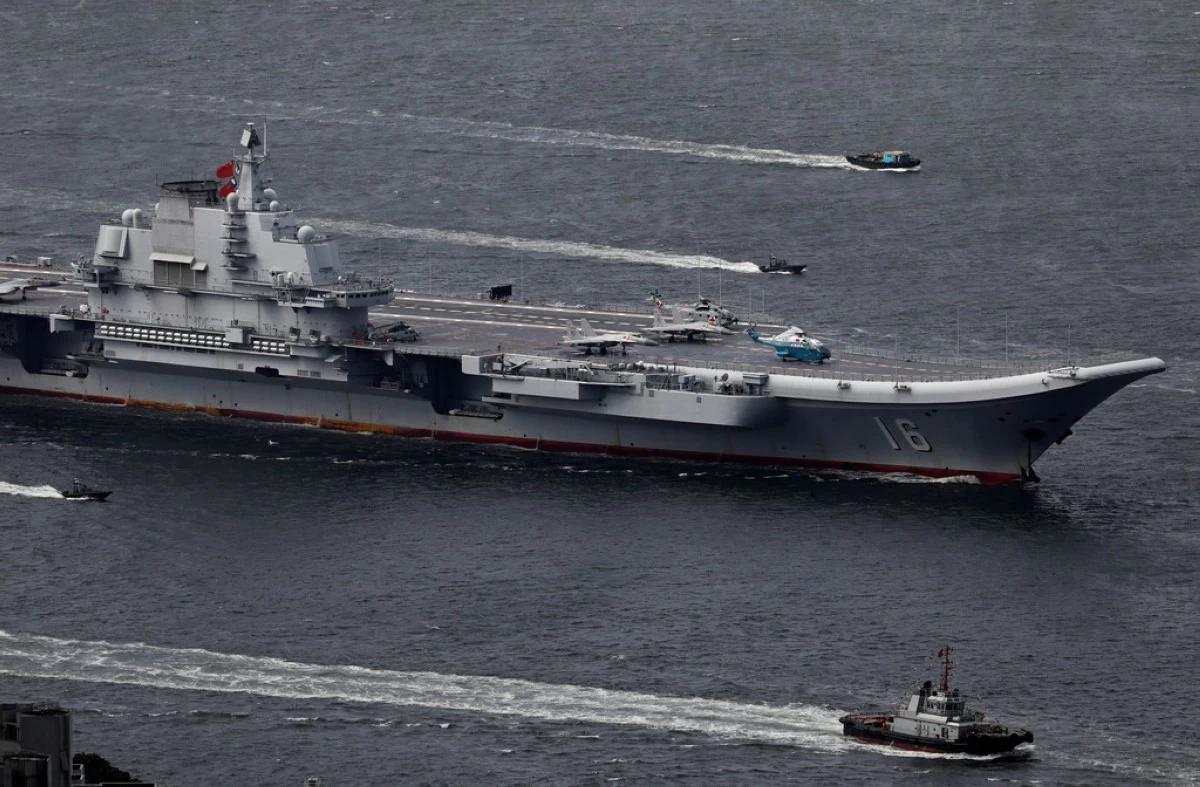
The Liaoning, China's first aircraft carrier, sails into Hong Kong for a port call to celebrate the 20th anniversary of the People's Liberation Army (PLA) garrison's presence in the semi-autonomous Chinese city and former British colony on July 7, 2017. (AP Photo/Vincent Yu, File)
The Armed Forces of the Philippines (AFP) said it will verify the alleged exercises conducted by a massive Chinese carrier strike group in the Pacific Ocean, specifically east of Luzon, as an official admitted the military only learned of the deployment through public bulletins issued by Japan.
The Japan Joint Staff Office released a detailed tracking report on June 1 indicating that China’s aircraft carrier Liaoning led a powerful flotilla through the Pacific Ocean from May 26 to 29.
When confronted with the Japanese intelligence report in a press briefing on Tuesday, June 2, retired admiral Roy Vincent Trinidad, the AFP spokesperson for the West Philippine Sea (WPS), said the local military command had no prior knowledge of the Chinese carrier's presence.
“There has been no report on that yet but I will check on it. It's the first time I heard about that, that it was monitored by the Japanese Maritime and Self-Defense Forces (JMSDF),” he said.
According to the Japanese military, the Liaoning carrier strike group was tracked from May 26 while operating southwest of Okinotorishima and south of Miyako Island. The group included a Renhai-class guided missile destroyer, a Luyang III-class guided missile destroyer, a Jiangkai III-class frigate, and a Fuyu-class fast combat support ship at various stages of the deployment.
Japan said it observed around 80 takeoffs and landings of carrier-based fighter aircraft and helicopters on May 26, about 50 on May 27, and roughly 40 on May 28. The total reached about 170 flight operations in three days.
The Japanese military also reported that on May 29, the Liaoning, a Renhai-class destroyer, and a Luyang III-class destroyer were sailing southeast in the Pacific Ocean east of Luzon.
The vessels were monitored by JMSDF destroyer JS Asahi, which carried out surveillance and intelligence-gathering activities, according to Japan’s bulletin.
Manila and Tokyo have been strengthening their defense cooperation amid increasing Chinese military activity in the region.
In fact, Department of National Defense (DND) Secretary Gilberto Teodoro Jr. expressed optimism that negotiations for the proposed General Security of Military Information Agreement (GSOMIA) between the two countries could be completed this year.
“I hope it is, I am ready to do that. We are ready to do that. The Department of National Defense is capable of doing that,” Teodoro said when asked if the two nations are prepared to finalize the GSOMIA within the year.
The proposed accord would establish rules for the exchange and protection of classified military information between the two countries. It is expected to complement expanding security ties following the Philippines-Japan Reciprocal Access Agreement (RAA).
“All we need are the proper consents from the appropriate agencies, of which I guarantee the DND knows that it is doing,” Teodoro added.