







3-month fishing ban starts in Davao Gulf for spawning season
Published Jun 2, 2026 01:55 pm


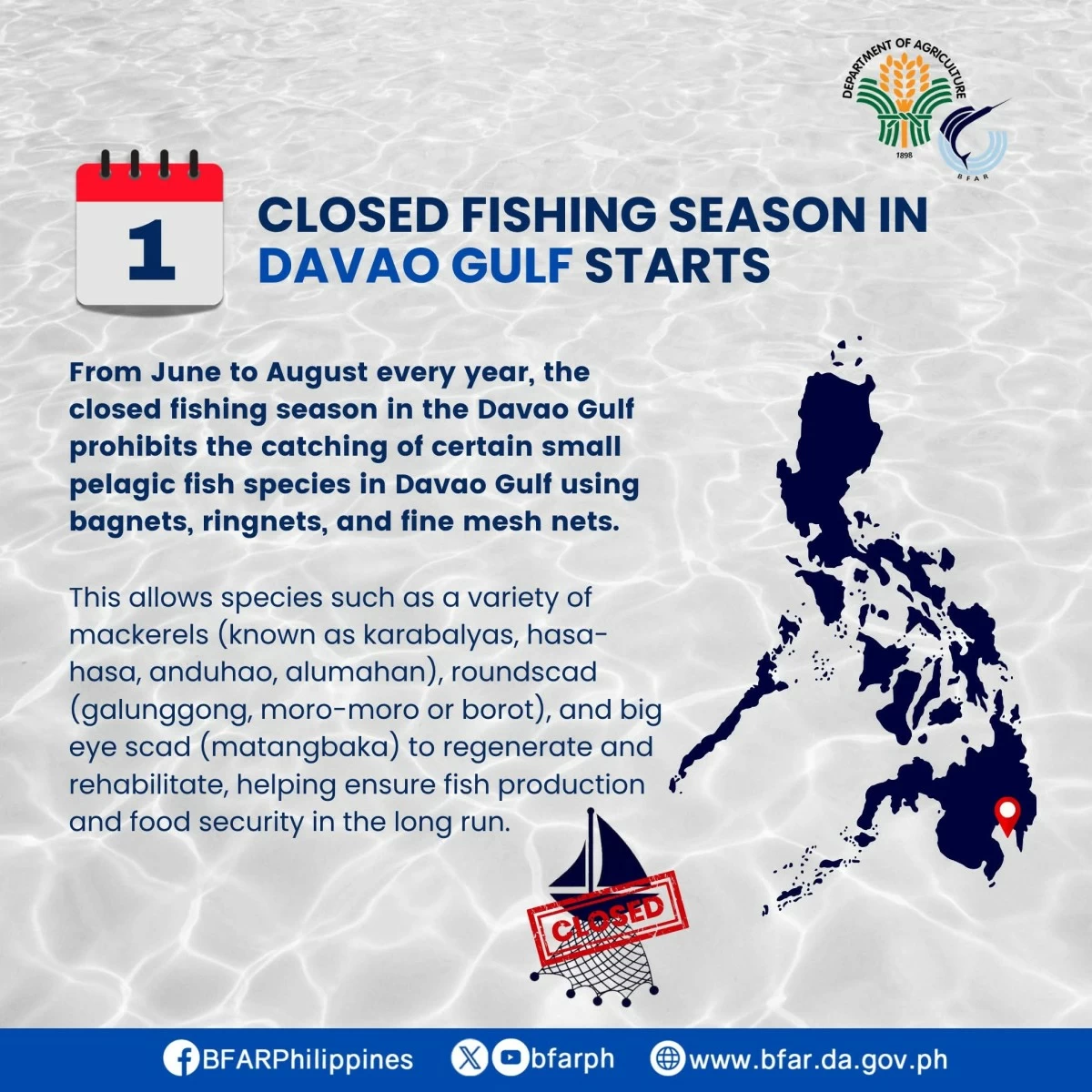
DAVAO CITY – The Bureau of Fisheries and Aquatic Resources-Davao (BFAR-11) has officially commenced the 2026 Davao Gulf closed season, enforcing a strict three-month ban on specific commercial fishing gear to protect small pelagic fish species during their peak spawning period until Aug. 31.
The ban spans from Cape San Agustin in Gov. Generoso, Davao Oriental, to Talagotong Point in Don Marcelino, Davao Occidental.
In a statement Tuesday, BFAR-11 said the closed season aims to ensure the long-term sustainability of the gulf's marine resources.
Under Department of Agriculture–Department of the Interior and Local Government Joint Administrative Order No. 2, Series of 2014, and Republic Act 10654, the use of bagnets (basnig or tapaytapay) and ringnets (kubkuban or likom) is strictly prohibited regardless of vessel tonnage. Modified fishing gear with similar operations is also banned.
Registered municipal fisherfolk using authorized, low-impact municipal gear are exempted from the ban. Permitted methods include hook and line, gillnet, and fish pots.
BFAR-11 has teamed up with the Philippine Coast Guard, the Philippine National Police-Maritime Unit 11, and local government units to step up monitoring and surveillance. Authorities are utilizing Vessel Monitoring System track analysis to detect illegal fishing activities.
Enforcement operations are currently concentrated in strategic coastal zones, including the Island Garden City of Samal, Banaybanay, Lupon, San Isidro, Gov. Generoso, and Don Marcelino.
Violators face severe penalties under Section 100 of RA 10654, including fines ranging from P20,000 to P500,000, imprisonment, confiscation of catch and gear, and cancellation of fishing licenses.
"Since 2015, the BFAR Regional Adjudication Committee Secretariat has docketed 13 closed-season violation cases, resulting in more than P1 million in total fines," BFAR-11 added.
BFAR-11 reaffirmed its commitment to protecting and conserving the marine ecosystem of Davao Gulf to ensure sustainable fisheries resources for future generations. The agency also urged the public to report fisheries violations to support enforcement efforts against illegal, unreported, and unregulated fishing in the region. (PNA)