






Manila Bulletin
 Business
The Stock Market
San Miguel explains why trees being removed on Quirino avenue
Business
The Stock Market
San Miguel explains why trees being removed on Quirino avenue
Business
The Stock Market
San Miguel explains why trees being removed on Quirino avenue
San Miguel explains why trees being removed on Quirino avenue
Published Jun 1, 2026 02:00 pm


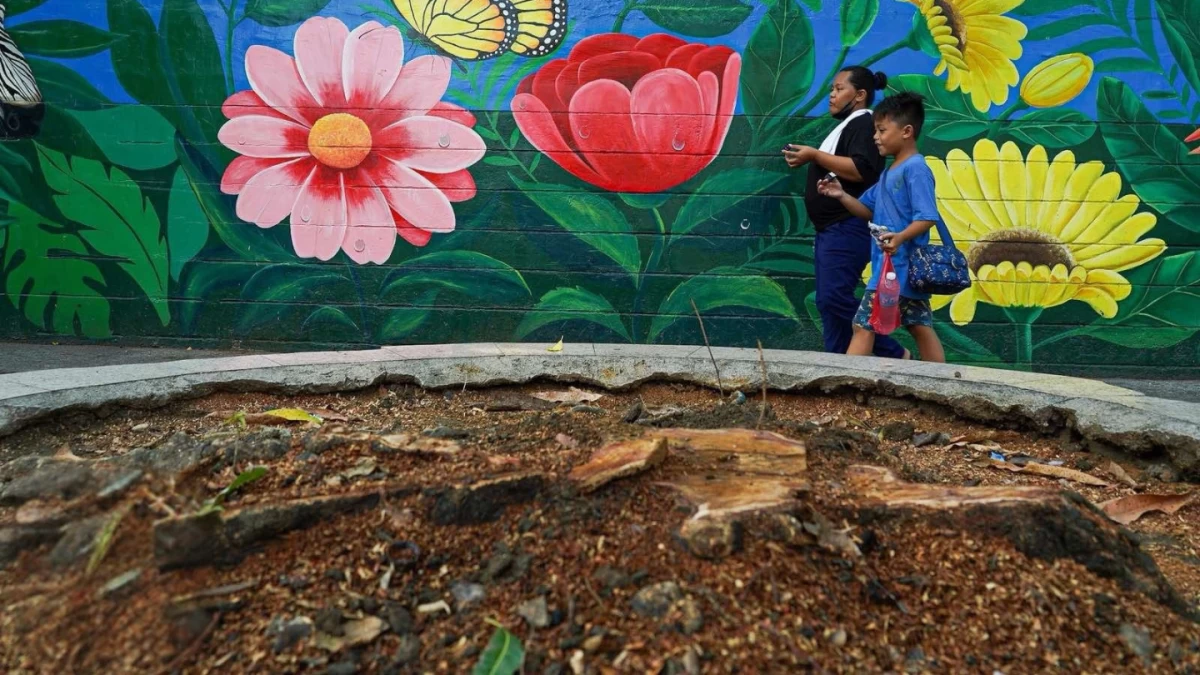
Trees along Quirino Avenue in Manila stand cut down to make way for San Miguel Corp.’s Southern Access Link Expressway (SALEX) and related Skyway projects. The Department of Environment and Natural Resources has temporarily suspended the tree-cutting operations to review environmental mitigation measures, while a joint plan with the Department of Education aims to repurpose the salvaged timber into school chairs and tables. (Photo by John Louie Abrina I Manila Bulletin)
San Miguel Corp.’s tollway unit said its tree-clearing operations along a major Manila thoroughfare comply with government environmental mandates, seeking to defuse local opposition to a multi-billion peso infrastructure project aimed at easing the capital’s notorious gridlock.
In a statement, SMC Southern Access Link Expressway Corp. (SMC SALEX) defended the tree-management activities along Quirino Avenue, stating the works are strictly monitored under permits approved by the Department of Environment and Natural Resources (DENR).
The clearing is part of the pre-construction phase for a 3.97-kilometer elevated toll road segment designed to link key corridors across Metro Manila.
The total investment for the broader SALEX network represents a massive capital outlay for San Miguel, the nation’s largest conglomerate by revenue, as it expands its infrastructure portfolio to capture growing commuter demand.
The company said it finalized the current alignment through Manila’s dense urban core after evaluating multiple design iterations. The selected route, which traverses parts of Quirino Avenue, San Marcelino Street, and Roxas Boulevard, was deemed the most commercially and structurally viable.
According to the company, the path minimizes the costly displacement of residential communities and avoids extensive damage to existing public and private utility infrastructure, which could otherwise trigger project delays and escalate capital expenditure.
Environmental compliance remains a critical hurdle for the project. Out of the trees identified within the construction corridor, a DENR technical assessment cleared 94 for earth-balling and relocation.
San Miguel has already transplanted more than 30 trees to alternative sites within the City of Manila. However, the company noted that engineering constraints—including narrow rights-of-way, subterranean utility networks, and the structural integrity of nearby buildings—make earth-balling technically unfeasible for the remainder of the affected foliage.
To offset the environmental footprint, SMC SALEX is legally bound by its permits to supply 50,700 replacement seedlings of indigenous and economically viable fruit-bearing species. The conglomerate will fund and manage the maintenance of these saplings over a mandatory three-year period at sites designated by the government. San Miguel is also reviewing the project’s environmental impact to see if it can integrate larger saplings and community greening initiatives to accelerate canopy recovery.
The Manila segment is the opening phase of the larger 40.65-kilometer SALEX network. Once fully operational, the elevated expressway is expected to significantly reduce logistics bottlenecks for cargo vehicles and slash travel times for motorists.
By creating a direct link between Manila, Bulacan, the Skyway System, and the South Luzon Expressway, the project aims to divert heavy traffic away from saturated primary arteries including EDSA and Roxas Boulevard, potentially unlocking economic efficiencies worth billions of pesos annually in saved fuel and man-hours.