







Epson's 2050 Commitment: Carbon negative, underground resource-free
Published Jun 1, 2026 02:51 pm


From the waters of the Davao Gulf, you can see the coral formations, schools of fish moving in slow patterns, a whole ecosystem that has no idea a technology company has pledged to protect it.
That was the subtext of Epson's Fusion EcoPrint 17, held from May 20 to 22 at Discovery Resort in Samal Island, Davao. Epson Philippines brought together members of the media and business partners not just for presentations and product talks, but for a gathering that was, by design, held somewhere that reminded us why any of this matters.
Epson’s Vision
Epson embodies the spirit of innovation, with its name nearly synonymous with "printers." This brand recognition, while significant, represents only a part of a larger vision that reflects what Epson intends to become.
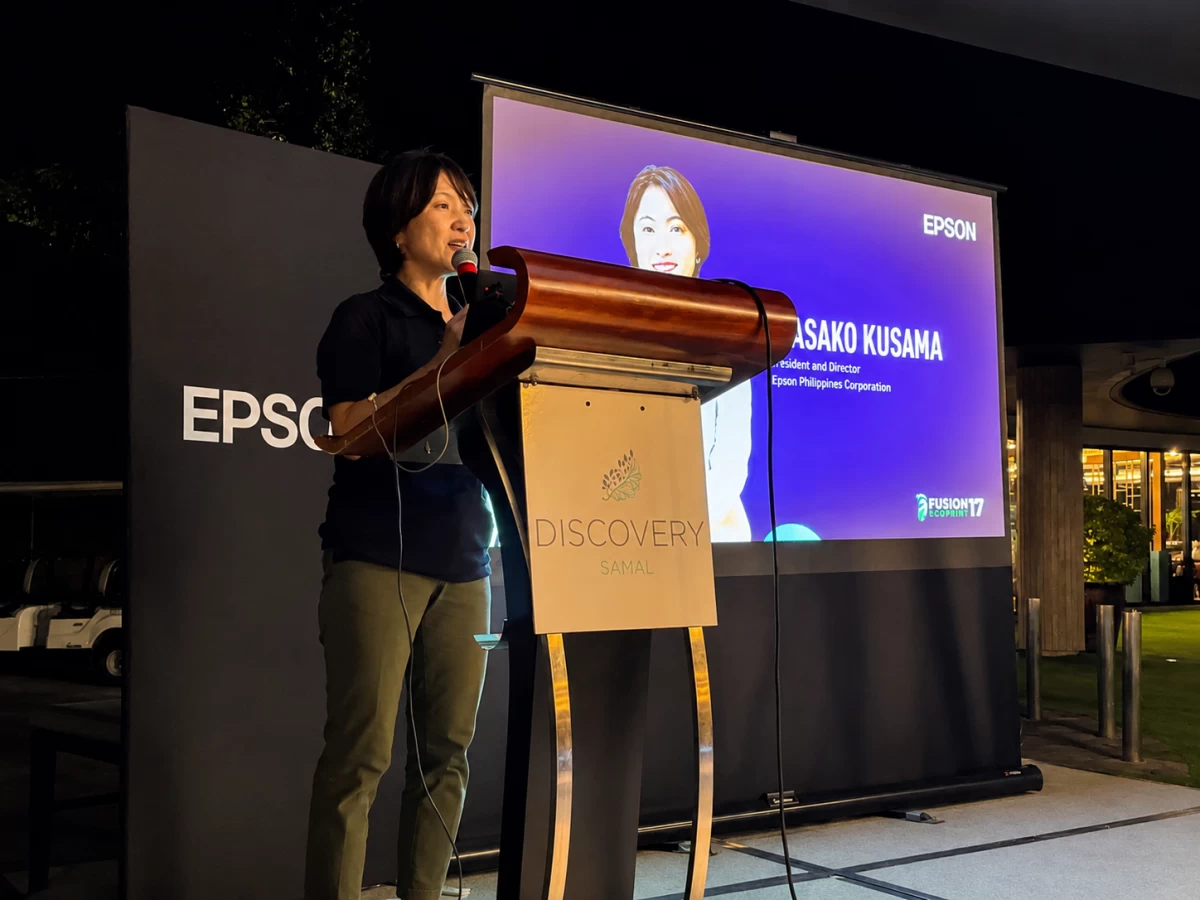
Masako Kusama on Epson’s transformation into an innovation and engineering company (Photo by Jersey Denise Manahan)
"We aim to transform Epson from just a printer-projector company into a technology innovation and engineering company," said Masako Kusama, president and director of Epson Philippines Corporation, during the opening evening talks.
The scaffolding around that shift is a roadmap called Engineered Future 2035. It’s a long-term strategy built on four business pillars: precision innovation, industrial and robotics, office and home printing, and visual and lifestyle solutions. The company is targeting a compound annual growth rate of five percent or more, with particular focus on Southeast Asia, where emerging economies offer both opportunity and urgency.
"Every decision matters," Kusama said, "and the impact we create is built over time through consistent effort." That line landed differently than most corporate statements because Epson has been saying a version of it for a while and backing it with numbers.
Engineering Out the Waste
One of the sharper presentations of the evening came from Ash Elshawbaki, Epson Philippines head of sales, who opened with a critique of sustainability certifications.
"Labels are just shortcuts," he said. "They do not really represent excellence in terms of that metric." Elshawbaki pointed out, with some amusement, that laser printing fuses toner onto paper by heating it to around 200 degrees Celsius, a temperature hot enough to bake bread and cake. Epson's Heat-Free Technology uses mechanical precision and pressure to eject ink, removing the heating process from the equation altogether. Independent testing by Meralco Power Lab showed Epson printers consuming as little as 96 watts during operation, while some competing laser units drew more than five times that.
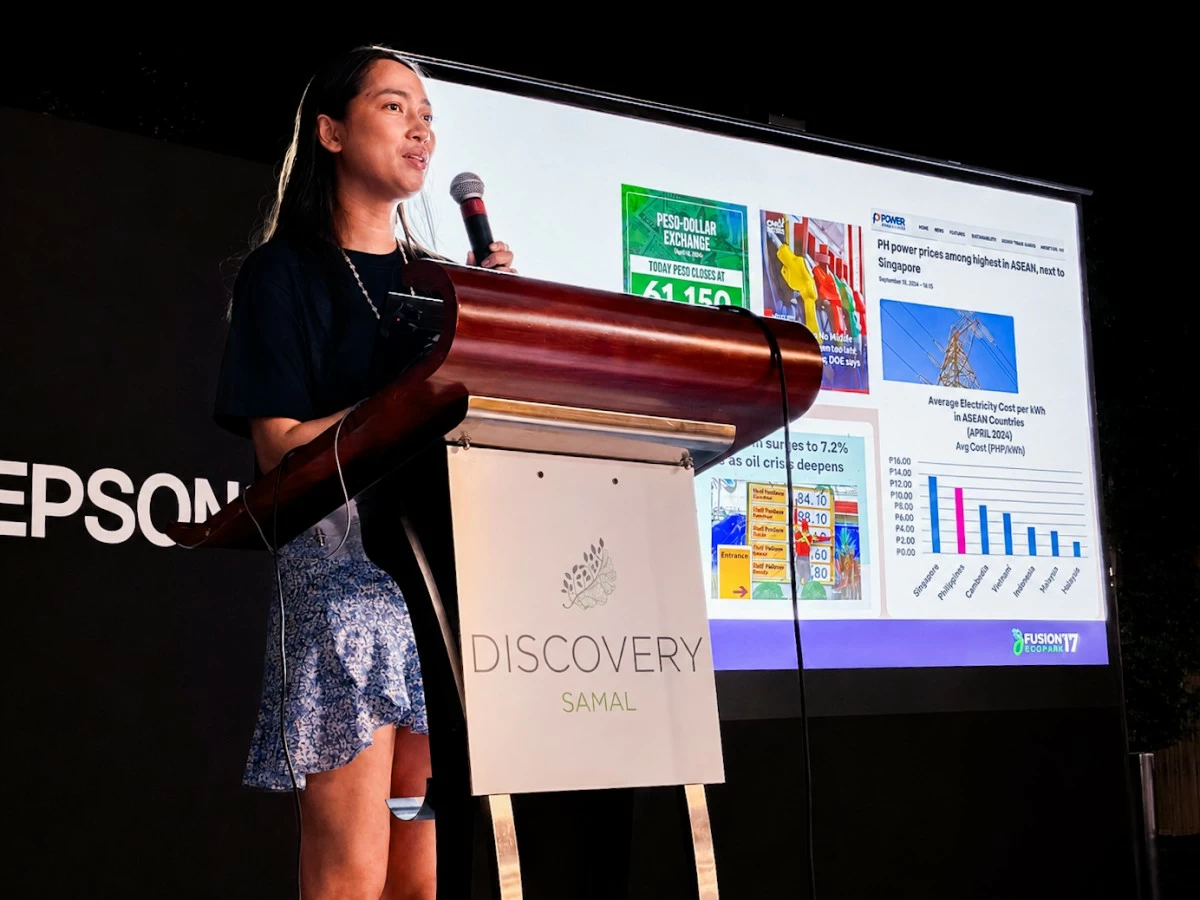
Julia Avila on electricity costs in ASEAN (Photo by Jersey Denise Manahan)
The Philippines has some of the highest electricity costs in ASEAN, second only to Singapore. That makes energy efficiency an argument that lands well beyond environmental principles. Julia Avila, product manager for business inkjet solutions, framed it from the business side. Philippine companies are scrutinizing every peso. They’re downsizing teams, demanding more from existing resources, and rethinking the size and speed of the equipment they pay for. Avila made the case for what Epson calls "right-fit solutions," matching printer setups to how an office actually operates rather than its theoretical peak demand.
"We want customers to ask questions," she said. "We want them to be more curious about where their investments are going."
The 2050 Horizon
Under its Environmental Vision 2050, Epson has committed to becoming carbon-negative and resource-free within the next 25 years. These goals don’t live in a slide deck. They’re ambitious enough that hitting either one would reshape how the company designs, manufactures, and sources everything it makes.
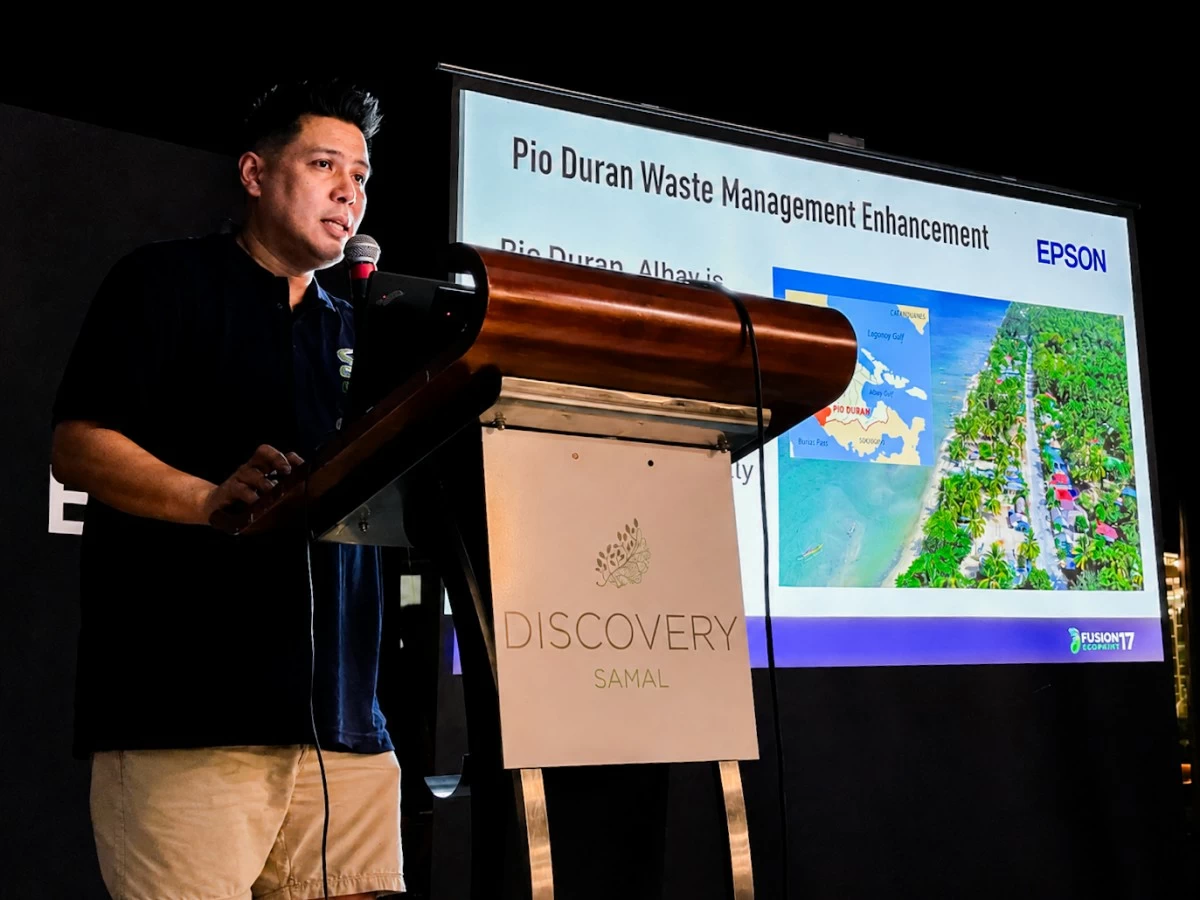
EJ Sulit on Epson’s Waste Management Project in Pio Duran, Albay (Photo by Jersey Denise Manahan)
EJ Sulit, Epson Philippines' sustainability champion, walked through the work already in motion. In Pio Duran, Albay, Epson partnered with the World Wide Fund for Nature on a waste management enhancement project that goes beyond collection to strengthen barangay-level systems that determine whether recyclable materials are diverted rather than buried. Collected plastics are converted into eco-bricks, chairs, tables, and construction materials. The project is designed so that the infrastructure outlasts the partnership.
Closer to the consumer side, Epson runs a corporate ink cartridge and packaging collection program, most recently piloted in Davao in partnership with EnviroTech. Used bottles, cartridges, and packaging are gathered and processed for recycling. Internally, employees participate in waste segregation programs, and the company incentivizes clean plastic collection. In the last fiscal year, Epson recovered more than 1,100 kilos each of clean plastic and shredded paper, all of which went to Pasig City's environmental office to be processed into sustainable materials.
These numbers are modest when held up against the scale of the 2050 commitment. Epson understands that large environmental goals have to be practiced at the small scale too, repeatedly, until the habit becomes the culture.
The wider Engineered Future 2035 strategy puts investment, technology, and people at the center — three levers that Epson sees as inseparable. Technology without people to apply it and capital to sustain it doesn't reach the communities that need it. The five-percent CAGR target is a business metric, but the framing around it keeps returning to the same idea: that growth has to be pointed at something real, or it's just motion.
What It Took to Win at Samal
On the second day, Epson put the media junket to work. We were split into teams and sent through a series of challenges across the island — seven stations, each demanding something different: memory, coordination, endurance, problem-solving, and a reasonable tolerance for saltwater in inconvenient places.
The first station asked us to organize colored coconuts by recalling a sequence the game master gave us exactly twice. At the second, we kayaked out to a divider in the ocean to retrieve letters one by one until our team had spelled out the word "FUSION" — six trips out, six trips back. Then came Sabang Cliff, where I dived off the edge, retrieved matchsticks from a balloon floating in the water, swam to the other side, and our team built a fire hot enough to boil water.
The bamboo stilt station came next: one team member standing on top of bamboo poles while everyone else controlled the stilts underneath, collecting bags that contained keychains. We counted the keychains, applied some math, and the final number became the code to a padlock. After that, the pickle dive station: swim out, retrieve balls attached to buoys, swim back, and someone has to hit them into a basket net. Then, a bamboo tube riddled with holes that we had to fill with water from the ocean, using our hands and feet to plug the gaps while others ran back and forth carrying water, until the ping pong ball finally floated to the top and fell out.
The final station was a sack race. Six of us climbed in and jumped to the assembly point, assembled the totems we had collected from every previous station, then jumped back to collect the three remaining teammates. From there, we hopped to the finish line together.
Team Vibe finished first. We emerged victorious.
What I kept thinking about afterward: none of those challenges were survivable alone. Every station required people to read to each other, distributing effort, filling the gaps. The challenges didn’t care how fast you were. It just needed enough people to cover it.
Why Samal Was the Right Place for This
Walking back from Sabang Cliff, salt-dried and slightly sunburned, I thought about what Kusama had said the evening before about impact being built over time.
The waters around Samal are one of the reasons diving tourism in Davao draws people from across the country and beyond. The coral reefs here are the kind of ecosystem that takes decades to build. Epson chose to hold this gathering here, surrounded by water and marine life, with challenges that put you in direct physical contact with the environment they've been spending years talking about protecting.
The reef doesn't know any of that. It just keeps growing, the way it has for decades, the way it will for decades more if it's given the chance.
Epson's 2050 goals are ambitious enough to be uncomfortable, which is probably the point. Being carbon negative isn't a headline. Being underground resource-free isn't a brand position. Growing five percent annually in emerging markets while doing both simultaneously is the kind of challenge that doesn't get solved in a single fiscal year, or a single media junket, or even a single decade.
What it takes is consistency. The kind that builds slowly, the way a reef does, or a forest, until one day someone standing at the edge of a cliff looks down and sees something worth protecting.