







Back to pre-war levels? Big-time oil price rollback set
Published Jun 1, 2026 03:33 pm


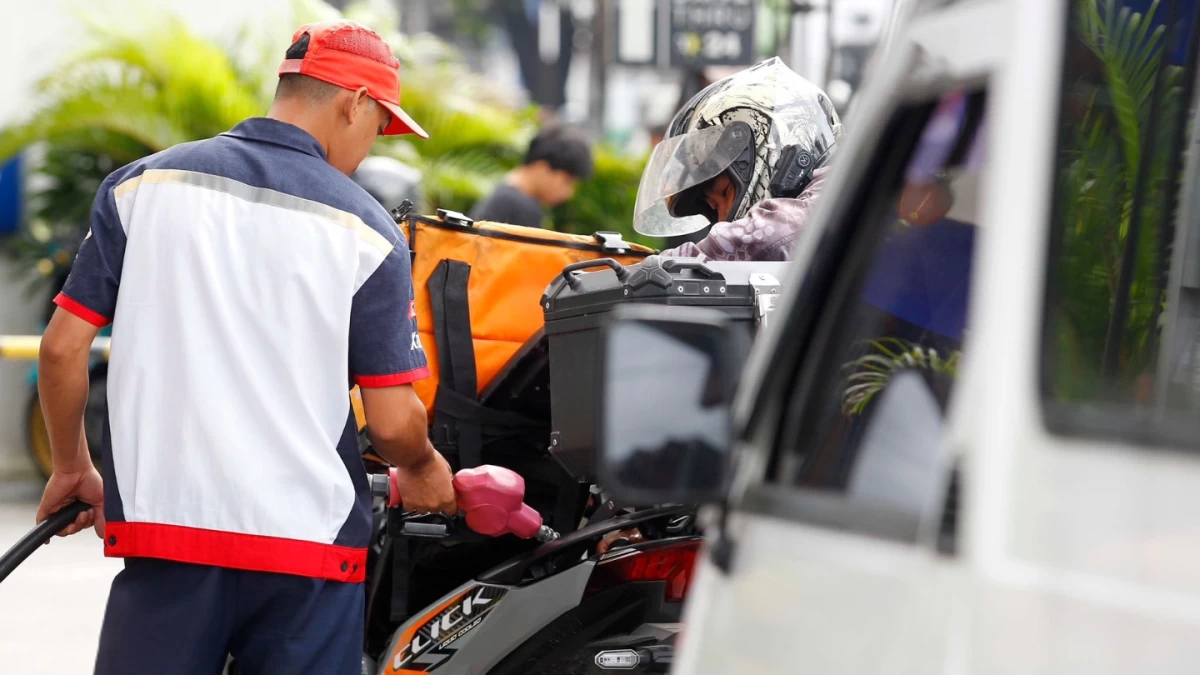
A rider fills up his tank ahead of a predicted “big-time” fuel price hike. Domestic oil firms are expected to implement double-digit increases starting Tuesday, potentially pushing diesel prices to a near-historic ₱166 per liter. (Photo by Mark Balmores I MB)
Fuel prices are set to tumble, offering motorists major reprieve after weeks of escalating costs driven by geopolitical frictions.
The Department of Energy prescribed a minimum rollback effective Tuesday, June 2, reducing diesel by ₱9.26 per liter, gasoline by ₱4.76 per liter, and kerosene by ₱10.86 per liter. The steep cuts reverse a series of consecutive weekly hikes that had pushed domestic pump prices to record highs earlier this year following the outbreak of conflict in the Middle East.
Energy Secretary Sharon Garin said that local fuel prices could eventually return to pre-war levels. That outlook hinges on whether parties involved in the Middle East conflict secure a permanent peace deal and successfully reopen the Strait of Hormuz. The strategic maritime chokepoint handles roughly 20 percent of the world’s petroleum transport, and its disruption triggered a state of national energy emergency in the Southeast Asian nation.
Even as pump prices retreat, households face a separate energy squeeze. Liquefied petroleum gas, or cooking gas, will buck the broader downward trend with a price increase of ₱3.41 per kilogram for the month of June.
To shore up domestic reserves against persistent global market volatility, the government has stepped up fuel procurement. The state-run Philippine National Oil Co. recently secured 21,000 metric tons of LPG, which arrived at a port in Batangas on May 30. Sourced from Texas, the shipment consists of an equal split between refrigerated propane and refrigerated butane.
The government is also moving to institutionalize longer-term supply buffers. The Department of Energy is preparing to sign an agreement with Japan and the sovereign wealth fund manager, Maharlika Investment Corporation, to establish a strategic petroleum reserve program.
The initiative aims to build a government-controlled national stockpile to add at least 30 days of oil products on top of the 30- to 60-day reserves currently mandated for private commercial oil companies.
While officials have not yet disclosed the exact investment requirements, a initial evaluation by the energy department, the national oil company, and Maharlika projects an eventual expansion capacity of 100 million to 500 million barrels. The government is studying how the scaled-up inventory could shield local consumers from global price shocks and eventually position the Philippines to export fuel to neighboring Asian countries.