






Manila Bulletin
 Opinion
A promise forged in a 1992 courtroom: Reflecting on President Lee Jae Myung's democratic legacy
Opinion
A promise forged in a 1992 courtroom: Reflecting on President Lee Jae Myung's democratic legacy
Opinion
A promise forged in a 1992 courtroom: Reflecting on President Lee Jae Myung's democratic legacy
A promise forged in a 1992 courtroom: Reflecting on President Lee Jae Myung's democratic legacy
Published Jun 1, 2026 12:05 am


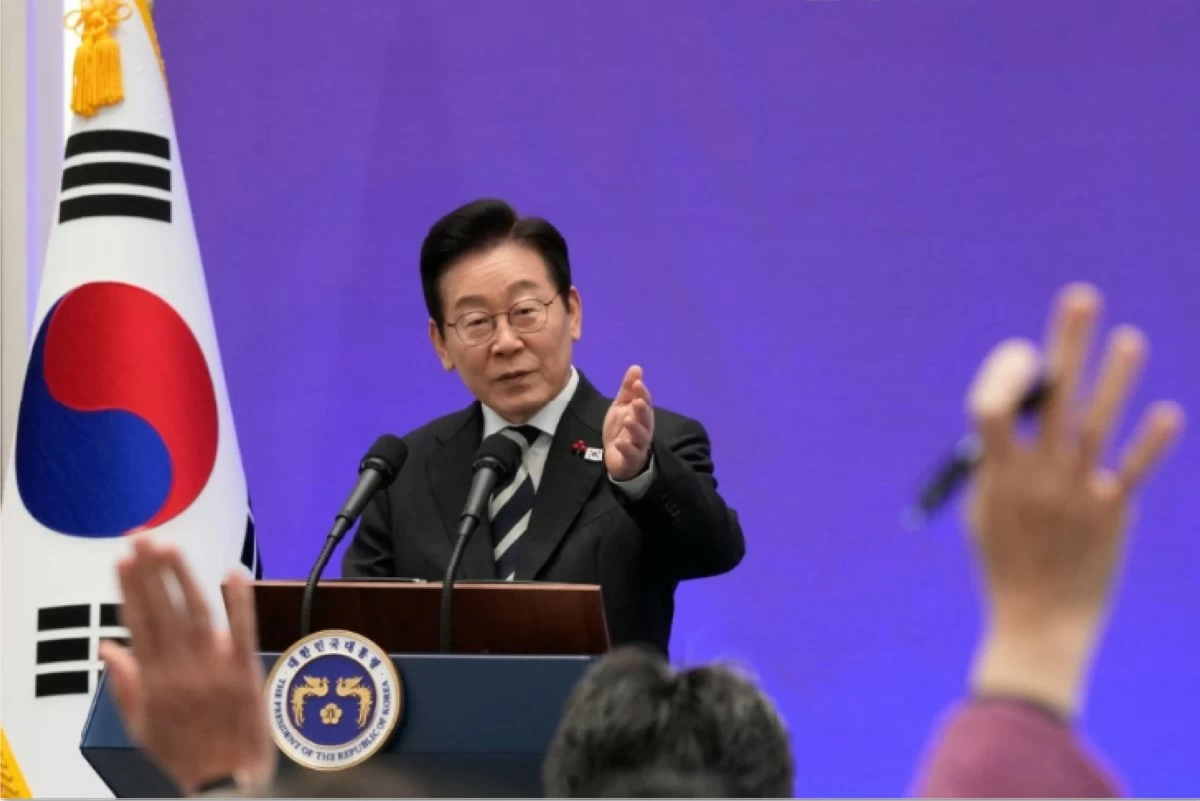
South Korean President Lee Jae Myung (AP file Photo)
Turning 60 this year, I find myself reflecting deeply on the turning points and unseen symmetries that cause human lives to intersect across borders and histories. For those born in the Year of the Fire Horse, the completion of a sixty-year cycle is considered highly auspicious: a moment marking the beginning of a new chapter and a fitting occasion for profound reflection.
Before assuming my post as the 22nd President of the University of the Philippines, my own professional journey was defined by a lifelong advocacy for labor and migration, with experience in public service, crisis diplomacy, and legal advocacy. I served as Labor Attaché, then under the Department of Labor and Employment (DOLE), to Japan, Kuwait, Iraq and Jordan. My work eventually covered the entire global operations serving Overseas Filipino Workers (OFWs) as Deputy Administrator of the Overseas Workers Welfare Administration (OWWA). I also helped in the process that led to the creation of the Department of Migrant Workers (DMW).
Today, as a close friend of Korea, my vantage point at the University of the Philippines has allowed me to champion deep bilateral cooperation. Over the past year, UP has proudly driven this relationship forward, from hosting former UN Secretary-General Ban Ki-moon and the ASEAN-Korea Forum to our recent critical academic collaborations with the visiting delegation from the Korea Advanced Institute of Science and Technology.
It is through this dual lens – as a university president steering global knowledge networks and as a lifelong migrant labor advocate – that I recognize a profound personal and ideological symmetry with the leader currently guiding the Republic of Korea. June 4th marks the first anniversary of President Lee Jae Myung’s inauguration, capping a historic twelve months that began with his assumption of office as the 21st President of the Republic, following a landslide victory in a June 2025 snap election representing the center-left Democratic Party of Korea (DPK).
President Lee’s ascent to the leadership of a global powerhouse is a narrative rooted in the rawest realities of the human condition. He was a child of impoverished roots who worked as a factory laborer. Having sustained a permanent disability in his youth from an industrial accident, he later studied law on a full academic scholarship and earned a degree from Chung-Ang University in 1986. His personal experience of the travails of the ordinary working man clearly influenced his choice to become a human rights lawyer and civic activist, leading major anti-corruption and public healthcare campaigns in Seongnam. This drove him into politics in 2005 where he later built a remarkable executive track record, over eight years as Mayor of Seongnam, three years as Governor of Gyeonggi Province, and three years as the leader of the DPK in the National Assembly.
Yet long before his ascent to the Presidency, it was as a relentless human rights lawyer that the name of Lee Jae Myung first resonated deeply with the Filipino people. This enduring connection came full circle on 4 March 2026, during his official State Visit to the Philippines, when President Lee Jae Myung held an emotional, highly publicized reunion with a Filipino worker named Ariel Galac during a specially arranged personal meeting in Manila.
Their bond was forged in tragedy and justice thirty-four years ago. While working at a manufacturing factory in 1992, Galac suffered a severe industrial accident that resulted in the loss of his arm. At that time, foreign workers who sustained injuries were routinely deported without proper medical treatment or financial compensation. The human rights lawyer Lee Jae Myung stepped in to represent Galac. He fought a grueling, year-long legal battle and successfully forced a retrial, securing critical medical care recognition and industrial accident compensation for the Filipino laborer. For President Lee Jae Myung, the case was deeply personal, mirroring his own permanently disabled arm from a childhood factory accident.
This landmark case did more than save one man; it paved the way for sweeping policy reforms in Korea that expanded state-backed legal protections and industrial compensation to all foreign laborers.
The poignant reunion of the two men serves as a reminder that leadership is ultimately measured not only by speeches or summits, but by whether a leader remembers the marginalized after ascending to the heights of power.
As we mark this first anniversary of his presidency, Korea’s trajectory under President Lee Jae Myung highlights the absolute resilience of its democracy. Despite severe global economic headwinds, Korea’s structural growth has remained steadfast, running parallel to its ever-expanding global soft power. Today, the strategic relationship between the Republic of Korea and the Philippines has truly reached its highest following President Lee Jae Myung’s state visit in March.
In my recent fruitful discussions with Mr. Lee Sang-hwa, Korean Ambassador to the Philippines, we touched upon the immense horizons ahead for our two nations. Under the current leadership, Korea is achieving remarkable milestones in artificial intelligence and industrial innovation. Crucially, we discussed our own hopes that Korea’s strategic entry into the Luzon Economic Corridor (LEC) could signal a transformative era of infrastructure, connectivity, and economic synergy that will benefit the next generation of Filipinos.
These developments matter deeply for the Philippines.
At a time when the global economy is increasingly defined by innovation ecosystems, technological competitiveness, and resilient democratic institutions, the Philippines has much to learn from Korea’s developmental journey. Universities such as UP must therefore continue serving as bridges between our societies, helping cultivate collaboration in science, technology, public policy, education, and people-to-people exchange.
There is a lesson to be learned from the rise of leaders like President Lee Jae Myung. From defending a lone Filipino worker in a courtroom decades ago to anchoring critical geopolitical alliances today, his journey reminds us of a fundamental truth: true national progress must always be measured by how fiercely a nation protects the vulnerable, drives forward-looking innovation, and honors its global friendships.
I cannot end my thoughts on Korea without remembering a much more personal one. In 1992, while serving as Student Regent at the university which I now lead, I joined two other young men, one each from Thailand and India, in a 10-day program in Korea with a rather flattering name: “An Invitation to the Next Generation of Asian Leaders.” I no longer know what happened to the program since but I still vividly remember the visits to Hyundai’s car factory in Ulsan and the Pohang Steel Corporation, crossing the line between the two Koreas in Panmunjom, cultural sites and the discussion with academics in Yonsei University, who took us seriously despite their curiosity about three young men their own program called “next generation leaders.” I thought it was funny, too, but here I am today, struggling under its weight before a Korea I have come to admire even more.