






 Philippines
National
Philippines, Japan elevate ties to 'Comprehensive Strategic Partnership'
Philippines
National
Philippines, Japan elevate ties to 'Comprehensive Strategic Partnership'
Philippines, Japan elevate ties to 'Comprehensive Strategic Partnership'


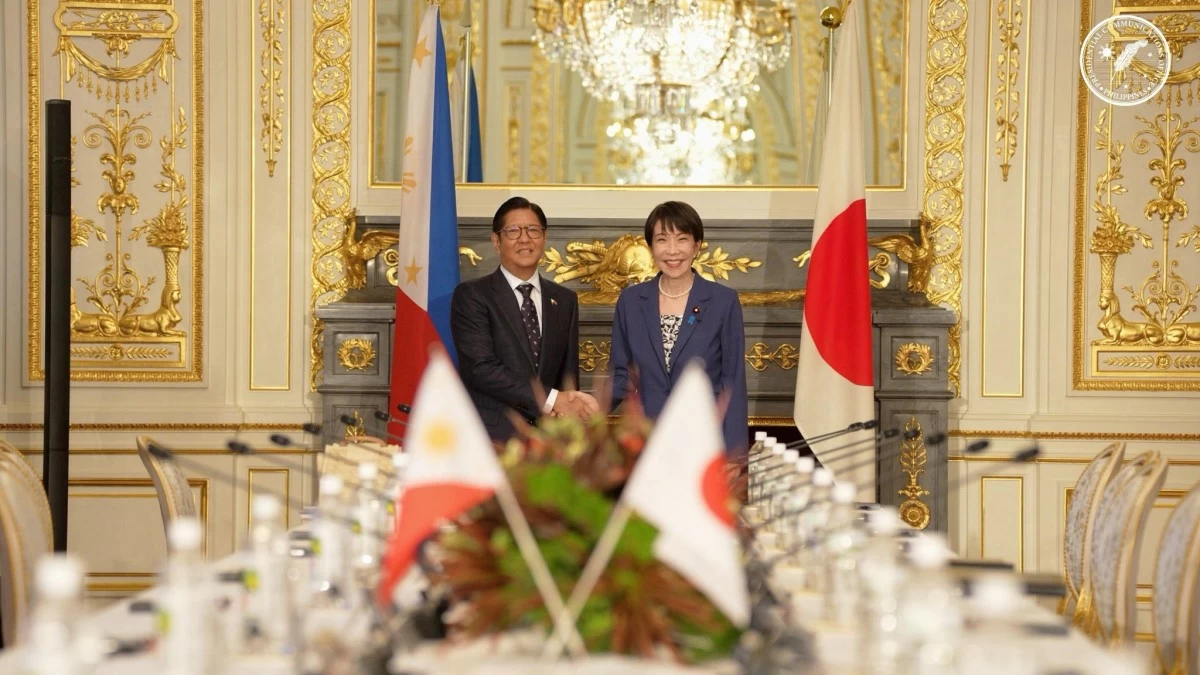
President Marcos and Japanese Prime Minister Takaichi Sanae have elevated the Philippines-Japan relations to a “Comprehensive Strategic Partnership,” marking what both leaders described as a major step forward in bilateral ties amid growing geopolitical and economic challenges.
The announcement was made during a joint press conference following their summit meeting at the Akasaka State Guest House in Tokyo on May 28, as the two countries commemorated the 70th anniversary of normalized diplomatic relations.
“As we commemorate the 70th anniversary of the normalization of diplomatic relations between our two countries, I am pleased to announce that we have elevated our relationship from a Strengthened Strategic Partnership to a Comprehensive Strategic Partnership,” Marcos said.
“This milestone reflects the strength, depth, and breadth of our ties as we respond to the evolving challenges and opportunities of our time,” he added.
In her own statement, Takaichi said the move reflects the determination of both countries to deepen cooperation despite uncertainties in the international environment.
“This demonstrates the determination of our two countries to strengthen multi-layered relations as like-minded countries sustainably going forward without being affected by changes in the international environment,” she said.
Takaichi, through Japan’s Prime Minister’s Office’s Facebook page, described the Philippines as one of Japan’s “closest like-minded countries.”
“We will cooperate across a wide range of fields toward realizing an updated Free and Open Indo-Pacific (FOIP),” she said.
“We elevated our relationship with the Philippines, one of our closest like-minded countries, to a ‘Comprehensive Strategic Partnership.’ We will cooperate across a wide range of fields toward realizing an updated Free and Open Indo-Pacific (FOIP).”
Defense, maritime security
The two leaders discussed expanding cooperation in defense and maritime security, economic resilience, trade and investment, energy security, and regional stability.
Marcos said the upgraded partnership reflects the countries’ “shared view to upholding international law” and commitment to a rules-based order in the Indo-Pacific.
“This reflects not only the progress that we have achieved across key areas such as security, maritime and defense cooperation, economic partnership, and infrastructure development, also our shared view to upholding international law and the expanding scope of our collaboration in several critical emerging areas,” the President said during his opening remarks.
The President also thanked Japan for its support on maritime developments and assistance in addressing the global energy situation, including ensuring continued fuel supply to the Philippines amid oil market uncertainties.
AI, space, emerging industries
President Marcos likewise highlighted growing cooperation in emerging technologies, artificial intelligence, robotics, and space development.
“As we mark the 10th anniversary of the launch into orbit of the Diwata-1 microsatellite from the Japanese module of the International Space Station this year, we are reminded of how our partnership has quite literally reached new heights,” he said.
He added that the milestone symbolizes both countries’ “shared commitment to innovation, science, and the industries of the future, such as robotics and artificial intelligence.”
The Presidential Communications Office (PCO) said the leaders also discussed expanding collaboration in infrastructure, higher education, disaster resilience, the Mindanao peace process, and economic security.
‘Steadfast support’
Marcos described Japan as a steadfast partner of the Philippines, especially during periods of heightened challenges.
“Time and again, Japan has demonstrated its steadfast support for the Philippines,” he said.
The President specifically cited Japan’s deployment of technical experts following the fire at the Navotas Sanitary Landfill as an example of the “responsiveness and practical value” of bilateral cooperation.
The summit meeting formed part of Marcos’ four-day State Visit to Japan — only the third State Visit hosted by Japan since Emperor Naruhito ascended to the throne in 2019.