






Manila Bulletin
 World
Japan, South Korea markets hit records on hopes for a winding down of the Iran war
World
Japan, South Korea markets hit records on hopes for a winding down of the Iran war
World
Japan, South Korea markets hit records on hopes for a winding down of the Iran war
Japan, South Korea markets hit records on hopes for a winding down of the Iran war
Published May 29, 2026 06:32 pm


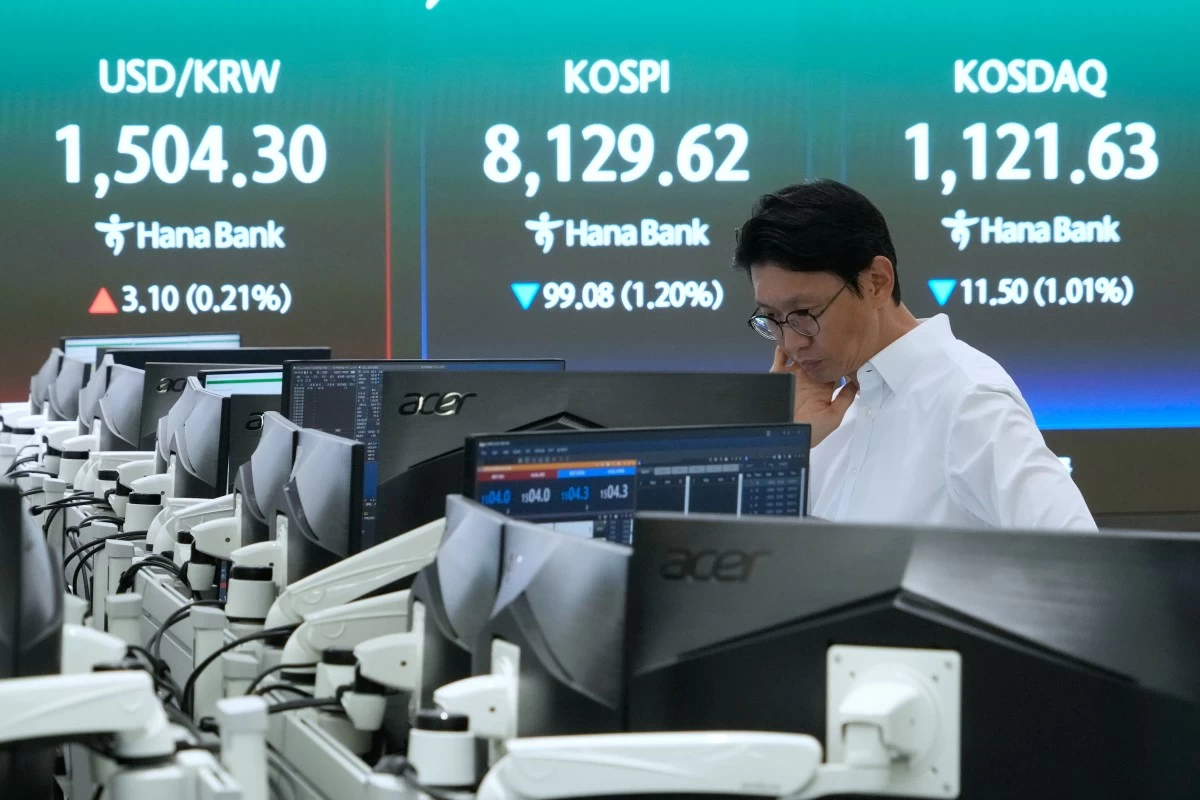
A currency trader watches monitors near a screen showing the Korea Composite Stock Price Index (KOSPI), top center, and the foreign exchange rate between U.S. dollar and South Korean won, top left, at the foreign exchange dealing room of the Hana Bank headquarters in Seoul, South Korea, Thursday, May 28, 2026. (AP Photo/Ahn Young-joon)
HONG KONG (AP) — Markets in Japan and South Korea hit fresh records as world shares mostly advanced Friday on expectations the U.S. and Iran will agree to extend the ceasefire in their war by 60 days.
Oil prices slipped, but remain above pre-war levels as the Strait of Hormuz remains largely closed. Analysts warned that the potential ceasefire extension should be viewed with caution, as it will take time for oil supplies to recover.
U.S. futures edged 0.1% higher.
In early European trading, Britain's FTSE 100 rose 0.2% to 10,446.42. Germany's DAX gained 0.3% to 25,157.61, while France's CAC 40 added 0.9% to 8,262.90.
In Asia, Tokyo’s Nikkei 225 jumped 2.5% and ended at a record high close of 66,329.50, as data released Friday showed that Tokyo’s core inflation rate for May rose more slowly than economists expected.
South Korea’s Kospi surged 3.6% to 8,476.15, also at an all-time closing high, with technology companies powering the gains thanks to the global boom in artificial intelligence.
Shares in Samsung Electronics, the country's leading company, rose 5.8%. SK Hynix, which has benefited greatly from the shift to AI, gained 1.9%.
In Hong Kong, the Hang Seng added 0.7% to 25,182.39, while the Shanghai Composite index fell 0.7% to 4,068.57.
Australia’s S&P/ASX 200 was up 1.6% at 8,731.70.
Taiwan’s Taiex traded 2.5% higher. India's Sensex lost 0.5%.
On Thursday, negotiators from the U.S. and Iran reached a tentative deal on extending their ceasefire and holding a new round of talks on Iran's nuclear program, a U.S. official said. Iran had not yet publicly confirmed the deal and the tentative agreement was still pending U.S. President Donald Trump’s sign off.
Brent crude, the international standard, slipped 0.1% early Friday to $92.58 a barrel. It was trading around $70 per barrel in late February before the war began. Benchmark U.S. crude also lost 0.1%, to $88.81 per barrel.
Investors are closely watching for a reopening of the Strait of Hormuz. The U.S. official said the tentative accord makes it clear that Iran wouldn’t be able to impose tolls on ships transiting the strait, while the U.S. would gradually lift its sea blockade on Iranian ports.
“The oil market continues to edge lower amid growing optimism that the U.S. and Iran are moving toward a deal,” ING commodities strategists Warren Patterson and Ewa Manthey wrote Friday. “A reopening of the strait would offer some immediate relief to the oil market with tankers leaving the Persian Gulf. However, the recovery is still uncertain.”
Shipowners may be reluctant to send vessels into the Persian Gulf, at least initially, over fears that the ceasefire could fail, they wrote. Also a recovery in oil and gas production would likely also be gradual rather than immediate.
On Thursday, Wall Street pushed to more records with the benchmark S&P 500 setting another all-time high, climbing 0.6% to 7,563.63. The Dow Jones Industrial Average added less than 0.1% to 50,668.97, and the technology-heavy Nasdaq composite gained 0.9% to 26,917.47.
In other dealings early Friday, the U.S. dollar was trading at 159.28 Japanese yen, up from 159.24 yen. The euro slipped to $1.1634 from $1.1651.