






Manila Bulletin
 Business
The Economy
Nomura downgrades Philippine growth outlook amid energy, inflation risks
Business
The Economy
Nomura downgrades Philippine growth outlook amid energy, inflation risks
Business
The Economy
Nomura downgrades Philippine growth outlook amid energy, inflation risks
Nomura downgrades Philippine growth outlook amid energy, inflation risks
By Derco Rosal
Published May 28, 2026 06:30 pm
|
Updated May 28, 2026 01:12 pm


At A Glance
- Nomura Holdings Inc., a Japanese investment and brokerage giant, has significantly downgraded its economic outlook for the Philippines as the nation struggles with energy security vulnerabilities and mounting inflationary pressures.

Nomura Holdings Inc., a Japanese investment and brokerage giant, has significantly downgraded its economic outlook for the Philippines as the nation struggles with energy security vulnerabilities and mounting inflationary pressures.
A new report showed that Nomura has slashed its real gross domestic product (GDP) growth forecast for the Philippines in 2026 to 4.6 percent from its previous assumption of five percent. This downward revision comes as the country is expected to face much higher costs of living.
Meanwhile, Nomura expects Philippine economic growth to recover to 5.6 percent in 2027, unchanged from its previous forecast.
Nomura chief economist for India and Asia ex-Japan Sonal Varma and economist for Asia ex-Japan Si Ying Toh have raised their inflation forecast to 6.1 percent this year from the earlier 4.9 percent—both of which would overshoot the four-percent ceiling set by the Bangko Sentral ng Pilipinas (BSP).
Annual price increases are expected to ease to 3.2 percent next year, returning to the target band of two to four percent.
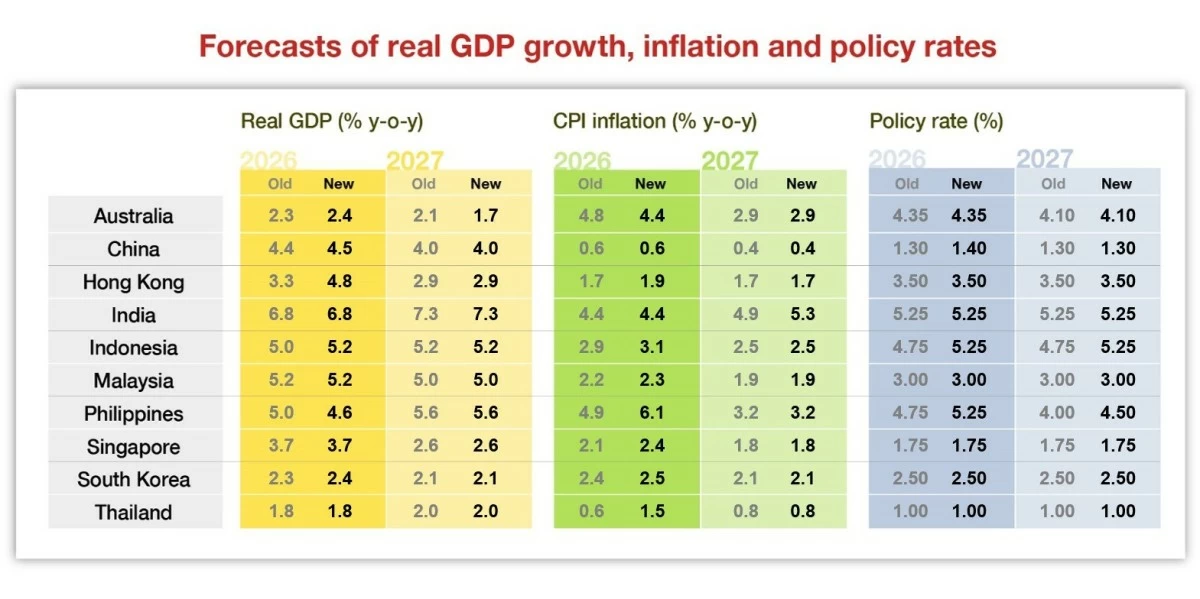
To manage these price spikes, Nomura anticipates that the BSP’s policy-setting Monetary Board (MB) would further raise key borrowing costs from the current 4.5 percent to 5.25 percent by the end of 2026. This is higher than Nomura’s previous estimate of a 4.75- percent terminal policy rate.
After a series of hikes, Nomura expects the BSP to switch back to a dovish mode and ease the key interest rate to 4.5 percent, higher than the previous assumption of four percent.
This bearish outlook hinges on the Philippines’ position in Nomura’s Asia energy security index, a gauge that ranks nations based on factors such as resource diversification, domestic production capabilities, and the adoption of green technologies.
This index, which measures how prepared Asian economies are for energy shocks, gives the Philippines an aggregate score of 97.2. A higher score indicates stronger energy security.
This score places the country in the lower tier of the region, trailing behind neighbors like Singapore (100.6), Indonesia (100.3), and Malaysia (99.4). It also lags behind other Asian countries such as China (110.5), Japan (101.5), South Korea (100.9), Australia (100.5), and India (98.9).
Meanwhile, the Philippines has higher energy security relative to Vietnam (97), Thailand (96.8), and New Zealand (96.8).
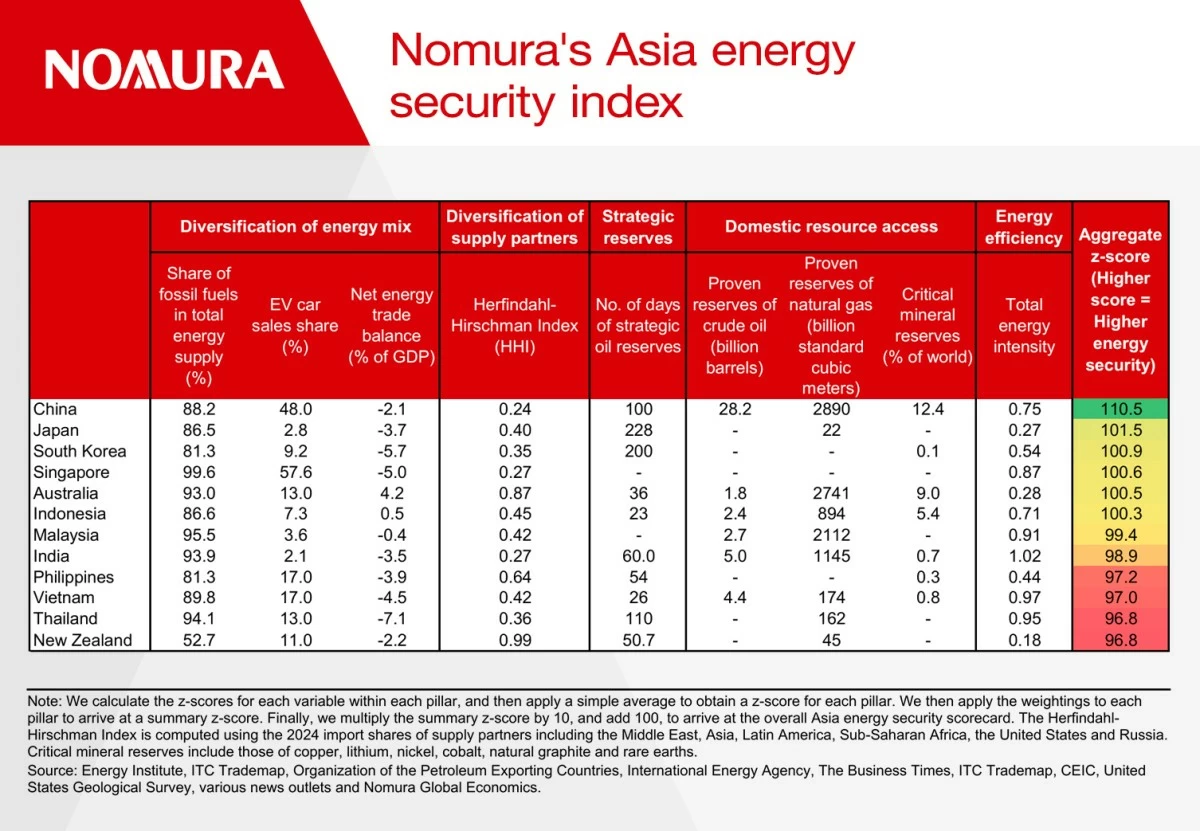
Nomura likewise pointed to the Philippines’ structural weakness, noting that while the country has a high share of renewables, it remains heavily reliant on imported oil.
This reliance makes the domestic economy particularly “prone to global supply disruptions,” such as those caused by the United States (US)-Iran conflict in the Middle East.
Further, while leaders like China and Japan have advanced their energy infrastructure, “India and the rest of the Association of Southeast Asian Nations (ASEAN), on the other hand, still face significant gaps in grid modernization,” Nomura noted.
Regional cooperation is expected to offer opportunities for long-term recovery despite these challenges.
Nomura noted that the global energy shock “has significantly accelerated the ASEAN Power Grid initiative,” a program designed to allow member states to “share renewable resources and reduce dependence on imported fossil fuels.”
This could offer the Philippines a pathway to stabilize consumer prices and output expansion, while insulating it against future disruptions.
In a separate May 27 report, think tank Capital Economics warned that as the Middle East conflict drags on, “the biggest inflation threat is in emerging markets (EMs) with high energy imports and fragile currencies like Turkey and the Philippines.”
Capital Economics chief global economist Jennifer McKeown, deputy chief global economist Simon MacAdam, and research assistant Adam Comley noted that the Philippines and Thailand posted the fastest inflation surges since the war erupted back in February, such that the BSP already raised interest rates.
“Central banks in economies with particularly high energy imports, where policy credibility is lacking, or where currencies are fragile will be forced to raise interest rates soon,” Capital Economics said.