







Marcos, FL meet Japan's Emperor, Empress
By Betheena Unite and JIJI PRESS
Published May 27, 2026 12:28 pm
|
Updated May 27, 2026 04:24 pm


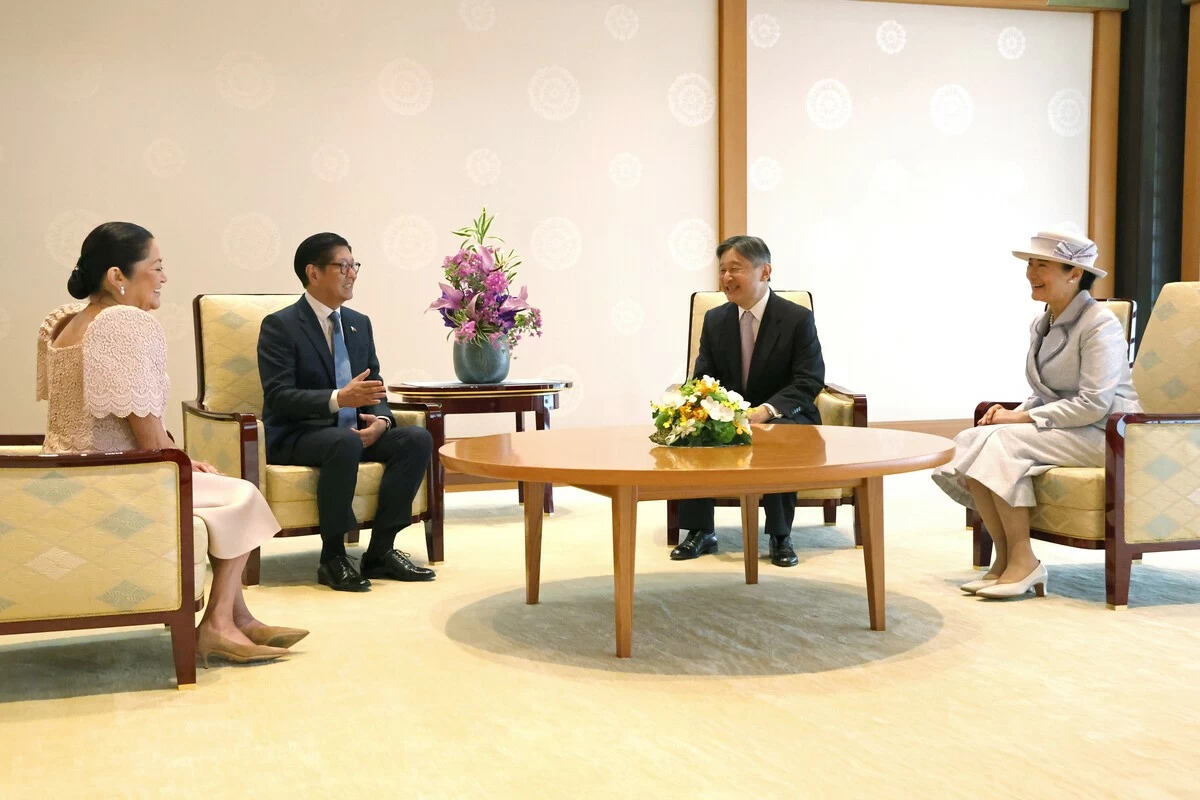
Japan's Emperor Naruhito and Empress Masako meet with Philippine President
Ferdinand Marcos Jr. and his wife in the "Take no Ma" audience room at the
Imperial Palace in Tokyo on Wednesday. (Pool)
President Marcos began his first state visit in Japan on Wednesday, May 27, by meeting Japanese Emperor Naruhito and Empress Masako.
A welcome ceremony for Marcos and First Lady Liza Araneta-Marcos was held at the Imperial Palace in Tokyo. Also in attendance from Japan’s Royal Family were Crown Prince Akishino and Crown Princess Kiko.
The event, held at the palace's Eastern Court, marked the first state guest reception since the visit of Brazilian President Luiz Inacio Lula da Silva in March last year and the third such ceremony in Japan's Reiwa era, which started in 2019 with Emperor Naruhito's enthronement.
During the ceremony, the national anthems of both countries were played, and Marcos received a guard of honor.
Following the event, the president and his wife held talks with the Emperor and the Empress in the "Take no Ma" audience room at the palace.
The Emperor told the couple he is deeply pleased to welcome them as state guests in the 70th anniversary year of the normalization of diplomatic ties, according to the Imperial Household Agency.
In response, Marcos expressed profound gratitude, the agency said.
After the meeting, the Emperor recalled that he stopped at a Philippine airport during a trip to Australia when he was in the third grade of junior high school, saying it was the first foreign land he had stepped on.
Marcos then invited the Emperor and the Empress to visit the Philippines, saying that a stopover alone was not enough, according to the agency.
During the state call, Marcos and the First Lady received two of Japan’s highest honors from the Emperor.
Marcos was conferred the Grand Cordon of the Supreme Order of the Chrysanthemum, while the First Lady received the Grand Cordon of the Order of the Precious Crown.
In the afternoon, the President was expected to meet with the Japan Philippines Parliamentary Friendship League (JPPFL), and attend a roundtable meeting with Japanese stakeholders.
Later in the day, he was expected to witness the signing of a memorandum of understanding (MOU) between the Ayala Group and Japanese companies.
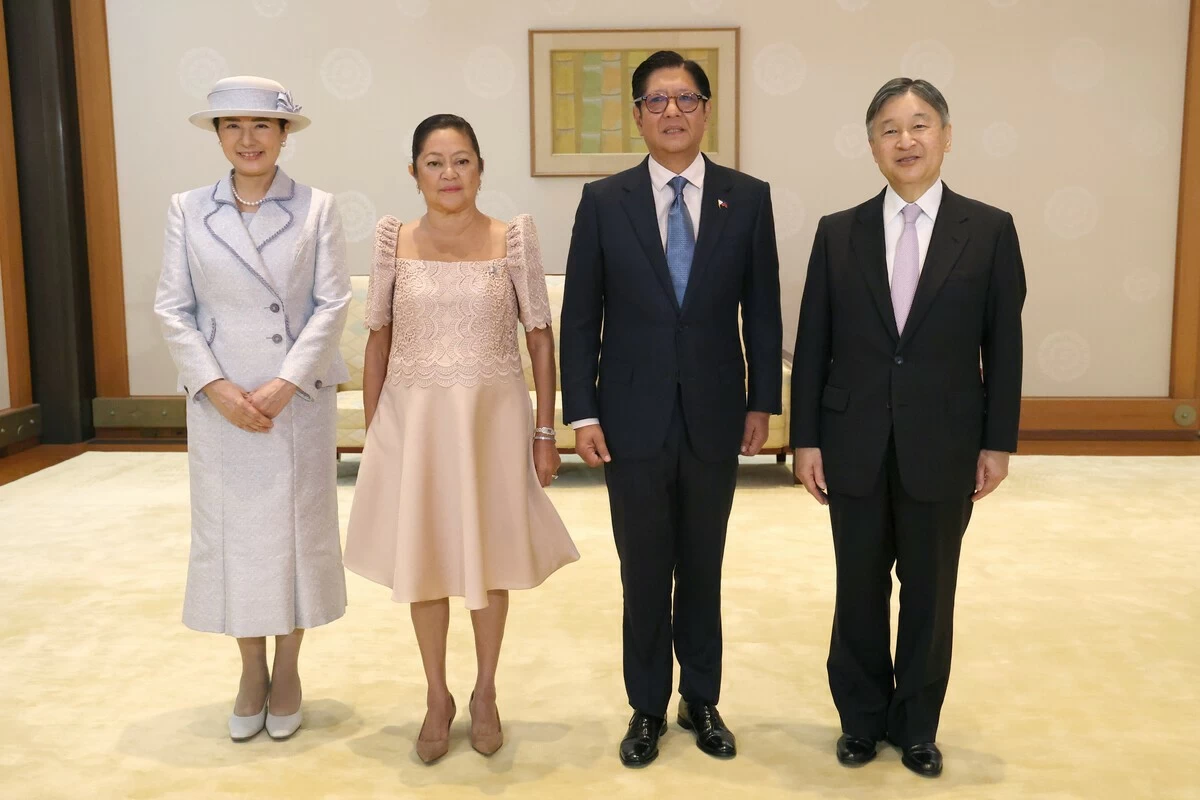
Japan's Emperor Naruhito and Empress Masako meet with Philippine President
Ferdinand Marcos Jr. and his wife in the "Take no Ma" audience room at the
Imperial Palace in Tokyo on Wednesday. (Pool)
A state banquet will take place at the palace in the evening, with attendants including Prince Hisahito, the 19-year-old son of the Crown Prince and the Crown Princess, who is currently in his second year at the University of Tsukuba. It will mark his first participation in an event welcoming a state guest. Prince Hisahito is second in line to the throne after the Crown Prince.
Marcos is also scheduled to meet with Japanese Prime Minister Sanae Takaichi to discuss stronger security, economic, and regional cooperation, and witness the signing and exchange of a major trade and investment agreement and new security and maritime initiatives.
Marcos arrived in Tokyo for his four-day visit on Tuesday night.
The plane carrying him, First Lady Liza Araneta-Marcos, and the Philippine delegation arrived at Haneda International Airport at 6:31 p.m. (Japan time).
Upon his arrival, he met with the Filipino community.
The visit coincides with the commemoration of the 70th anniversary of the normalization of diplomatic relations between the Philippines and Japan.
Marcos previously visited Japan during his official and working visits to Tokyo and Osaka in 2023 and 2025, respectively.
Marcos' visit is the first state guest visit to Japan by a Philippine president since 2015. This year, the Philippines serves as the chair of the Association of Southeast Asian Nations and marks the 70th anniversary of the normalization of diplomatic relations with Japan.
True friends
Citing the growing Filipino community in Japan, Marcos encouraged Filipinos working and living in the foreign country to continue being good friends with the Japanese.
In his speech during a gathering with Filipinos in Tokyo on Tuesday night, May 26, Marcos underscored that the Filipino community has thrived and deeply integrated into the threads of Japanese society for decades now.
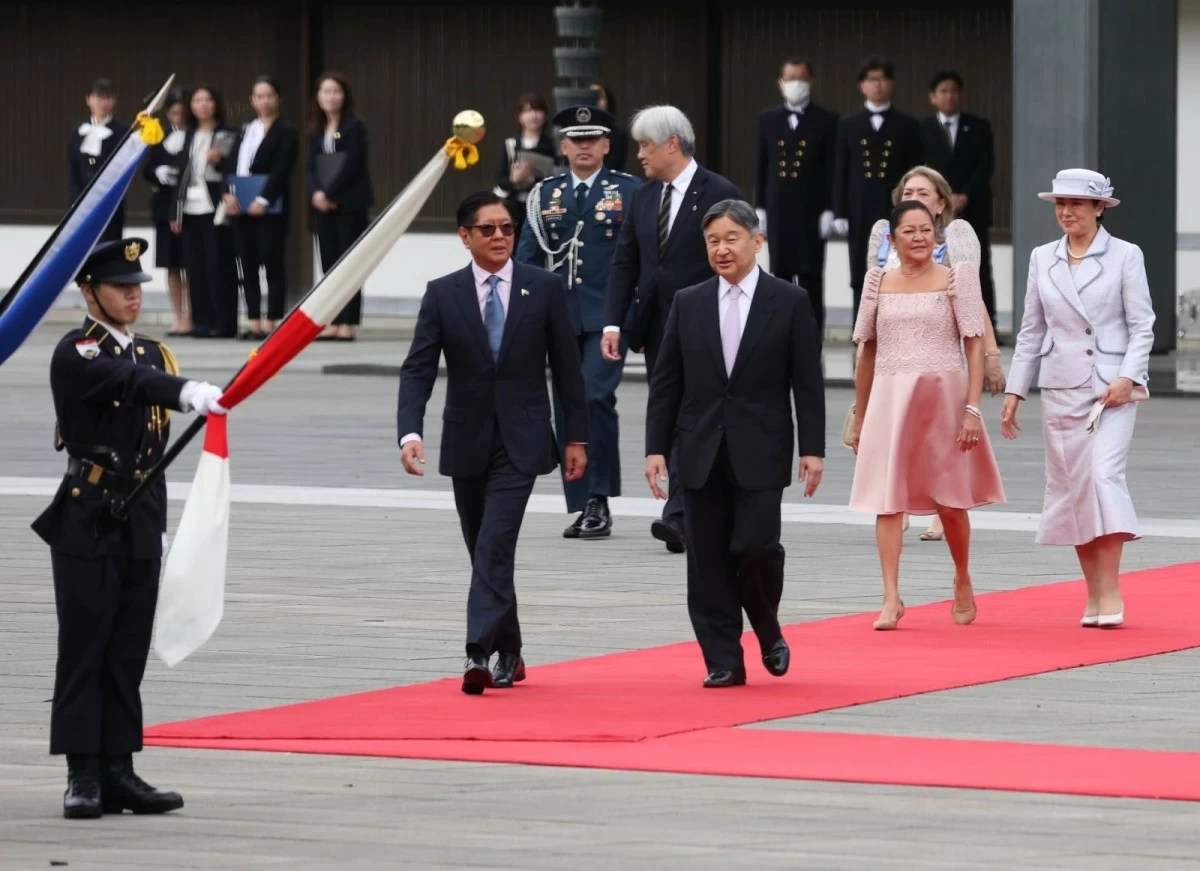
President Ferdinand R. Marcos Jr. with First Lady Liza Araneta-Marcos are welcomed by Japanese Emperor Naruhito and Empress Masako at the Imperial Palace on May 27, 2026. (PPA)
"Manatili po tayong tunay na kaibigan ng mga Hapon sa ating mga komunidad at pamayanan nang sa gayon ay maipakita at maipabatid natin sa kanila ang pagiging tunay na Pilipino (Let us continue to be true friends to the Japanese people in our communities and neighborhoods so that we may show and convey to them what it truly means to be Filipino)," Marcos said.
The President further urged them to show that "we stand beside them in facing the problems and challenges we all experience."
"Naniniwala po ako na kung maayos at naaayon sa batas ang ating pamumuhay, patuloy na yayabong ang pamayanang Pilipino dito sa Japan (I believe that if we live properly and in accordance with the law, the Filipino community here in Japan will continue to flourish)," Marcos said.
"As our community grows across Japan— from Hokkaido all the way to Okinawa— our strength lies in our firm adherence to our faith and our national identity," he added.
There are an estimated 350,000 Filipinos living and working in Japan.
'Integration does not mean assimilation'
Marcos also encouraged younger Filipinos in Japan to take advantage of available opportunities and "in return, contribute positively to the society that you have taken as your own."
"It is my fervent hope that you succeed in all your endeavors in your chosen careers. Whether it be in business, the arts, the professional arena, the service sector, or in sports, I urge you to make a good account of yourselves and be proud of your heritage as Filipinos," Marcos said.
He emphasized that living in Japan requires a delicate balance, noting that Japan is a nation of profound tradition, structure, and etiquette.
"For us to thrive here, we need to be masters of the art of integration. We must respect the local laws, embrace the culture, and learn the language. However, integration does not mean assimilation," he told them.
“It does not mean forgetting your roots and abandoning who you are. Our greatest asset is our unique identity,” he added.
The President described young Filipinos in Japan as the “torch bearers” for the next 70 years of Philippine-Japan relations and expressed confidence that they will continue to strengthen the friendship and cooperation between the two nations.
He also paid tribute to older members of the Filipino community who paved the way for younger generations to thrive in Japan.