








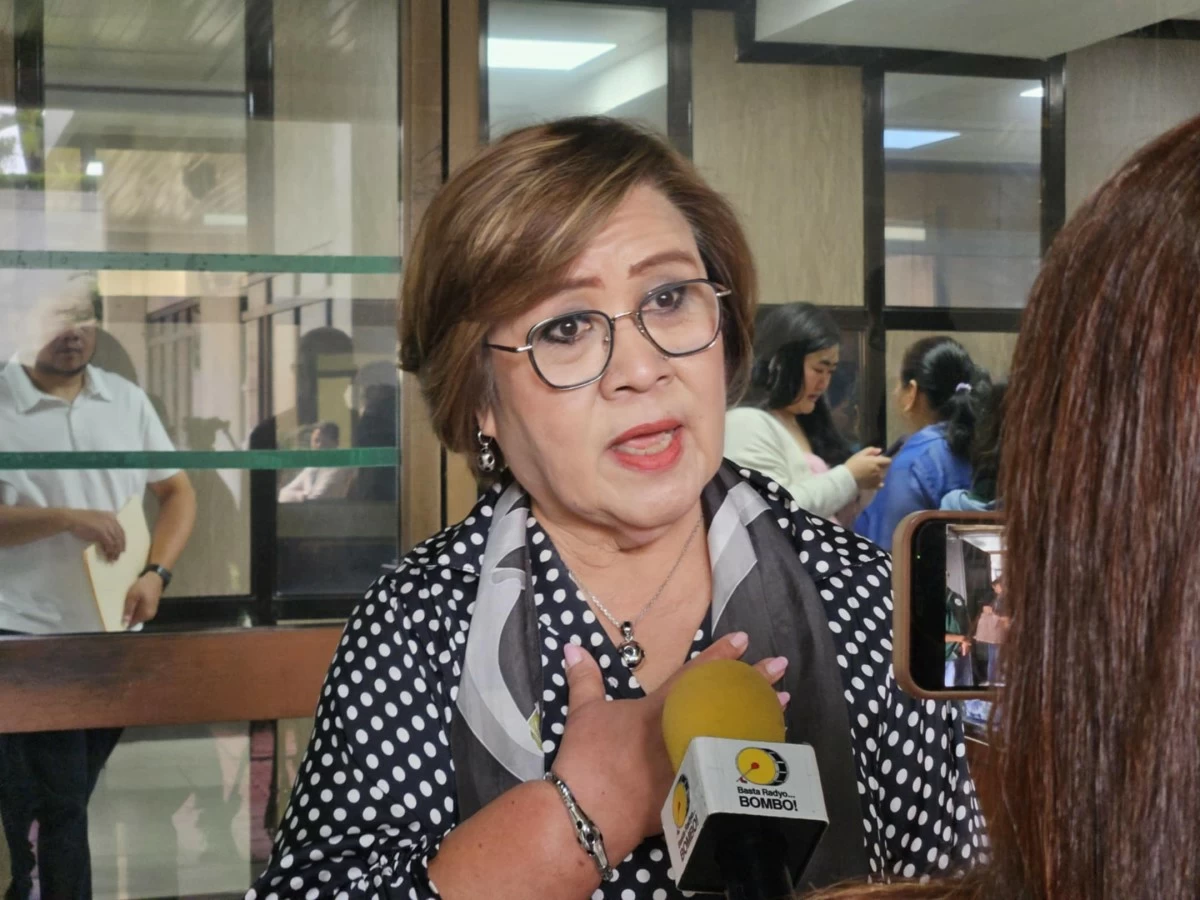
This, as De Lima and her fellow members of the House minority bloc hailed the Philippine Coas Guard's (PCG) tracking and challenging a China Coast Guard (CCG) vessel drifting just 50 nautical miles off the coast of Zambales.
"We laud the [PCG] for defending and asserting that what is ours is ours. Ipinakikita nito ang ating paninindigan at pinatutunayan na hindi tayo magwawalang-kibo sa panghihimasok ng dayuhan sa ating sariling bakuran," De Lima said.
(This shows our firm stand and proves that we will not remain passive in the face of foreign intrusion into our own territory.)
"China’s refusal to acknowledge our radio challenges while within our Exclusive Economic Zone (EEZ) demonstrates the behavior of a superpower who feels entitled to bully others," added the House senior deputy minority leader.
Ealier, minority bloc member Akbayan Party-list Rep. Dadah Kiram Ismula condemned Beijing's "brazen intrusion" on conducting illegal patrols within the Philippines' exclusive economic zone (EEZ).
She says that this makes any talks of a joint energy exploration deal with China completely unacceptable at this time.
"Wala pa ring respeto ang China sa ating soberanya dito sa kanilang pagaaligid sa Zambales; hinding hindi sila mapagkakatiwalaan na mag-engage in good faith sa pag-explore ng oil," Ismula said.
(China still shows no respect for our sovereignty with its maneuvers near Zambales; they can never be trusted to engage in good faith in oil exploration)
“Magsimula muna ang China na kilalanin at respetuhin ang 2016 Arbitral Award na nagsasabing sa Pilipinas ang [WPS] at masimulan ang accountability sa damage na ginawa nila sa karagatan. Kung sa imagination ng China ay kanila ang [WPS], malamang aangkinin din nila ang kung ano mang oil ang makuha doon,” she added.
(China must first recognize and respect the 2016 Arbitral Award that declares the [WPS] as belonging to the Philippines and begin accountability for the damage they caused to the seas. If in China’s imagination the [WPS] is theirs, then most likely they will also claim whatever oil is found there.)
Ismula's fellow nominee, Akbayan Party-list Rep. Perci Cendaña echoed her stand.
"China actions and words show there is little good faith on their part. Hindi magkakaroon ng matino at maayos na usapan kasama ang China kung pag-aangkin agad sa [WPS] at pagbabalewala sa international law ang totoong interes nila," Cendaña said.
(There will be no proper and orderly dialogue with China if their true interest is immediate territorial claim over the [WPS] and disregard for international law.)
De Lima pointed out that China’s refusal to acknowledge radio challenges while lingering off the Zambales shoreline was a direct, mocking violation of the Philippine Maritime Zones Act and international law.
At the very least, she says it reflects Beijing's lack of respect for Philippine sovereignty and its lack of sincerity in resolving issues in the WPS.
The Department of Foreign Affairs (DFA) in April assured Filipinos that any potential joint oil and gas exploration with China, or any other country, will strictly adhere to the Philippine Constitution and existing laws, amid renewed discussions on energy cooperation.
In a statement, the DFA emphasized that the Philippines retains sovereign rights over natural resources within its EEZ and continental shelf.
“Any decision to pursue, structure, or conclude an agreement on oil and gas cooperation, with China or any other foreign government, will be made solely in accordance with the Philippine Constitution and the country’s laws, jurisprudence and regulations, and in full assertion of its sovereign prerogatives,” it said.
"Amid these continued harassment and intrusions," De Lima said, "We should continue strengthening our partnership with regional allies to preserve and defend a rules-based international order, especially when it comes to enforcing the law of the sea."
De Lima said that given the strategic importance of the country’s maritime domain, she called on her colleagues in the House of Representatives to pass House Bill (HB) No.5131 or the “Revised Philippine Coast Guard Law”. The bill aims to strengthen the PCG through vital policy and organizational reforms.