







Advisory on the May 25 meteor sighting over Mayon Volcano
Published May 27, 2026 02:30 pm


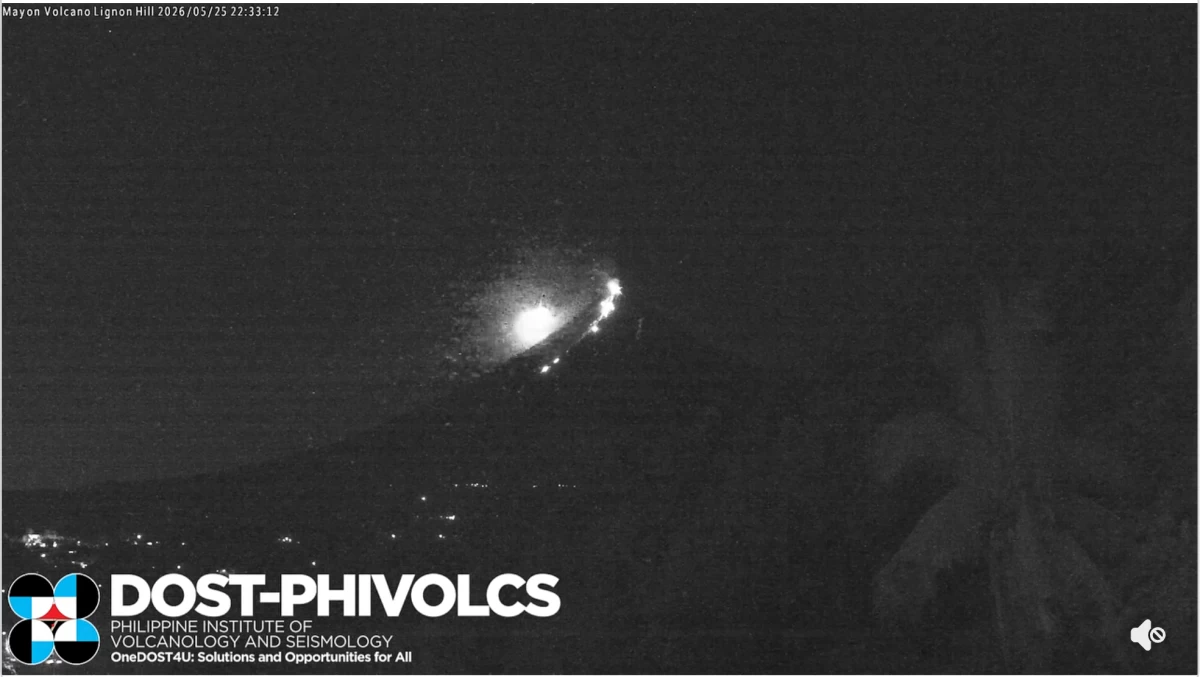
The bright streak of light captured over Mayon Volcano by the Philippine Institute of Volcanology and Seismology (PHIVOLCS) Ligñon Hill camera at 10:33 PM on 25 May 2026 was caused by a meteor entering the atmosphere, a phenomenon that often produces a brilliant flash of light.
While meteors or space rocks enter Earth's atmosphere daily, the vast majority burn up completely before reaching the ground. Meteors usually burn up at altitudes 60 to 100 kilometers above sea level. As they plunge through the atmosphere at extreme speeds, friction heats them so intensely that they vaporize. This heat also ionizes the air molecules around them, creating the bright, glowing streak we see as “shooting stars”. Fragments that are large enough to survive atmospheric entry and hit the ground are classified as meteorites.
The event was visually striking with the Mayon Volcano at the foreground of PHIVOLCS' video capture. Tracking meteor trajectories is not straightforward. Globally, scientists are able to detect and track meteors using radar and optical camera networks, coupled with data analysis and computational modeling.