







Steadying the PH economy amid gathering headwinds
Published May 26, 2026 12:05 am
|
Updated May 24, 2026 03:52 pm


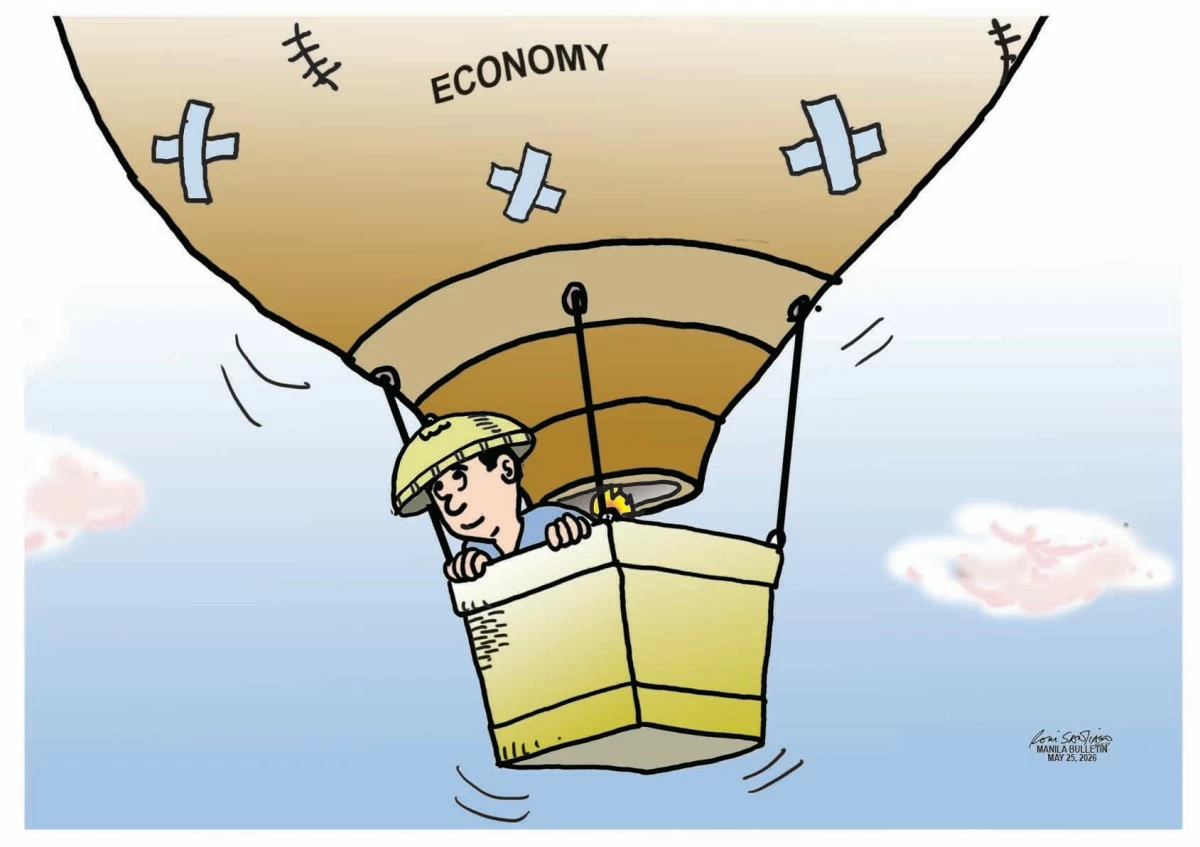
The Philippine economy enters the second half of 2026 with mixed prospects. Recent analyses by the Department of Economy, Planning, and Development and forecasts made by the Institute of International Finance paint a cautiously optimistic picture. The Philippines remains among Southeast Asia’s more resilient economies, yet faces mounting risks arising from geopolitical instability abroad and political volatility at home.
The country continues to benefit from strong domestic consumption, a young labor force, sustained remittances from overseas Filipinos, and ongoing infrastructure investments. These fundamentals provide a measure of insulation against external shocks. Development planners remain hopeful that growth targets through 2028 can still be achieved if reforms continue and investor confidence is sustained.
Yet the challenges are formidable.
The intensifying conflict in the Middle East threatens to disrupt global oil supply chains and drive fuel prices upward anew. For an import-dependent economy like the Philippines, higher energy costs significantly affect transportation, food prices, electricity rates, and industrial production. Inflationary pressures could return just as households and businesses are beginning to recover from earlier economic strains. At the same time, uncertainty in global financial markets may weaken investor appetite for emerging economies, including the Philippines.
Compounding these external pressures is the growing volatility of domestic politics. Investors value predictability, institutional stability, and policy continuity. Political noise, prolonged partisan conflict, and governance uncertainty risk undermining business confidence precisely when the country needs greater investment inflows to sustain growth and employment generation.
The period from 2026 to 2028 will therefore test not only the resilience of the Philippine economy but also the discipline and maturity of its political leadership.
Government must respond with clarity, urgency, and strategic focus.
First, economic managers must intensify efforts to ensure energy security. The country cannot continue to remain excessively vulnerable to imported fuel shocks. Accelerating investments in renewable energy, liquefied natural gas facilities, power transmission modernization, and regional energy partnerships must become a national priority. Every delay in expanding energy capacity increases the economy’s exposure to global instability and raises costs for ordinary Filipinos.
Second, infrastructure development must continue despite fiscal constraints. The government should focus on projects with the highest economic multiplier effects — transportation connectivity, logistics modernization, digital infrastructure, irrigation systems, and disaster resilience. These investments stimulate employment while enhancing long-term competitiveness.
Third, government must strengthen food security and agricultural productivity. Rising fuel costs and climate disruptions continue to expose weaknesses in food supply chains. Modernizing agriculture through mechanization, irrigation, cold storage systems, and farm-to-market logistics will help stabilize prices while protecting vulnerable sectors from inflationary shocks.
Fourth, policymakers must preserve fiscal prudence and macroeconomic credibility. The Philippines has thus far maintained a reputation for relatively sound banking fundamentals and manageable debt dynamics. This credibility must not be squandered through populist spending, regulatory inconsistency, or politically driven economic decisions. Investors and credit-rating agencies closely monitor governance signals, especially during periods of political uncertainty.
Equally important is the need to strengthen institutional cohesion. Political competition is natural in a democracy, but prolonged instability carries economic consequences. National leaders across the political spectrum must recognize that investor confidence, employment generation, and poverty reduction depend heavily on perceptions of governance stability and rule-based decision-making.
In a world increasingly shaped by geopolitical conflict and economic fragmentation, the countries that will thrive are those able to combine stability with adaptability. The Philippines must now demonstrate that it can do both.