






Manila Bulletin
 Philippines
National
Sen Bato should be arrested or should surrender before he could challenge validity of his arrest, detention – SC Justice Leonen
Philippines
National
Sen Bato should be arrested or should surrender before he could challenge validity of his arrest, detention – SC Justice Leonen
Philippines
National
Sen Bato should be arrested or should surrender before he could challenge validity of his arrest, detention – SC Justice Leonen
Sen Bato should be arrested or should surrender before he could challenge validity of his arrest, detention – SC Justice Leonen
Published May 26, 2026 11:17 am
|
Updated May 26, 2026 01:52 pm


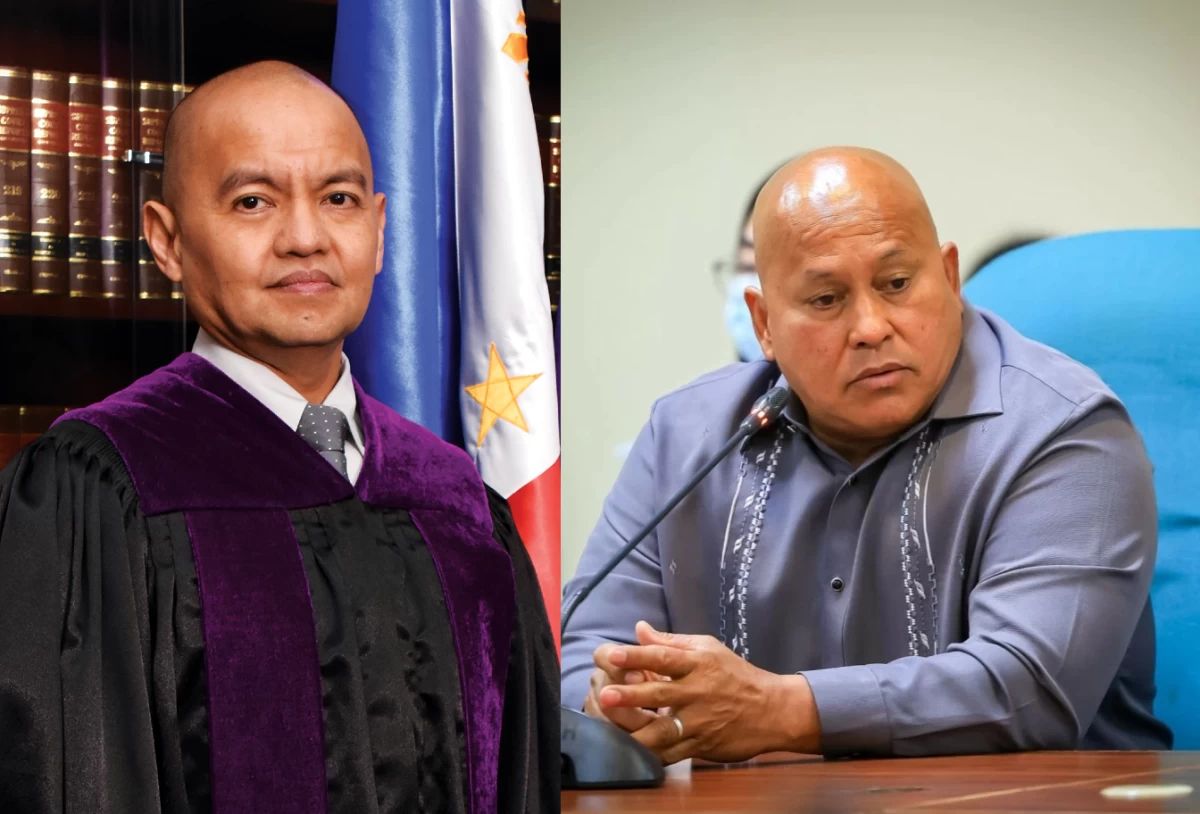
For Supreme Court (SC) Senior Associate Justice Marvic M.V.F. Leonen, Senator Ronald “Bato” dela Rosa should be arrested or he should surrender first before he could test the legality of his arrest and detention.
Leonen said the SC cannot yet make any judgment on the existence, authenticity, or validity of the much publicized "warrant of arrest."
“We can only assume, like every other warrant implemented in this jurisdiction, that an authenticated copy of the warrant issued by the international tribunal together with its relevant and material supporting documents will be presented to petitioner (Dela Rosa) upon his detention, arrest, or his voluntary submission to law enforcers,” he also said.
In his separate concurring opinion on the May 20 SC ruling that denied Dela Rosa’s appeal to stop the enforcement of the arrest order issued by the International Criminal Court (ICC), Justice Leonen said:
“Should petitioner (Dela Rosa) be placed under restraint, habeas corpus is the constitutionally fitted vehicle to test the legality of that restraint, to determine whether a lawful cause exists, whether any warrant is authentic, and whether the conditions for a citizen's surrender have been met. It is in that proceeding, with a return, a hearing, and a full record, that the reserved questions are properly tried.”
Leonen pointed out that “as a general rule, our courts will not issue writs of injunction or prohibition to restrain a criminal prosecution; the legality of the State's action is tested after it is invoked in the proceeding it sets in motion, and is not pre-empted before it begins.”
He stressed that the purpose of the rule is to keep the judiciary from arrogating to itself, through provisional remedies, a general superintendence over the timing and manner of law enforcement.
“What is true of enjoining a prosecution holds a fortiori for enjoining an arrest before it occurs,” he also said.
Leonen cited that “nanlaban” (fought back) “served as code for some of our law enforcers – apparently encouraged by their leaders and a President -- to be brutal.”
He said that in some cases decided by the trial courts, "nanlaban" was used as justification for killing during law enforcement without a warrant.
“The incident before us involves a Senator of the Republic who was also a former Chief of the Philippine National Police. It is not about ‘nanlaban.’ Rather, it appears to be another form of resistance: to an attempt by law enforcers to serve what they consider a valid warrant, albeit one issued not by any of our courts but, allegedly, by the International Criminal Court established by treaty,” he also said.
“’Nanlaban’ did not happen. Petitioner ran. He sought sanctuary among the majority of his colleagues in the Senate within their premises. He fled shortly thereafter. The Senator and former Chief of the Philippine National Police is now at large,” Leonen pointed out.
He noted that Dela Rosa pleaded to stop his arrest. “We cannot enjoin law enforcement at this stage and under the circumstances in this case. That would be dangerous precedent,” he declared.
Leonen also said: “The applicant occupied the apex of the institution constitutionally bound to protect life, and was, by the allegations, central to the program from which the deaths arose. Equity cannot he invoked to suspend the operation of law against him without asking what equity owes those whose deaths the same institution caused or failed to prevent. The ‘voiceless dead’ are not a rhetorical flourish. They are a constituency whose absence and coerced silence themselves are, in my view, constitutionally significant.”
However, Leonen said that Dela Rosa will have judicial remedies of he is arrested or if he surrendered like a petition for a writ of habeas corpus (a citizen’s legal challenge against arrest and detention).
“For instance, and at a minimum, a writ of habeas corpus will require that he be brought before this Court, and in pleadings and oral arguments, the parties can exhaust their arguments on the critical issues of interpretation of Republic Act No. 9851, the application as a matter of jurisdiction or admissibility based on our residual obligations to the Treaty Creating the International Criminal Court, the process of arrest and seizure both under our Constitution and by treaty, and whether he can (i.e., by who and under what conditions) be surrendered or extradited to the International Criminal Court,” he added.
In a 9-5-1 vote, the SC denied Dela Rosa’s plea to stop his arrest ordered by the ICC.
The ICC arrest order is now being implemented by the Department of Justice (DOJ) through the Philippine National Police and the National Bureau of Investigation.
Based on the resolution issued last May 20 and made public by the SC at about 6:30 p.m. on Monday, May 25, those who voted to grant Dela Rosa’s plea for a temporary restraining order (TRO) to stop his arrest were Associate Justices Ramon Paul L. Hernando, Amy C. Lazaro-Javier, Henri Jean Paul B. Inting, Ricardo R. Rosario, and Antonio T. Kho Jr. They are all appointees of former president Rodrigo R. Duterte.
The majority members who voted to deny Dela Rosa’s plea for TRO were Chief Justice Alexander G. Gesmundo, Senior Associate Justice Leonen, and Associate Justices Alfredo Benjamin S. Caguioa, Rodil V. Zalameda, Samuel H. Gaerlan, Jhosep Y. Lopez, Jose Midas P. Marquez, Maria Filomena D. Singh, and Raul B. Villanueva.
Six of them – Gesmundo, Zalameda, Gaerlan, Lopez, Marquez, and Singh -- are appointees of Duterte.
Leonen and Caguioa are appointees of the late president Noynoy Aquino, while Villanueva is the appointee of President Marcos.
Associate Justice Japar B. Dimaampao, also an appointee of Duterte, was on leave at the time Dela Rosa’s motion was taken up by the SC last May 20 during its special full court session.
Dela Rosa was ordered arrested by the ICC as an “indirect co-perpetrator” in the killings that took place during the campaign against illegal drugs. The ICC’s Pre-Trial Chamber had said that Duterte and his alleged co-perpetrators, including Dela Rosa, “shared a common plan or agreement to neutralize alleged criminals in the Philippines,” and those linked with drug use and sale through violent crimes, including murder.
In it resolution, the SC stressed that for a writ of preliminary injunction to TRO to issue, an applicant must have a clear and unmistakable right to be protected, that is, a right in esse (in existence); there is a material and substantial invasion of such right; there is an urgent need for the writ to prevent irreparable injury to the applicant; and no other ordinary, speedy, and adequate remedy exists.
However, it said that Dela Rosa failed to show that there is a meritorious ground for the issuance of a TRO in his favor.
It cited that Dela Rosa argued that the threatened enforcement of the ICC warrant imperiled his constitutional rights to (1) liberty, (2) be free from unreasonable seizure, (3) due process, (4) not be surrendered, transferred, rendered, or removed from Philippine territory, and (5) effective exercise of legislative functions.
The SC said: “The first three rights are fundamental, but the fourth and fifth are questionable. The right to liberty is not absolute. Seizure or arrest is not unlawful when made pursuant to a lawful order of a court with competent jurisdiction. Likewise, the right to due process is satisfied when the process or proceedings comply with the law of the Iand.”
At the same time, the SC said: “There is no material and substantial invasion of Senator Dela Rosa's rights. In the first place, Senator Dela Rosa has no clear and unmistakable right to be protected. He was also given ‘protective custody’ by the Senate in the interim, which prevented the alleged service or implementation of the ICC warrant, as well as his arrest.
“Simply put, since there is no legal right in the first place, there can be no irreparable injury to speak of. Proceeding from the lack of irreparable injury, the issuance of a TRO is inappropriate,” the SC ruled.