








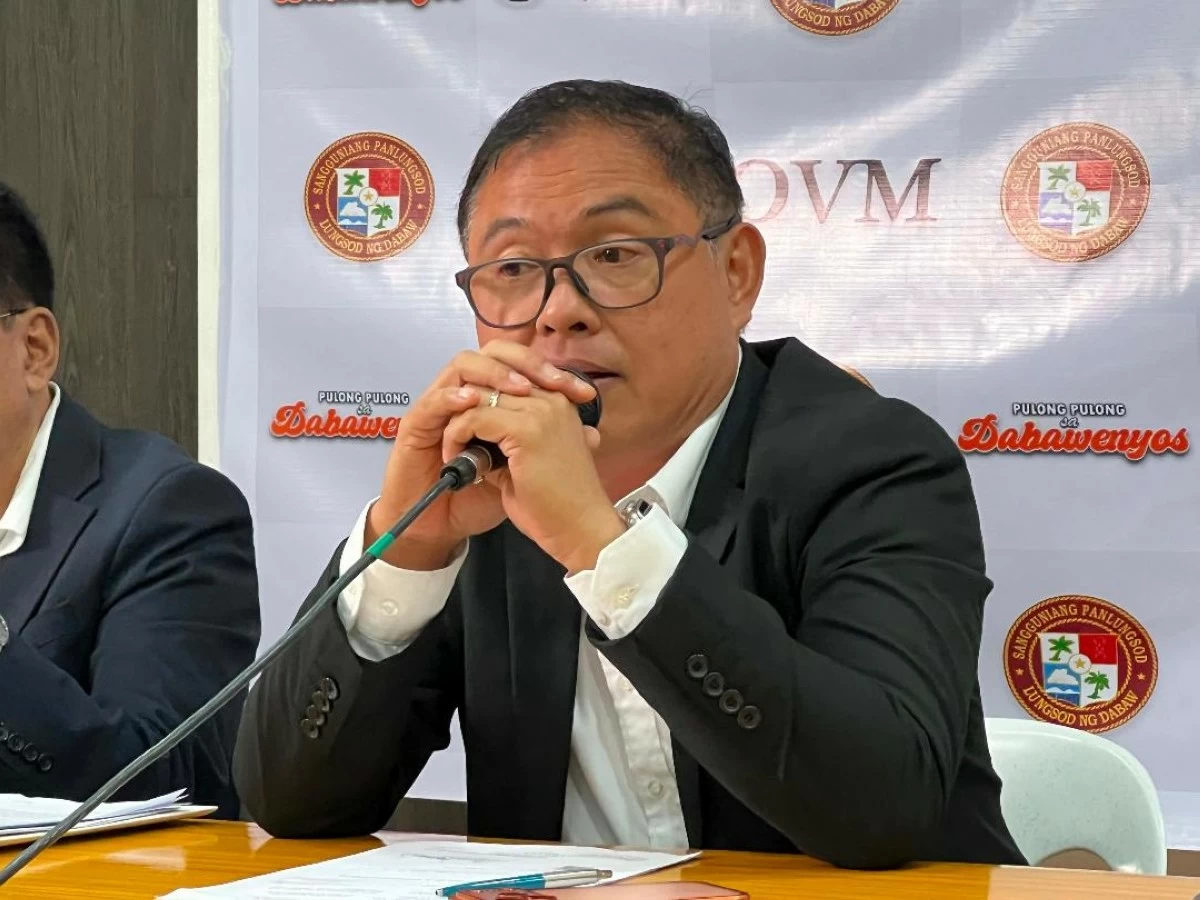
OCAMPO
DAVAO CITY – The Davao City government is working to comply with corrective measures ordered by the Department of Environment and Natural Resources following a deadly landslide at the New Carmen Sanitary Landfill in Tugbok District and assured residents that garbage collection services will continue despite possible delays.
Speaking at the Pulong-Pulong sa Dabawenyos media forum on Tuesday, May 26, Committee on Environment and Natural Resources Chairman Councilor Temujin Ocampo said the city is coordinating with the DENR, the City Environment and Natural Resources Office, and the City Engineer's Office to address deficiencies cited in the operation of the landfill and implement recommended corrective actions.
The DENR ordered the immediate suspension of waste disposal operations at the New Carmen Sanitary Landfill after it collapsed on May 20. One person was killed, two others were missing, and two were injured.
In a statement issued on May 25, DENR-Davao Regional Executive Director Maria Mercedes V. Dumagan said the suspension would allow the local government to undertake slope stabilization measures and comply with the requirements of Republic Act 9003, or the Ecological Solid Waste Management Act, as well as the conditions of the facility's Environmental Compliance Certificate.
"In the meantime, let us place our trust in their plans and follow their directives to ensure public safety," Dumagan said.
Ocampo said the heavy rainfall was among the primary factors being examined in the ongoing investigation. He noted that the intense downpour on May 18 produced an "overwhelming" volume of rain, exceeding the capacity of local drainage systems and contributing to water infiltration into the landfill.
He said initial observations indicated that rainwater penetrated the layered waste and soil, causing movement within the landfill mass. He added that the facility had already been operating under heavy loads before the incident.
Following the suspension order, City Information Office chief Harvey Lanticse said the local government temporarily halted the use of the existing landfill on May 22 and has since filed a motion for reconsideration with DENR-11.
The city's appeal cited the results of geotechnical assessments conducted at the site and proposed corrective measures intended to address stability concerns.
Lanticse said the city plans to utilize a new landfill facility adjacent to the existing site in Barangay New Carmen while rehabilitation efforts continue.
Councilor Danilo Dayanghirang, chairman of the Committee on Finance, Ways and Means, and Appropriations, disclosed that P34 million has been approved for mitigation and construction works at the landfill, including erosion-control measures.
Dayanghirang said the allocation could be released immediately and supplemented by calamity and infrastructure funds if necessary.
The councilor also said the city's supplemental budget currently stands at around P1.2 billion, with the landfill rehabilitation among the priority expenditures endorsed by the City Development Council and the Local Finance Committee.
Despite the suspension of disposal operations at the existing facility, Ocampo assured residents that waste collection services would not stop.
"We cannot stop the waste collection," Ocampo said, stressing that halting garbage collection would create greater public health and environmental problems.
He acknowledged that operational adjustments could result in temporary delays but emphasized that collection services would continue as the city handles between 600 and 800 tons of waste daily.
The landfill incident has renewed attention to Davao City's growing waste management challenges.
City Environment and Natural Resources Office data said average daily waste disposal at the sanitary landfill reached 753 tons in 2025. The facility, which opened in December 2010, is already operating at full capacity.
To address the increasing volume of waste, Ocampo said the city is accelerating the construction of a second sanitary landfill adjacent to the current site.
The new facility covers 6.5 hectares and has a total project cost of P559 million, comprising P340 million in initial funding and an additional P219 million in an appropriation. Construction began in October 2024.
Ocampo said the project cannot be rushed because it must comply with strict DENR technical and environmental requirements designed to ensure long-term safety and stability.
Beyond landfill expansion, city officials are exploring alternative waste management technologies.
Ocampo said discussions continue regarding possible assistance from the Japanese government for waste-to-energy, although the proposed facility would only accommodate around 600 tons of waste per day.
"The city is also studying proposals from a Korean firm interested in methane gas recovery and a Malaysian-Singaporean company, Gain Cities, which has proposed waste-to-resources technology," Ocampo said.
City officials called on residents to strengthen household waste segregation practices by separating biodegradable, recyclable, and residual waste.
Dumagan urged the public to actively participate in proper waste management to reduce the amount of garbage reaching the landfill. She said this simple effort will be a big help and will significantly ease our waste collection challenges.
Ocampo echoed the appeal, encouraging households with sufficient backyard space to compost biodegradable waste and reduce their reliance on landfills.
He also said the city is assessing the relocation of residents living near the landfill, describing the area as unsafe for habitation. Qualified residents may receive relocation assistance from the city government.
Meanwhile, Councilor J. Melchor Quitain Jr., chairperson of the Committee on Government-owned Properties and on Housing and Subdivision Development under Presidential Decree 957, emphasized the need to upgrade aging drainage infrastructure to better cope with increasingly intense rainfall events.
Quitain said the city continues to scrutinize subdivision and housing projects to ensure compliance with drainage, safety, and land-use standards, particularly in flood-prone areas.
City officials said recent flooding incidents and landfill collapse highlight the need for improved infrastructure, stronger waste management systems, and greater public participation as Davao City confronts the effects of increasingly abnormal weather patterns.