






Manila Bulletin
 Embassies & Foreign Affairs
Cine Europa 29 opens with films reflecting a changing Europe
Embassies & Foreign Affairs
Cine Europa 29 opens with films reflecting a changing Europe
Embassies & Foreign Affairs
Cine Europa 29 opens with films reflecting a changing Europe
Cine Europa 29 opens with films reflecting a changing Europe
Published May 25, 2026 11:47 am



Cine Europa opens in 2026, celebrating almost three decades of being an integral part of Manila’s cultural calendar. (Photo: Manila Bulletin)
Cine Europa returns to the Philippines on May 28 for its 29th edition, bringing with it a lineup of films that span family storytelling, contemporary drama, political conflict, and documentary filmmaking from across Europe.
Organized by the Delegation of the European Union to the Philippines (EU) together with its member states, the festival remains the country’s longest-running European film festival and one of the European Union’s most visible cultural initiatives in the Philippines.
Screenings will begin at Shangri-La Plaza from May 28 to June 3 before moving to Rizal Park from June 15 to 20, with additional screenings scheduled in Tacloban and Cagayan de Oro. Admission remains free on a first-come, first-served basis.
This year’s edition features 17 films and three documentaries from across Europe, continuing Cine Europa’s long-standing role as both a film festival and a platform for cultural dialogue between Europe and the Philippines.
Ahead of the official opening, representatives of EU member states and members of the diplomatic community gathered on May 14 for the festival’s launch at Shangri-La Plaza, where guests were treated to a special screening of the Polish film “Lampo, the Travelling Dog”.
Presented by Poland as part of this year’s lineup, the film tells the story of a traveling dog inspired by real events and offered a lighter, family-oriented entry into contemporary Polish cinema.
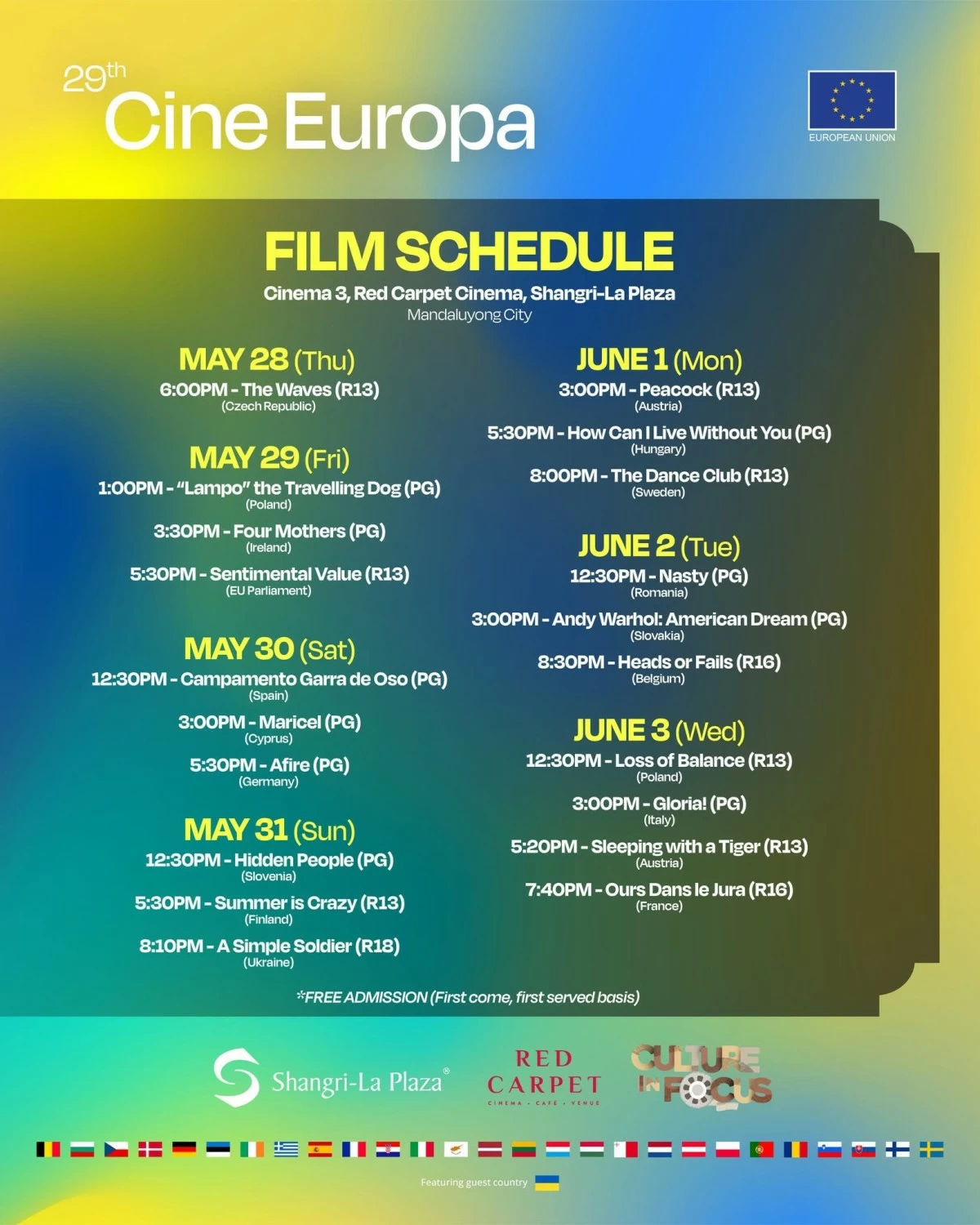
Full schedule of this year’s Cine Europa (Photo: EU Delegation in the Philippines)
Poland is also bringing the drama “Loss of Balance” to the festival, exploring more introspective themes through contemporary storytelling.
At the same time, Cine Europa 29 also reflects the political realities shaping Europe today.
Ukraine joins this year’s lineup with the documentary “A Simple Soldier”, directed by Artem Ryzhykov and Juan Cruz. The documentary follows Ryzhykov, a filmmaker who joined Ukraine’s Territorial Defence Forces following Russia’s full-scale invasion and continued documenting the war from inside the conflict itself.
Its inclusion brings a sharper political dimension to the festival, underscoring how European cinema continues to engage with questions of war, identity, displacement, and resistance.
That intersection between art and political reflection has long defined much of European filmmaking.
Over the years, Cine Europa has gradually built an audience in the Philippines that extends beyond diplomats and film enthusiasts to include students, artists, filmmakers, and younger audiences interested in international storytelling and independent cinema.
The festival’s continued expansion outside Metro Manila also reflects a broader effort by the European Union to make cultural programming more accessible beyond traditional diplomatic spaces.
Nearly three decades since it first launched in the Philippines, Cine Europa has evolved into a familiar part of Manila’s cultural calendar—one where diplomacy is done through film, and stories that offer Filipino audiences a window into the many versions of Europe itself.