ADVERTISEMENT

GCash strengthens user support through official help channels and security features

By MBrand
Published May 23, 2026 01:10 pm
As digital financial services become essential to daily life, GCash, the Philippines’ leading finance superapp, continues to strengthen its commitment to user security by streamlining its support channels
To help users navigate concerns such as unauthorized transactions, account takeovers, scams, and “wrong send” errors, GCash provides clear and accessible reporting tools designed to enable faster resolution. By knowing exactly where to seek help, users can better protect their accounts and minimize financial risks in an increasingly cashless ecosystem.
Built-in support channels and security safeguards
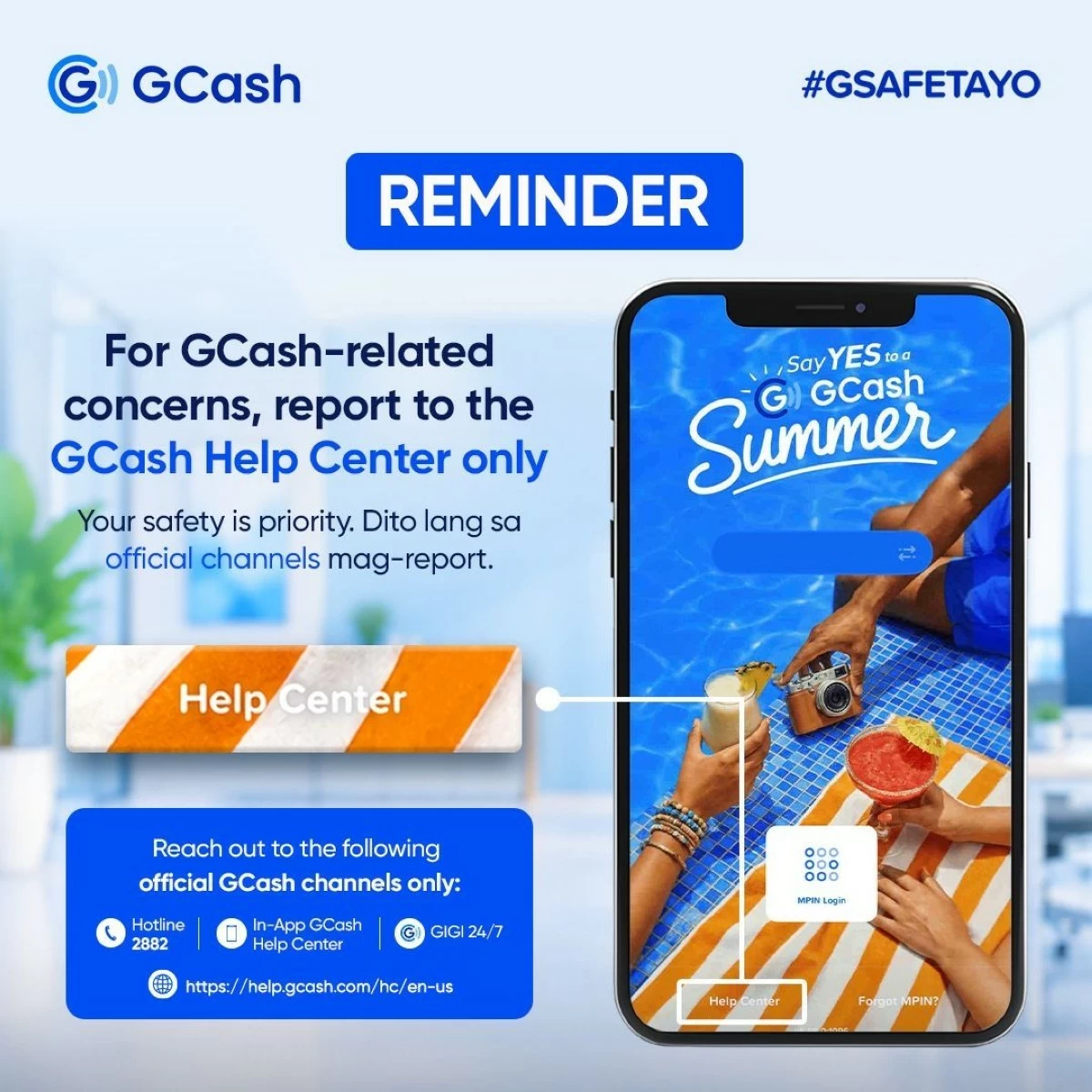
GCash provides a range of official help channels designed to address different types of concerns. Inside the app, users can access in-app guides that offer step-by-step instructions for common issues. The GCash Help Center also serves as a central hub where users can find articles, submit requests, and report concerns.
For transaction-related concerns, the transaction history feature allows users to review details and identify discrepancies. Error notifications within the app also help flag failed or suspicious activities, prompting users to take action when needed.
Users seeking direct support can connect with Gigi, the chat agent in the Help Center, which serves as the primary channel for account-related concerns. Through Gigi, users can report lost SIM cards or phones, request transfer of funds, and apply for wallet limit upgrades, with guided steps to help resolve these cases quickly.
For more complex concerns, live agent support is available to handle cases that require deeper investigation, such as unauthorized transactions or account takeovers. Users can get in touch with these agents by calling the official GCash Help Center hotline at 2882.
These support channels are structured based on the level of concern. Simple issues can often be resolved through guides and self-service tools, while more sensitive cases are escalated to trained support agents. This approach helps ensure that users receive the right level of assistance without unnecessary delays.
Alongside this support ecosystem are security features built into the GCash app that give users an added layer of protection. Account Secure limits account access to one device at a time. DoubleSafe adds an extra verification step that requires selfie scans to confirm the user’s identity, especially for high-risk activities such as logging in to a new device and high-value transactions. Biometrics Login and MPIN Protection confirm that only the account owner can authorize transactions, while One-Time Passwords (OTP) provide an additional check for sensitive actions.
A shared effort to keep digital financing safe
Beyond its in-app security features and help channels, GCash also works closely with regulators and law enforcement agencies such as the Cybercrime Investigation and Coordinating Center (CICC) and PH Payments Management Inc. (PPMI) to detect and act on fraud. GCash has blocked more than 4,900 fraudulent merchants linked to quishing or QR phishing schemes, reflecting the scale of its enforcement efforts.
The company continues to strengthen its customer experience by refining support tools and reducing response times. Enhancements are regularly introduced to make it easier for users to report concerns and track the status of their requests.
"Resolving a concern quickly starts with going to the right channel. We have built our support system so that users can find the help they need, whether it is a simple guide in the app or a conversation with a live agent,” said Paul Velasquez, GCash AVP and Head of Customer Service Operations.
GCash also encourages users to remain vigilant and report suspicious activity immediately through official support channels. The company advises transacting only through official GCash channels and verifying website URLs before completing any payment. No one from GCash will ever ask for an OTP, MPIN, or password.
Suspicious activity can be reported through the GCash Help Center in the app or by going to help.gcash.com and submitting a ticket. Users can also call the official hotline at 2882 to speak to a live agent.
For more information on account safety and available support, visit www.gcash.com.

Related Tags

GCash security fintech fintech in Philippines
ADVERTISEMENT
.most-popular .layout-ratio{ padding-bottom: 79.13%; } @media (min-width: 768px) and (max-width: 1024px) { .widget-title { font-size: 15px !important; } }

{{ articles_filter_1561_widget.title }}

.most-popular .layout-ratio{ padding-bottom: 79.13%; } @media (min-width: 768px) and (max-width: 1024px) { .widget-title { font-size: 15px !important; } }

{{ articles_filter_1562_widget.title }}

.most-popular .layout-ratio{ padding-bottom: 79.13%; } @media (min-width: 768px) and (max-width: 1024px) { .widget-title { font-size: 15px !important; } }

{{ articles_filter_1563_widget.title }}

{{ articles_filter_1564_widget.title }}

.mb-article-details { position: relative; } .mb-article-details .article-body-preview, .mb-article-details .article-body-summary{ font-size: 17px; line-height: 30px; font-family: "Libre Caslon Text", serif; color: #000; } .mb-article-details .article-body-preview iframe , .mb-article-details .article-body-summary iframe{ width: 100%; margin: auto; } .read-more-background { background: linear-gradient(180deg, color(display-p3 1.000 1.000 1.000 / 0) 13.75%, color(display-p3 1.000 1.000 1.000 / 0.8) 30.79%, color(display-p3 1.000 1.000 1.000) 72.5%); position: absolute; height: 200px; width: 100%; bottom: 0; display: flex; justify-content: center; align-items: center; padding: 0; } .read-more-background a{ color: #000; } .read-more-btn { padding: 17px 45px; font-family: Inter; font-weight: 700; font-size: 18px; line-height: 16px; text-align: center; vertical-align: middle; border: 1px solid black; background-color: white; } .hidden { display: none; }
function initializeAllSwipers() { // Get all hidden inputs with cms_article_id document.querySelectorAll('[id^="cms_article_id_"]').forEach(function (input) { const cmsArticleId = input.value; const articleSelector = '#article-' + cmsArticleId + ' .body_images'; const swiperElement = document.querySelector(articleSelector); if (swiperElement && !swiperElement.classList.contains('swiper-initialized')) { new Swiper(articleSelector, { loop: true, pagination: false, navigation: { nextEl: '#article-' + cmsArticleId + ' .swiper-button-next', prevEl: '#article-' + cmsArticleId + ' .swiper-button-prev', }, }); } }); } setTimeout(initializeAllSwipers, 3000); const intersectionObserver = new IntersectionObserver( (entries) => { entries.forEach((entry) => { if (entry.isIntersecting) { const newUrl = entry.target.getAttribute("data-url"); if (newUrl) { history.pushState(null, null, newUrl); let article = entry.target; // Extract metadata const author = article.querySelector('.author-section').textContent.replace('By', '').trim(); const section = article.querySelector('.section-info ').textContent.replace(' ', ' '); const title = article.querySelector('.article-title h1').textContent; // Parse URL for Chartbeat path format const parsedUrl = new URL(newUrl, window.location.origin); const cleanUrl = parsedUrl.host + parsedUrl.pathname; // Update Chartbeat configuration if (typeof window._sf_async_config !== 'undefined') { window._sf_async_config.path = cleanUrl; window._sf_async_config.sections = section; window._sf_async_config.authors = author; } // Track virtual page view with Chartbeat if (typeof pSUPERFLY !== 'undefined' && typeof pSUPERFLY.virtualPage === 'function') { try { pSUPERFLY.virtualPage({ path: cleanUrl, title: title, sections: section, authors: author }); } catch (error) { console.error('ping error', error); } } // Optional: Update document title if (title && title !== document.title) { document.title = title; } } } }); }, { threshold: 0.1 } ); function showArticleBody(button) { const article = button.closest("article"); const summary = article.querySelector(".article-body-summary"); const body = article.querySelector(".article-body-preview"); const readMoreSection = article.querySelector(".read-more-background"); // Hide summary and read-more section summary.style.display = "none"; readMoreSection.style.display = "none"; // Show the full article body body.classList.remove("hidden"); } document.addEventListener("DOMContentLoaded", () => { let loadCount = 0; // Track how many times articles are loaded const offset = [1, 2, 3, 4, 5, 6, 7, 8, 9, 10]; // Offset values const currentUrl = window.location.pathname.substring(1); let isLoading = false; // Prevent multiple calls if (!currentUrl) { console.log("Current URL is invalid."); return; } const sentinel = document.getElementById("load-more-sentinel"); if (!sentinel) { console.log("Sentinel element not found."); return; } function isSentinelVisible() { const rect = sentinel.getBoundingClientRect(); return ( rect.top < window.innerHeight && rect.bottom >= 0 ); } function onScroll() { if (isLoading) return; if (isSentinelVisible()) { if (loadCount >= offset.length) { console.log("Maximum load attempts reached."); window.removeEventListener("scroll", onScroll); return; } isLoading = true; const currentOffset = offset[loadCount]; window.loadMoreItems().then(() => { let article = document.querySelector('#widget_1690 > div:nth-last-of-type(2) article'); intersectionObserver.observe(article) loadCount++; }).catch(error => { console.error("Error loading more items:", error); }).finally(() => { isLoading = false; }); } } window.addEventListener("scroll", onScroll); });

Sign up by email to receive news.