ADVERTISEMENT

Dutch frigate reports brief encounter with Chinese helicopter in WPS during Manila port visit

Published May 22, 2026 03:19 pm
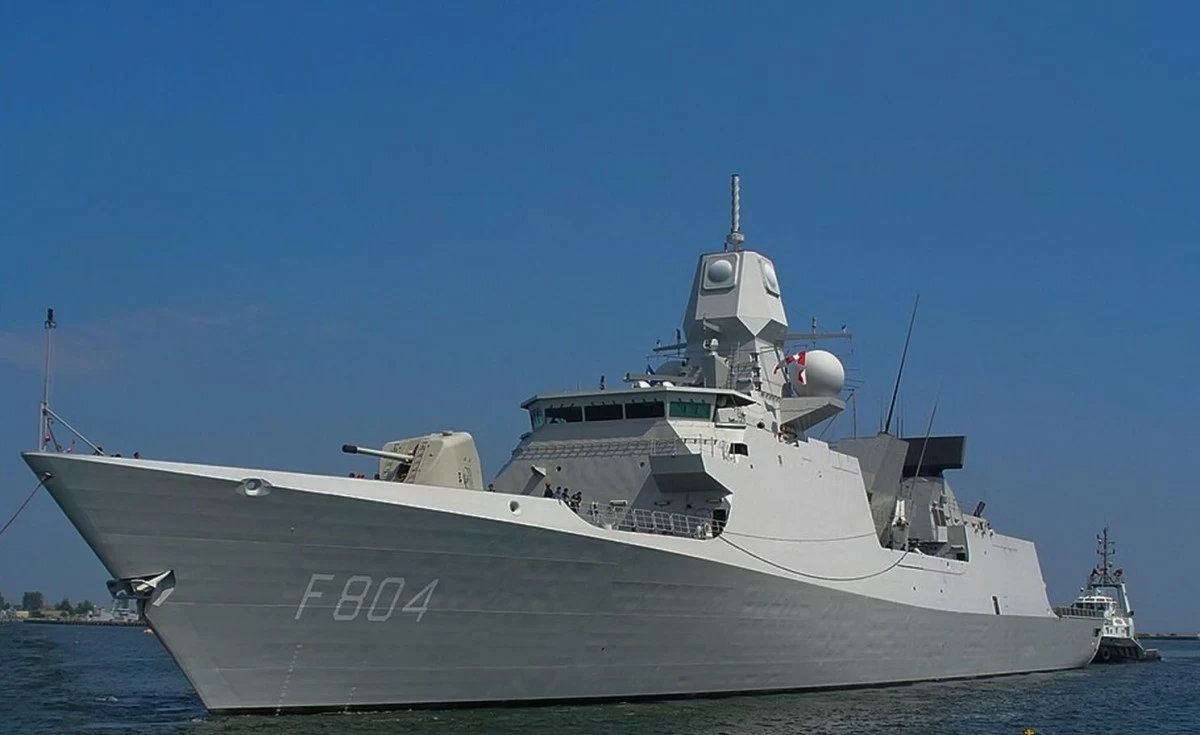
HNLMS De Ruyter (F804) (Courtesy of Philippine Navy)
A Chinese military helicopter closely approached a Dutch naval frigate navigating the West Philippine Sea (WPS), the ship’s commander revealed on Friday, May 22, upon arriving in Manila for a historic three-day goodwill visit.
Commander Rodger de Wit, commanding officer of the Royal Netherlands Navy frigate HNLMS De Ruyter (F804), described the encounter as “brief but highly professional.”
"If you ask our interaction with the Chinese Navy, it was really limited. We were approached by a helicopter, but it was really professional on both sides. They just came to see who we were and left again," he said.
When asked by reporters what the Chinese crew communicated, De Wit said the exchange was routine: "They asked who we were and we replied, and that was enough."
He confirmed that the helicopter approached "only one, just one" time, and that the Chinese forces did not issue any territorial challenges.
The interaction highlighted the highly militarized environment of the South China Sea, where Beijing asserts expansive maritime claims that overlap with the Philippines' exclusive economic zone (EEZ).
HNLMS De Ruyter, a De Zeven Provinciën-class frigate, entered the contested waters through a specific maritime corridor after departing from Surabaya in East Java, Indonesia.
"We’ve passed east of Borneo," De Wit explained, mapping out their journey. "So we went through the Celebes Sea, the Sulu Sea, and then south of Palawan to the Balabac Strait. And that's where we entered the South China Sea. And from there we went up to Manila."
The Dutch warship, which carries its own NH90 multi-role maritime helicopter, is equipped with advanced long-range air defense and command-and-control capabilities designed to protect against modern missile threats.
Its presence in Manila, scheduled from May 22 to 24, includes planned interoperability activities with the Philippine Navy (PN) to strengthen bilateral defense cooperation.
The arrival was welcomed by the PN with a message of support and cooperation, as both countries continue to strengthen maritime ties.
“Welcome to the Philippines, HNLMS De Ruyter!” the Philippine Navy said in a post on Facebook, adding a greeting with Philippine and Dutch flags.
'Pacific Archer' mission
According to the Royal Netherlands Navy, the port call is a cornerstone of "Pacific Archer," a planned five-month Indo-Pacific deployment mission.
Carrying a crew of around 200 personnel, HNLMS De Ruyter is tasked with a geopolitical mandate to promote free passage and keep strategic global waterways safe.
"We're here to promote freedom of navigation," De Wit emphasized, noting that the deployment signifies the Netherlands’ continued commitment to maritime security and deeper ties with Indo-Pacific partners.
The arrival of the De Ruyter marked 75 years of formal diplomatic relations between the Philippines and the Netherlands.
According to De Wit, the port visit sought to boost maritime cooperation, uphold freedom of navigation, and deepen defense ties between the two nations at a time of rising geopolitical friction.

Related Tags

Philippine Navy Royal Netherlands Navy West Philippine Sea Chinese helicopter HNLMS De Ruyter
ADVERTISEMENT
.most-popular .layout-ratio{ padding-bottom: 79.13%; } @media (min-width: 768px) and (max-width: 1024px) { .widget-title { font-size: 15px !important; } }

{{ articles_filter_1561_widget.title }}

.most-popular .layout-ratio{ padding-bottom: 79.13%; } @media (min-width: 768px) and (max-width: 1024px) { .widget-title { font-size: 15px !important; } }

{{ articles_filter_1562_widget.title }}

.most-popular .layout-ratio{ padding-bottom: 79.13%; } @media (min-width: 768px) and (max-width: 1024px) { .widget-title { font-size: 15px !important; } }

{{ articles_filter_1563_widget.title }}

{{ articles_filter_1564_widget.title }}

.mb-article-details { position: relative; } .mb-article-details .article-body-preview, .mb-article-details .article-body-summary{ font-size: 17px; line-height: 30px; font-family: "Libre Caslon Text", serif; color: #000; } .mb-article-details .article-body-preview iframe , .mb-article-details .article-body-summary iframe{ width: 100%; margin: auto; } .read-more-background { background: linear-gradient(180deg, color(display-p3 1.000 1.000 1.000 / 0) 13.75%, color(display-p3 1.000 1.000 1.000 / 0.8) 30.79%, color(display-p3 1.000 1.000 1.000) 72.5%); position: absolute; height: 200px; width: 100%; bottom: 0; display: flex; justify-content: center; align-items: center; padding: 0; } .read-more-background a{ color: #000; } .read-more-btn { padding: 17px 45px; font-family: Inter; font-weight: 700; font-size: 18px; line-height: 16px; text-align: center; vertical-align: middle; border: 1px solid black; background-color: white; } .hidden { display: none; }
function initializeAllSwipers() { // Get all hidden inputs with cms_article_id document.querySelectorAll('[id^="cms_article_id_"]').forEach(function (input) { const cmsArticleId = input.value; const articleSelector = '#article-' + cmsArticleId + ' .body_images'; const swiperElement = document.querySelector(articleSelector); if (swiperElement && !swiperElement.classList.contains('swiper-initialized')) { new Swiper(articleSelector, { loop: true, pagination: false, navigation: { nextEl: '#article-' + cmsArticleId + ' .swiper-button-next', prevEl: '#article-' + cmsArticleId + ' .swiper-button-prev', }, }); } }); } setTimeout(initializeAllSwipers, 3000); const intersectionObserver = new IntersectionObserver( (entries) => { entries.forEach((entry) => { if (entry.isIntersecting) { const newUrl = entry.target.getAttribute("data-url"); if (newUrl) { history.pushState(null, null, newUrl); let article = entry.target; // Extract metadata const author = article.querySelector('.author-section').textContent.replace('By', '').trim(); const section = article.querySelector('.section-info ').textContent.replace(' ', ' '); const title = article.querySelector('.article-title h1').textContent; // Parse URL for Chartbeat path format const parsedUrl = new URL(newUrl, window.location.origin); const cleanUrl = parsedUrl.host + parsedUrl.pathname; // Update Chartbeat configuration if (typeof window._sf_async_config !== 'undefined') { window._sf_async_config.path = cleanUrl; window._sf_async_config.sections = section; window._sf_async_config.authors = author; } // Track virtual page view with Chartbeat if (typeof pSUPERFLY !== 'undefined' && typeof pSUPERFLY.virtualPage === 'function') { try { pSUPERFLY.virtualPage({ path: cleanUrl, title: title, sections: section, authors: author }); } catch (error) { console.error('ping error', error); } } // Optional: Update document title if (title && title !== document.title) { document.title = title; } } } }); }, { threshold: 0.1 } ); function showArticleBody(button) { const article = button.closest("article"); const summary = article.querySelector(".article-body-summary"); const body = article.querySelector(".article-body-preview"); const readMoreSection = article.querySelector(".read-more-background"); // Hide summary and read-more section summary.style.display = "none"; readMoreSection.style.display = "none"; // Show the full article body body.classList.remove("hidden"); } document.addEventListener("DOMContentLoaded", () => { let loadCount = 0; // Track how many times articles are loaded const offset = [1, 2, 3, 4, 5, 6, 7, 8, 9, 10]; // Offset values const currentUrl = window.location.pathname.substring(1); let isLoading = false; // Prevent multiple calls if (!currentUrl) { console.log("Current URL is invalid."); return; } const sentinel = document.getElementById("load-more-sentinel"); if (!sentinel) { console.log("Sentinel element not found."); return; } function isSentinelVisible() { const rect = sentinel.getBoundingClientRect(); return ( rect.top < window.innerHeight && rect.bottom >= 0 ); } function onScroll() { if (isLoading) return; if (isSentinelVisible()) { if (loadCount >= offset.length) { console.log("Maximum load attempts reached."); window.removeEventListener("scroll", onScroll); return; } isLoading = true; const currentOffset = offset[loadCount]; window.loadMoreItems().then(() => { let article = document.querySelector('#widget_1690 > div:nth-last-of-type(2) article'); intersectionObserver.observe(article) loadCount++; }).catch(error => { console.error("Error loading more items:", error); }).finally(() => { isLoading = false; }); } } window.addEventListener("scroll", onScroll); });

Sign up by email to receive news.