

ADVERTISEMENT

Rare Mindanao tarsier rescued in Lanao del Sur

Published May 20, 2026 01:15 pm
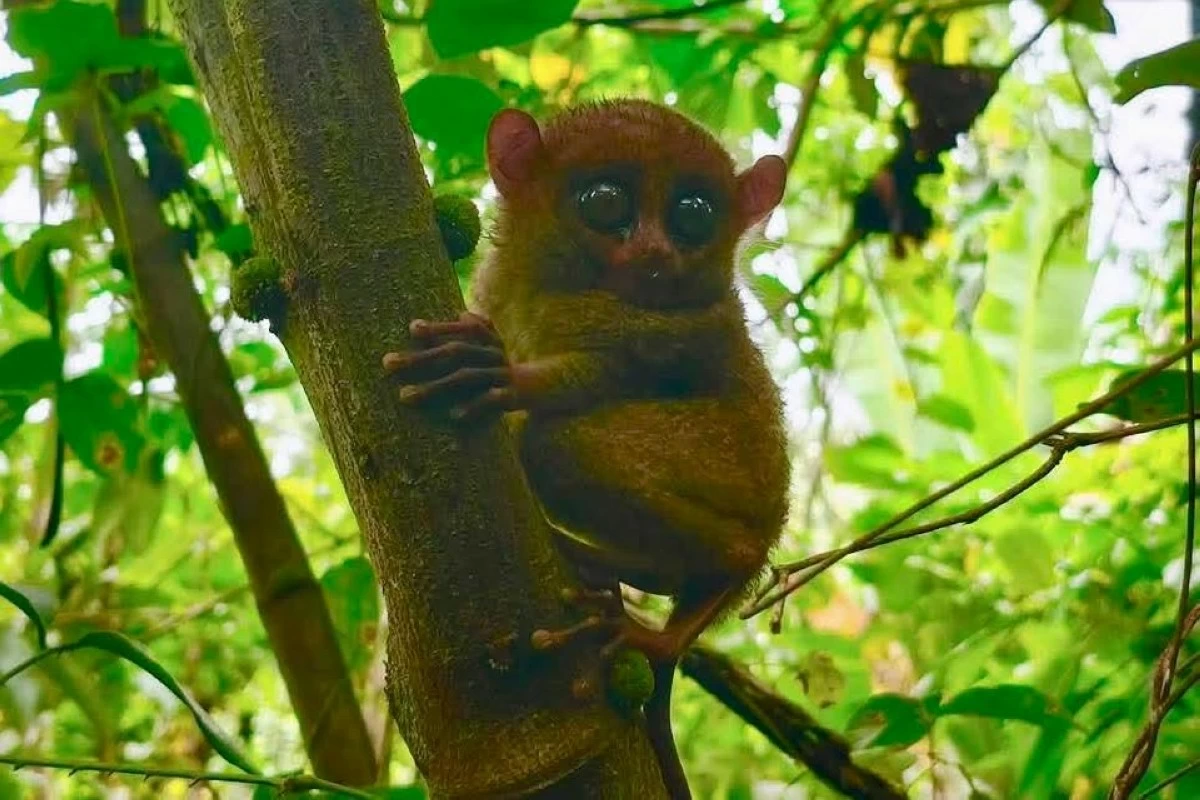
THE rescued tarsier in Lanao del Sur. (Photo via Bonita Ermac)
ILIGAN CITY – A rare juvenile Mindanao tarsier was recently rescued in the Piyapayungan mountain range in Marogong, Lanao del Sur.
Residents of Barangay Diragun discovered the creature near a National Greening Program rehabilitation site and a partially disturbed forest area increasingly threatened by agricultural expansion and human activity.
They immediately turned over the endangered species to Barangay Chairman Imran Benito, who coordinated with the Provincial Environment, Natural Resources, and Energy Office (PENREO) for proper rescue and assessment.
Environmental workers and wildlife specialists said it was a rare and hopeful sign that despite habitat degradation and environmental pressures, fragments of healthy biodiversity still survive within the forests of Lanao del Sur.
A joint assessment conducted by Ecosystems Specialists Chief Forester Ameer Hussein Abbas Jr. and Chief Hindawi Abdulwahab showed that the tarsier was alert and responsive.
The small primate, brown and measuring approximately four inches long with an eight-inch tail, exhibited normal climbing and jumping behavior during evaluation.
The male animal is one of the Philippines’ most elusive and delicate nocturnal primates.
To ensure its survival in the wild, Community Environment, Natural Resources, and Energy Officer Ashawie Pangandaman recommended the tarsier’s immediate release back into its natural habitat.
The rescue team returned the animal to the forested area on May 18 in the Piyapayungan mountain range.
Provincial Environment, Natural Resources, and Energy Officer Asmarie Labao said the rescue symbolizes hope and responsibility.
“The appearance of the tarsier reminds us that our forests remain ecologically significant and must continue to be protected,” Labao said, emphasizing the urgent need to strengthen biodiversity conservation efforts throughout the Bangsamoro region.
Conservation workers said the tarsier could eventually become recognized as the Ranaw tarsier of the Bangsamoro region, a symbol of the province’s hidden biodiversity and enduring natural heritage.
The rescue team named him “Datu a Mangoda sa Kalasan” or “The Charming Prince of the Forest,” a symbolic name representing peace, hope, unity, and the continuing call to safeguard the biodiversity corridors of Lanao del Sur.

Related Tags

Tarsier Endangered species Rescue Marogong Lanao del Sur
ADVERTISEMENT
.most-popular .layout-ratio{ padding-bottom: 79.13%; } @media (min-width: 768px) and (max-width: 1024px) { .widget-title { font-size: 15px !important; } }

{{ articles_filter_1561_widget.title }}

.most-popular .layout-ratio{ padding-bottom: 79.13%; } @media (min-width: 768px) and (max-width: 1024px) { .widget-title { font-size: 15px !important; } }

{{ articles_filter_1562_widget.title }}

.most-popular .layout-ratio{ padding-bottom: 79.13%; } @media (min-width: 768px) and (max-width: 1024px) { .widget-title { font-size: 15px !important; } }

{{ articles_filter_1563_widget.title }}

{{ articles_filter_1564_widget.title }}

.mb-article-details { position: relative; } .mb-article-details .article-body-preview, .mb-article-details .article-body-summary{ font-size: 17px; line-height: 30px; font-family: "Libre Caslon Text", serif; color: #000; } .mb-article-details .article-body-preview iframe , .mb-article-details .article-body-summary iframe{ width: 100%; margin: auto; } .read-more-background { background: linear-gradient(180deg, color(display-p3 1.000 1.000 1.000 / 0) 13.75%, color(display-p3 1.000 1.000 1.000 / 0.8) 30.79%, color(display-p3 1.000 1.000 1.000) 72.5%); position: absolute; height: 200px; width: 100%; bottom: 0; display: flex; justify-content: center; align-items: center; padding: 0; } .read-more-background a{ color: #000; } .read-more-btn { padding: 17px 45px; font-family: Inter; font-weight: 700; font-size: 18px; line-height: 16px; text-align: center; vertical-align: middle; border: 1px solid black; background-color: white; } .hidden { display: none; }
function initializeAllSwipers() { // Get all hidden inputs with cms_article_id document.querySelectorAll('[id^="cms_article_id_"]').forEach(function (input) { const cmsArticleId = input.value; const articleSelector = '#article-' + cmsArticleId + ' .body_images'; const swiperElement = document.querySelector(articleSelector); if (swiperElement && !swiperElement.classList.contains('swiper-initialized')) { new Swiper(articleSelector, { loop: true, pagination: false, navigation: { nextEl: '#article-' + cmsArticleId + ' .swiper-button-next', prevEl: '#article-' + cmsArticleId + ' .swiper-button-prev', }, }); } }); } setTimeout(initializeAllSwipers, 3000); const intersectionObserver = new IntersectionObserver( (entries) => { entries.forEach((entry) => { if (entry.isIntersecting) { const newUrl = entry.target.getAttribute("data-url"); if (newUrl) { history.pushState(null, null, newUrl); let article = entry.target; // Extract metadata const author = article.querySelector('.author-section').textContent.replace('By', '').trim(); const section = article.querySelector('.section-info ').textContent.replace(' ', ' '); const title = article.querySelector('.article-title h1').textContent; // Parse URL for Chartbeat path format const parsedUrl = new URL(newUrl, window.location.origin); const cleanUrl = parsedUrl.host + parsedUrl.pathname; // Update Chartbeat configuration if (typeof window._sf_async_config !== 'undefined') { window._sf_async_config.path = cleanUrl; window._sf_async_config.sections = section; window._sf_async_config.authors = author; } // Track virtual page view with Chartbeat if (typeof pSUPERFLY !== 'undefined' && typeof pSUPERFLY.virtualPage === 'function') { try { pSUPERFLY.virtualPage({ path: cleanUrl, title: title, sections: section, authors: author }); } catch (error) { console.error('ping error', error); } } // Optional: Update document title if (title && title !== document.title) { document.title = title; } } } }); }, { threshold: 0.1 } ); function showArticleBody(button) { const article = button.closest("article"); const summary = article.querySelector(".article-body-summary"); const body = article.querySelector(".article-body-preview"); const readMoreSection = article.querySelector(".read-more-background"); // Hide summary and read-more section summary.style.display = "none"; readMoreSection.style.display = "none"; // Show the full article body body.classList.remove("hidden"); } document.addEventListener("DOMContentLoaded", () => { let loadCount = 0; // Track how many times articles are loaded const offset = [1, 2, 3, 4, 5, 6, 7, 8, 9, 10]; // Offset values const currentUrl = window.location.pathname.substring(1); let isLoading = false; // Prevent multiple calls if (!currentUrl) { console.log("Current URL is invalid."); return; } const sentinel = document.getElementById("load-more-sentinel"); if (!sentinel) { console.log("Sentinel element not found."); return; } function isSentinelVisible() { const rect = sentinel.getBoundingClientRect(); return ( rect.top < window.innerHeight && rect.bottom >= 0 ); } function onScroll() { if (isLoading) return; if (isSentinelVisible()) { if (loadCount >= offset.length) { console.log("Maximum load attempts reached."); window.removeEventListener("scroll", onScroll); return; } isLoading = true; const currentOffset = offset[loadCount]; window.loadMoreItems().then(() => { let article = document.querySelector('#widget_1690 > div:nth-last-of-type(2) article'); intersectionObserver.observe(article) loadCount++; }).catch(error => { console.error("Error loading more items:", error); }).finally(() => { isLoading = false; }); } } window.addEventListener("scroll", onScroll); });

Sign up by email to receive news.