

ADVERTISEMENT

Criminal charges recommended vs Aplasca, OSAA men over Senate gunfire

CIDG says OSAA head may have been fed with wrong info on alleged attack

Published May 20, 2026 02:00 pm

At A Glance

  • The case is for violation of the existing Implementing Rules and Regulations of the Republic Act 11917, or the of Private Security Services Act.
  • The IRR prohibits the use of warning shots.
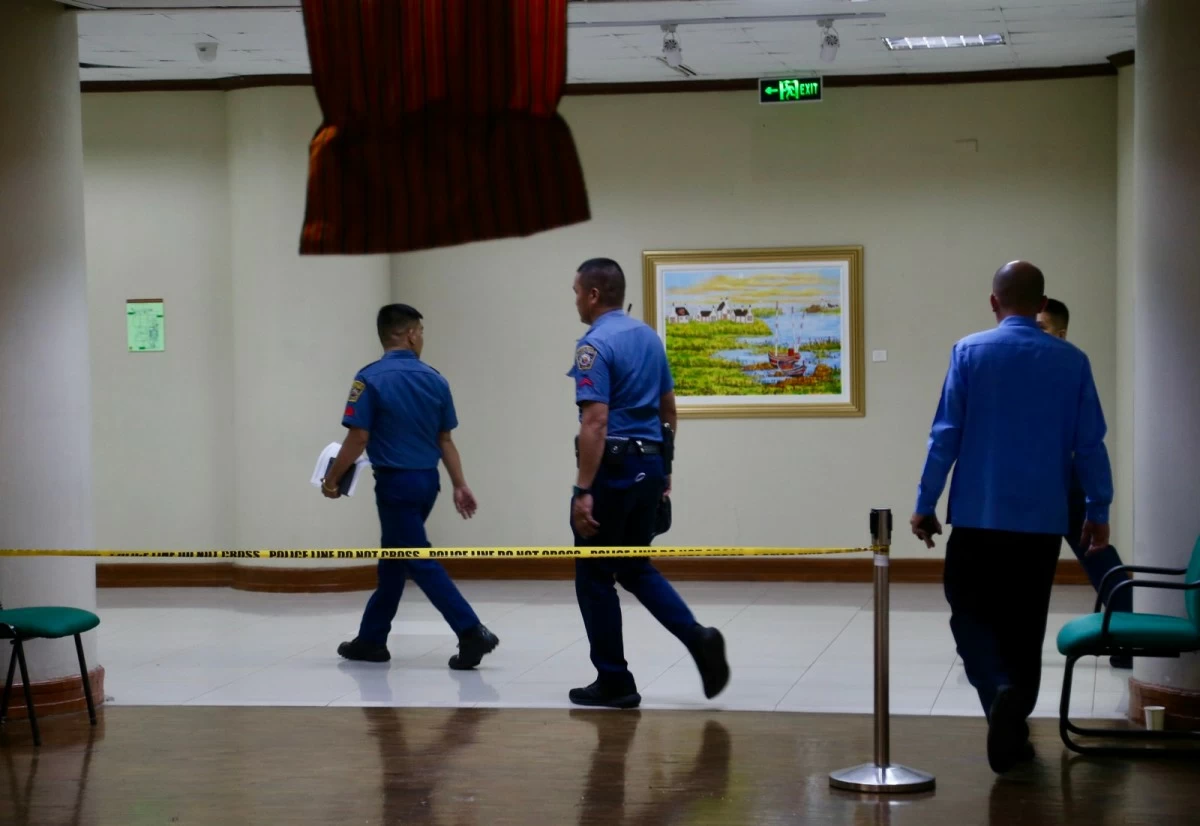
Personnel of the Philippine National Police walk past a police cordon leading to the site of the shooting inside the Senate of the Philippines in Pasay City on May 14, 2026. (Mark Balmores)
If policemen are prohibited from firing warning shots, then it follows that stricter rules and regulations govern non-law enforcement agencies that include the Senate’s Office of Sergeant-At-Arms (OSAA).
So just imagine how screwed up you would be if you, as a civilian or a private security man, once you fire a warning shot directed at legitimate law enforcers—in this case, an agent of the National Bureau of Investigation (NBI)
And for that, the Criminal Investigation and Detection Group (CIDG) has recommended the filing of criminal charges against OSAA head Mao Aplasca and at least two of his men who were found to have pulled their trigger during the controversial Senate gunfire incident on May 13.
CIDG director Maj. Gen. Robert AA Morico II said what Aplasca and his men did is a clear violation of the existing Implementing Rules and Regulations of the Republic Act 11917, or the of Private Security Services Act—which incidentally happened to have been enacted into law in 2022 when ousted Senate president Vicento Sotto III was still the head of the Upper Chamber.
The IRR of the RA 11917 is clear, according to Morico, “There are six stages that need to be observed before the use of lethal force.”
“And it does not include the use of a warning shot,” he stressed.
Besides, Morico said the investigation they conducted revealed that there was not even a threat in the Senate when the incident happened and the succeeding actions of the OSAA clearly goes against the basic rules of common sense in securing an area that was supposed to have been under attack.
“It is very clear in our investigation that there was no attack in the Senate, there was no intent,” said Morico.
“In fact, if there is really a perceived ongoing attack, why did they abandon the area where the shooting happened”,” Morico stressed.
Nabudol?
Aplasca is a police official who retired as a two-star general and who used to head the police’s Directorate for Operations.
And in fairness to him, Morico said his actions may have been triggered by wrong information fed on him.
Morico said they are now conducting an investigation to identify the person or persons who may have misled Aplasca that NBI agents were about to storm the Senate to get his mistah, Sen. Ronald “Bato” Dela Rosa.
“Part of our investigation is to determine who fed general Aplasca the wrong information because in fairness to him, he was very busy at the time of the incident,” said Morico.
That wrong information, according to Morico, could change one's mindset especially on the aspect of hostility of some groups.
And in the case of Aplasca, it led him to order a lock and load on his men and led a sweep on the Senate to confront the threat.
“Who fed him the wrong information that the Senate will be attacked? There must be some administrative sanctions also and it is part of our recommendation because the judgement does not entirely fall on general Aplasca alone,” said Morico.
No show
While Aplasca snubbed the summon sent by the CIDG, Morico said the retired general sent his firearm to the police investigators.
Based on the PNP findings, there were 44 spent cartridges recovered at the Senate and all of them were fired from four different firearms.
All the three alleged shooters already surrendered the fired guns.
A total of 23 cartridges are yet to be subjected to ballistics exams and the PNP wants to establish if those 23 were fired using Aplasca’s gun, a Scorpion CZ 9mm pistol carbine.
The PNP already submitted the result of its probe to the Department of Justice for case build-up.

Related Tags

Senate gunfire CIDG Mao Aplasca OSAA
ADVERTISEMENT
.most-popular .layout-ratio{ padding-bottom: 79.13%; } @media (min-width: 768px) and (max-width: 1024px) { .widget-title { font-size: 15px !important; } }

{{ articles_filter_1561_widget.title }}

.most-popular .layout-ratio{ padding-bottom: 79.13%; } @media (min-width: 768px) and (max-width: 1024px) { .widget-title { font-size: 15px !important; } }

{{ articles_filter_1562_widget.title }}

.most-popular .layout-ratio{ padding-bottom: 79.13%; } @media (min-width: 768px) and (max-width: 1024px) { .widget-title { font-size: 15px !important; } }

{{ articles_filter_1563_widget.title }}

{{ articles_filter_1564_widget.title }}

.mb-article-details { position: relative; } .mb-article-details .article-body-preview, .mb-article-details .article-body-summary{ font-size: 17px; line-height: 30px; font-family: "Libre Caslon Text", serif; color: #000; } .mb-article-details .article-body-preview iframe , .mb-article-details .article-body-summary iframe{ width: 100%; margin: auto; } .read-more-background { background: linear-gradient(180deg, color(display-p3 1.000 1.000 1.000 / 0) 13.75%, color(display-p3 1.000 1.000 1.000 / 0.8) 30.79%, color(display-p3 1.000 1.000 1.000) 72.5%); position: absolute; height: 200px; width: 100%; bottom: 0; display: flex; justify-content: center; align-items: center; padding: 0; } .read-more-background a{ color: #000; } .read-more-btn { padding: 17px 45px; font-family: Inter; font-weight: 700; font-size: 18px; line-height: 16px; text-align: center; vertical-align: middle; border: 1px solid black; background-color: white; } .hidden { display: none; }
function initializeAllSwipers() { // Get all hidden inputs with cms_article_id document.querySelectorAll('[id^="cms_article_id_"]').forEach(function (input) { const cmsArticleId = input.value; const articleSelector = '#article-' + cmsArticleId + ' .body_images'; const swiperElement = document.querySelector(articleSelector); if (swiperElement && !swiperElement.classList.contains('swiper-initialized')) { new Swiper(articleSelector, { loop: true, pagination: false, navigation: { nextEl: '#article-' + cmsArticleId + ' .swiper-button-next', prevEl: '#article-' + cmsArticleId + ' .swiper-button-prev', }, }); } }); } setTimeout(initializeAllSwipers, 3000); const intersectionObserver = new IntersectionObserver( (entries) => { entries.forEach((entry) => { if (entry.isIntersecting) { const newUrl = entry.target.getAttribute("data-url"); if (newUrl) { history.pushState(null, null, newUrl); let article = entry.target; // Extract metadata const author = article.querySelector('.author-section').textContent.replace('By', '').trim(); const section = article.querySelector('.section-info ').textContent.replace(' ', ' '); const title = article.querySelector('.article-title h1').textContent; // Parse URL for Chartbeat path format const parsedUrl = new URL(newUrl, window.location.origin); const cleanUrl = parsedUrl.host + parsedUrl.pathname; // Update Chartbeat configuration if (typeof window._sf_async_config !== 'undefined') { window._sf_async_config.path = cleanUrl; window._sf_async_config.sections = section; window._sf_async_config.authors = author; } // Track virtual page view with Chartbeat if (typeof pSUPERFLY !== 'undefined' && typeof pSUPERFLY.virtualPage === 'function') { try { pSUPERFLY.virtualPage({ path: cleanUrl, title: title, sections: section, authors: author }); } catch (error) { console.error('ping error', error); } } // Optional: Update document title if (title && title !== document.title) { document.title = title; } } } }); }, { threshold: 0.1 } ); function showArticleBody(button) { const article = button.closest("article"); const summary = article.querySelector(".article-body-summary"); const body = article.querySelector(".article-body-preview"); const readMoreSection = article.querySelector(".read-more-background"); // Hide summary and read-more section summary.style.display = "none"; readMoreSection.style.display = "none"; // Show the full article body body.classList.remove("hidden"); } document.addEventListener("DOMContentLoaded", () => { let loadCount = 0; // Track how many times articles are loaded const offset = [1, 2, 3, 4, 5, 6, 7, 8, 9, 10]; // Offset values const currentUrl = window.location.pathname.substring(1); let isLoading = false; // Prevent multiple calls if (!currentUrl) { console.log("Current URL is invalid."); return; } const sentinel = document.getElementById("load-more-sentinel"); if (!sentinel) { console.log("Sentinel element not found."); return; } function isSentinelVisible() { const rect = sentinel.getBoundingClientRect(); return ( rect.top < window.innerHeight && rect.bottom >= 0 ); } function onScroll() { if (isLoading) return; if (isSentinelVisible()) { if (loadCount >= offset.length) { console.log("Maximum load attempts reached."); window.removeEventListener("scroll", onScroll); return; } isLoading = true; const currentOffset = offset[loadCount]; window.loadMoreItems().then(() => { let article = document.querySelector('#widget_1690 > div:nth-last-of-type(2) article'); intersectionObserver.observe(article) loadCount++; }).catch(error => { console.error("Error loading more items:", error); }).finally(() => { isLoading = false; }); } } window.addEventListener("scroll", onScroll); });

Sign up by email to receive news.