







Security ties with Japan top Marcos' agenda during Tokyo trip
Published May 19, 2026 11:46 am
|
Updated May 19, 2026 01:47 pm


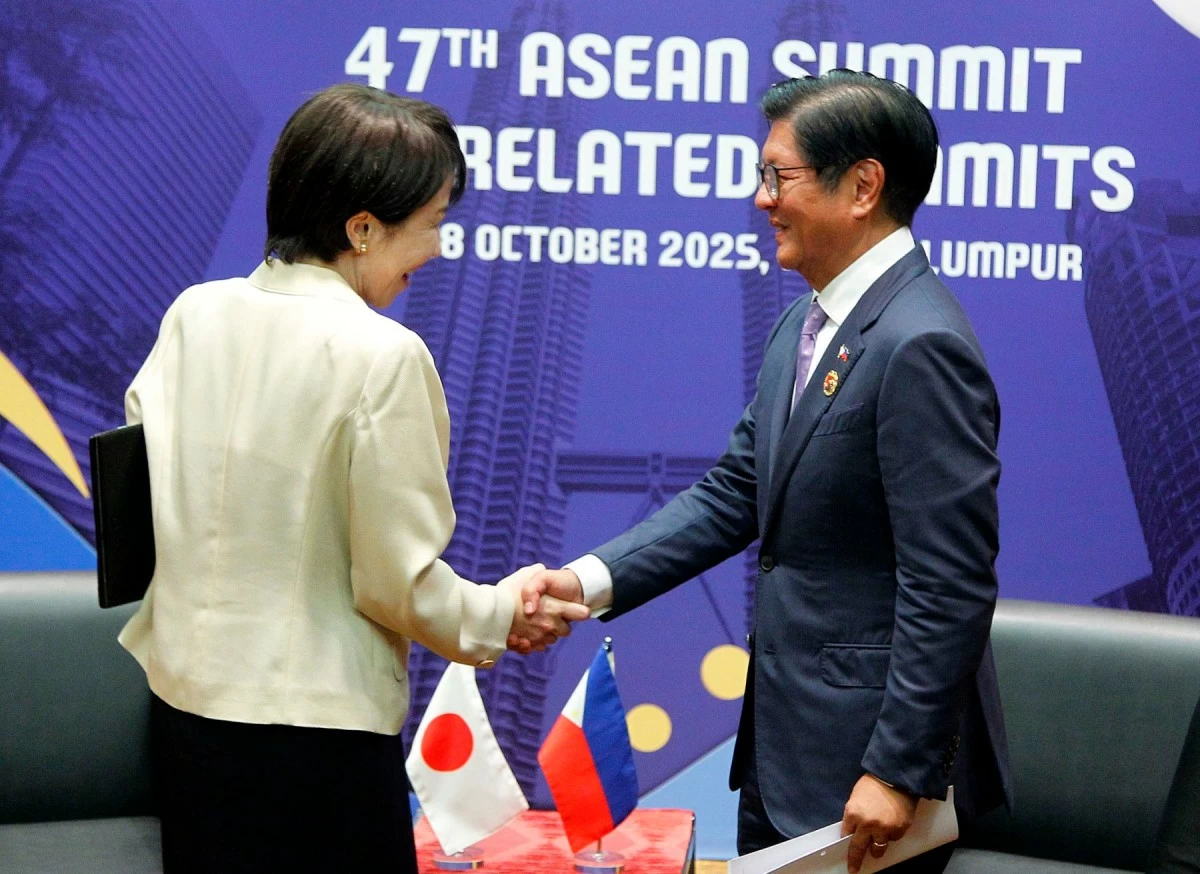
President Ferdinand R. Marcos Jr. and Japan Prime Minister Sanae Takaichi hold a bilateral meeting on the sidelines of the 47th ASEAN Summit and Related Meetings in Kuala Lumpur, Malaysia on Oct. 26, 2025. (Mark Balmores/MANILA BULLETIN)
Security cooperation with Japan is expected to be a key agenda during President Marcos' meeting with Japanese Prime Minister Sanae Takaichi next week.
"I expect that we will be talking about many things, but of course, security cooperation will be a very important part of that discussion,” Marcos said in a roundtable with Japanese media in Malacañang on Monday, May 18.
Marcos will undertake a state visit to Japan from May 26 to 29.
"First of all, what we have agreed upon is the reciprocal access agreement, for example, and the acquisition and cross-servicing agreement that was signed last January. We want, I’m sure, we are going to discuss those to fully implement those agreements," Marcos added.
The President further said that Japan’s new approach to security and defense, especially in the region, will also be discussed to clarify further cooperation and assistance.
He noted that Japan taking an active role in the Balikatan exercises for the first time this year is a significant development in the ongoing cooperation and personnel training for better interoperability.
Marcos also expects to discuss the assistance Manila is receiving from Tokyo for the modernization of the Armed Forces of the Philippines (AFP), as well as Tokyo's official security assistance to the Philippines, including radar and support systems, information and technology sharing, and personnel training.
The Chief Executive pointed out that many areas require exploration in line with the two nations’ shared values regarding adherence to international law, especially UNCLOS.
Energy supply concerns
Aside from security cooperation, Marcos will also prioritize energy supply concerns amid the Middle East conflict during his state visit.
"We will again try to engage Japan and to see how it will work together with Japan, as Japan has now taken a more active role when it comes to the subject of energy and the energy supply," Marcos said.
"We are actually very grateful to Japan because Japan has been of great assistance to us in trying to find different solutions for the supply of the different kinds of fuel. And that has become a critical part of our policy," the President added.
Marcos particularly mentioned Japan’s role in energy security after the 48th ASEAN Summit in Cebu, which addressed measures to secure the region’s electricity and fuel supplies, including establishing oil reserves and a common grid for ASEAN member countries.
Marcos said Japan has offered a response mechanism to provide up to $10 billion in assistance through the Partnership on Wide Energy and Resources Resilience (POWERR Asia), which the Japanese Prime Minister launched last April.
It aims to help Asian nations secure crude oil, diversify critical minerals, and build sustainable, zero-emission supply chains to protect economies from Middle East-related supply shocks.
"And we will again try to get more clarity on what the POWERR Asia system that has been proposed by Prime Minister Takaichi. What does it mean in terms of linkages between our different countries, between the Philippines and Japan, and between all of the countries in the region?" Marcos said.
"So it is extensively used for supply procurement, for supply chain maintenance, and for crude oil stockpiling capacity augmentation in Asia," Marcos added.