






Manila Bulletin
 Philippines
National
Dela Rosa to SC: 'I do not claim exemption from legal accountability'
Philippines
National
Dela Rosa to SC: 'I do not claim exemption from legal accountability'
Philippines
National
Dela Rosa to SC: 'I do not claim exemption from legal accountability'
Dela Rosa to SC: 'I do not claim exemption from legal accountability'
Published May 19, 2026 01:45 pm


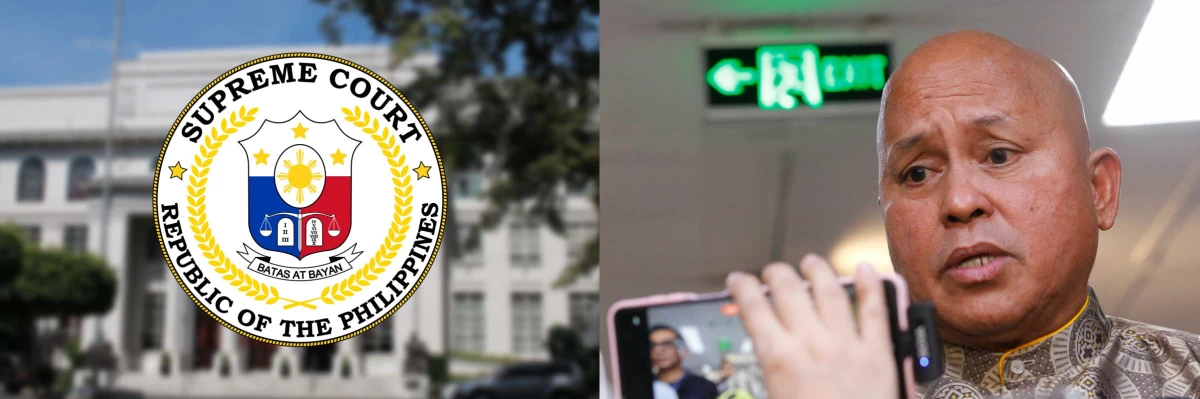
Senator Ronald “Bato” dela Rosa told the Supreme Court (SC) that his plea to stop the enforcement of the arrest warrant issued by the International Criminal Court (ICC) does not mean that he claims exemption from legal accountability.
“Any accountability, should there be any, must be grounded in law, including when the government is the party seeking,” Dela Rosa said in his reply to the comment filed by government lawyers.
At the same time, he said he does not ask the SC to acquit him.
He stressed that “before any Filipino citizen is seized on Philippine soil pursuant to a foreign or international process, that process must first be made enforceable under Philippine law and subjected to prior Philippine judicial determination” as required by Article III, Section 2 of the Constitution.
He pointed out: “No foreign tribunal, no executive department, and no international body is the final and authoritative voice on what Philippine law requires within Philippine territory.”
In his reply filed last Monday, May 18, Dela Rosa pleaded the SC to issue a temporary restraining order (TRO) to stop immediately the enforcement of the ICC’s arrest warrant.
He said his plea was based on the SC’s “express reservation” in its May 13 resolution that it may take “any interim or urgent measures as prayed for by Senator Dela Rosa, should it become necessary."
He also asked the SC to stop the respondents in the case, particularly the Department of Justice (DOJ), the Department of the Interior and Local Government (DILG) and law enforcement agencies “from arresting, detaining, restraining, transferring, surrendering, rendering, or otherwise removing Petitioner (Dela Rosa) from Philippine territory on the basis of any ICC warrant, Interpol (International Criminal Police Organization) Red Notice or Diffusion, PCTC (Philippine Center for International Crime) communication, foreign or international request, executive directive, or analogous process, absent a valid warrant issued by a competent Philippine court upon its own independent determination of probable cause.”
Last May 16, the respondents in the petition through the Office of the Solicitor General (SC) asked the SC to deny Dela Rosa’s plea for a TRO.
The OSG, in effect, asked the SC to direct law enforcement agencies to enforce the ICC arrest warrant against Dela Rosa.
With the filing of the comment and the reply, it was not known immediately as of posting time if the SC will hold a special full court session anytime until Friday, May 22, this week to tackle and resolve the issue.
The SC is on its month-long decision-writing period until May 31. However, Chief Justice Alexander G. Gesmundo can call for a special full court session to tackle important cases like what he did last May 13 on Dela Rosa’s motion.
In his reply filed through his lawyers led by Israelito P. Torreon, Dela Rosa cited the government’s alleged inconsistencies on the issue involving the ICC and the tribunal’s arrest order.
He pointed out that no less than President Marcos had declared that the government would not assist the ICC “in any way, shape or form,” and would “not lift a finger” to help any ICC investigation.
He also cited the statement issued by Palace Press Officer Claire Castro that the government is not cooperating with the ICC since the Philippines has withdrawn as a member state as she quoted DILG Secretary Jovic Remulla.
He also mentioned statements issued by other executive officials that a warrant cannot be enforced in the country unless it is coursed through the Interpol.
Despite all the statements, he said DOJ Acting Secretary Fredderick Vida confirmed the existence of a valid arrest warrant and said the government “will definitely submit to the request of the ICC.”
Also, Vida declared that Dela Rosa will be arrested if he attempts to leave the Philippines.
At the same time, Dela Rosa told the SC of the attempt of the National Bureau of Investigation (NBI) last May 11 to serve the ICC arrest warrant inside the Senate premises in Pasay City.
He reminded the SC of the Philippines’ withdrawal from the Rome Statute on March 17, 2019. The Rome Statute created the ICC and the Philippines was a member prior to 2019.
Dela Rosa said: “The ICC Prosecutor sought authorization to investigate only on 24 May 2021; the Pre-Trial Chamber authorized the investigation only on 15 September 2021; and the warrant against Petitioner was issued only on 6 November 2025. Thus, the ICC process respondents seek to enforce arose only after withdrawal had become complete. Respondents must therefore identify a present domestic legal source of authority. They identify none.”
The OSG had tagged Dela Rosa as a fugitive from justice based on his “consistent pattern of hiding” to evade the ICC arrest warrant.
It said the in November 2025, Dela Rosa went into hiding when news of the warrant first circulated and resurfaced only on May 11 to vote in the Senate that led to the installation of Senator Alan Peter Cayetano as Senate president. He was then placed under the Senate’s protective custody.
It also cited Dela Rosa’s departure from the Senate while the building was under lockdown and high security.
“His flight, coupled with the fact that he had previously gone into hiding, is not merely incidental but is also a deliberate act to avoid accountability,” the OSG stressed.
In November 2025, the SC ruled that fugitives from justice are persons who evade criminal prosecution before the courts and those who flee after conviction to avoid the punishment imposed on them.
The SC stressed that fugitives from justice are barred from seeking judicial relief unless they voluntarily surrender.
Dela Rosa said that to prematurely brand him as a “fugitive” before the threshold jurisdictional question is resolved would effectively prejudge the very controversy submitted for adjudication.
“The doctrine cannot be invoked to defeat a litigant’s right to question the legality of the process he assails, otherwise judicial review itself becomes meaningless,” he said.
He explained that his acts are fundamentally inconsistent with true fugitive behavior.
He said: “Petitioner did not secretly leave the country, assume a false identity, permanently conceal himself, or sever communication with legal institutions. On the contrary, the records cited by the Respondents themselves show that Petitioner continued to participate in public affairs, invoked judicial remedies, and acted in a manner allegedly intended to prevent further institutional tension within the Senate.”
At the same time, he said he did not escape. “Hence, Respondents' attempt to stretch these circumstances into “fugitive” conduct is unsupported by both law and fact.