






Manila Bulletin
 Business
Trade & Industry
Smugglers overtake Philippine vape industry with 84% illicit market share
Business
Trade & Industry
Smugglers overtake Philippine vape industry with 84% illicit market share
Business
Trade & Industry
Smugglers overtake Philippine vape industry with 84% illicit market share
Smugglers overtake Philippine vape industry with 84% illicit market share
E-vape tax leakages lead ASEAN
By Derco Rosal
Published May 18, 2026 04:00 pm


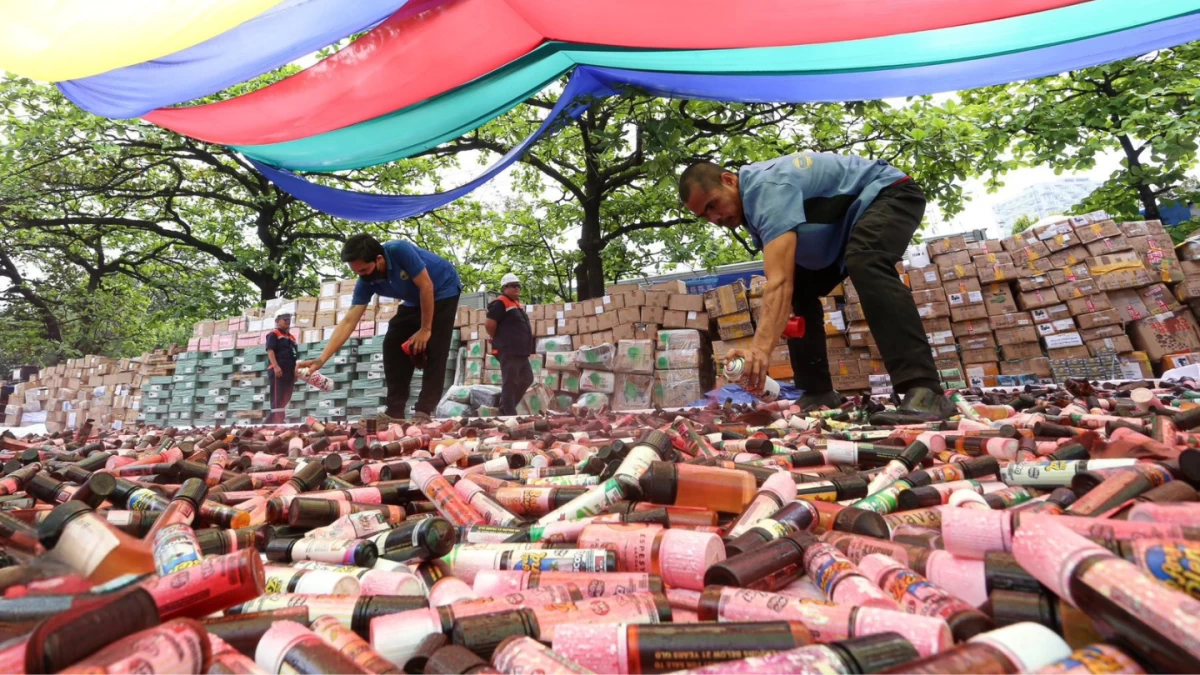
(Photo by Santi San Juan | Manila Bulletin)
The Philippine government lost more than ₱80 billion in tax revenues in 2025 due to illicit tobacco and e-vapor activities, making the country the primary source of illegal vape leakages in Southeast Asia.
This fiscal drain is a key finding of the latest study by the European Union-Association of Southeast Asian Nations (ASEAN) Business Council (EU-ABC) and Euromonitor International, covering 2024 and 2025, which describes the Philippines as a high-stakes battleground for both illicit cigarettes and e-vapor products.
While the entire ASEAN-6 region is struggling with systemic leakages, the Philippines’ e-vapor market has become particularly compromised.
According to the report, the Philippines led the region in illicit incidence at 84.5 percent, or four in five e-vapes in the market, overtaking Malaysia’s 66.2 percent and Indonesia’s 54.8 percent. Estimates showed this will climb further to 85.6 percent in 2025.
These losses pose serious consequences for the country’s fiscal space. In 2025 alone, the government was seen losing $1.1 billion (around ₱68 billion) to illicit cigarettes and an additional $212.1 million (around ₱13 billion) to illegal e-vapes.
Tax collections lost to cigarette smugglers in a single year could have funded the nation’s entire disaster preparedness budget nearly three times over, the EU-ABC said. Recall that the government allocated ₱20 billion in calamity funds in 2025.
A mix of aggressive tax increases and a widening affordability gap has been driving this surge in illicit activity. Legal cigarette prices in the Philippines rose from ₱63.00 per pack in 2024 to an estimated ₱66.15 in 2025, a shift the report attributed to the “impact of a rise in excise tax rates.”
This year, the government has implemented a fresh round of excise tax hikes on cigarettes, vapes, and alcoholic drinks. These changes are part of a multi-year effort to boost state revenues and curb consumption of health-impacting commodities.
As such, a pack of 20 cigarettes is taxed at ₱69.46, up from ₱66.15. Heated tobacco products (HTPs) saw rates rise to ₱37.63 per pack from ₱35.84, while nicotine salt and conventional freebase or classic nicotine vapor products increased to ₱60.20 per milliliter from ₱57.33.
Tax hikes have placed a heavy burden on Filipino consumers, who already face the highest affordability challenges in the region.
Smokers in the Philippines spent a larger share of their disposable income on cigarettes, posting a 13.4 percent relative income price (RIP) rate in 2024. This was followed by Indonesia at 8.8 percent and Thailand at 6.6 percent.
Given the rising unaffordability of legal tobacco products, price-sensitive smokers are often drawn to cheaper, unregulated alternatives.
‘Elevated risk’
Firdaus Muhamad, EU-ABC head of consulting for Asia and the Pacific (APAC), told a May 18 press briefing that the Philippines stands out among the “most exposed markets,” noting that the country is a “priority containment market for e-vapors and an elevated risk market for cigarettes.”
This was attributed to the large volume of illicit sales, which reached an estimated 18.7 billion sticks in 2024, as well as widespread tax evasion.
According to the organization, the country’s complex tax structure remains a major vulnerability, with the gap in tax rates between tobacco products likely resulting in underdeclaration and additional revenue leakages.
To combat this threat, the government is moving toward significant policy reform, announcing early this year its support for and exploration of a unified e-vapor tax system instead of a two-tiered tax system to mitigate some fiscal losses.
Illicit tobacco activities, according to the report, are also directly linked to organized crime and regional instability.
“Armed groups in Malaysia and the Philippines are observed to be involved in cigarette smuggling, which is viewed as a ‘low-risk’ crime. Revenues from the illicit cigarette trade are observed to fund these groups, which are engaged in other crimes, including abductions,” it said.
Of a range of factors, EU-ABC Executive Director Chris Humphrey pointed to the archipelagic composition of the Philippines, which makes border monitoring and enforcement challenging, consequently making it “susceptible to the inflow of illicit cigarettes.”

EU-ABC Executive Director Chris Humphrey
Humphrey noted that it becomes difficult for an archipelagic nation to track “every small speedboat that's coming in with several hundred cartons of cigarettes on board.”
While some measures could be done, Humphrey particularly opposed banning e-vapes in the domestic market, noting users would still look for the product anyway. “Prohibition has never worked in any product category. If you completely ban a product, as humans, we will still go and seek that product,” he said.
Meanwhile, on tax measures, Humphrey affirmed the government’s multi-year tax hike approach, saying these should also be predictable. “So if you’re thinking about increasing taxes over the next few years, announce it today and implement gradual, steady tax increases,” he said.
With total illicit incidence for all tobacco products in the region expected to reach 27.8 percent by 2028, the Philippines remains classified as an “elevated risk” market that requires urgent, coordinated intervention to protect both public health and the national budget.