

ADVERTISEMENT

PH Red Cross expands water tanker fleet, boosts disaster response capability with private sector donation

Published May 18, 2026 11:33 am

At A Glance

  • The Philippine Red Cross received a new 8,000-liter water tanker from ACMobility and Isuzu Philippines Corporation to strengthen its disaster response operations.
  • The tanker, a 2025 Isuzu FVR Medium Duty Truck, was turned over at the PRC National Headquarters in Mandaluyong City.
  • With the addition, the PRC's emergency water delivery fleet has grown to 31 units, 15 of which are Isuzu vehicles.
  • PRC Chairman and CEO Richard J. Gordon said the tanker will help deliver clean water faster to communities affected by disasters such as typhoons, floods, fires, and droughts.
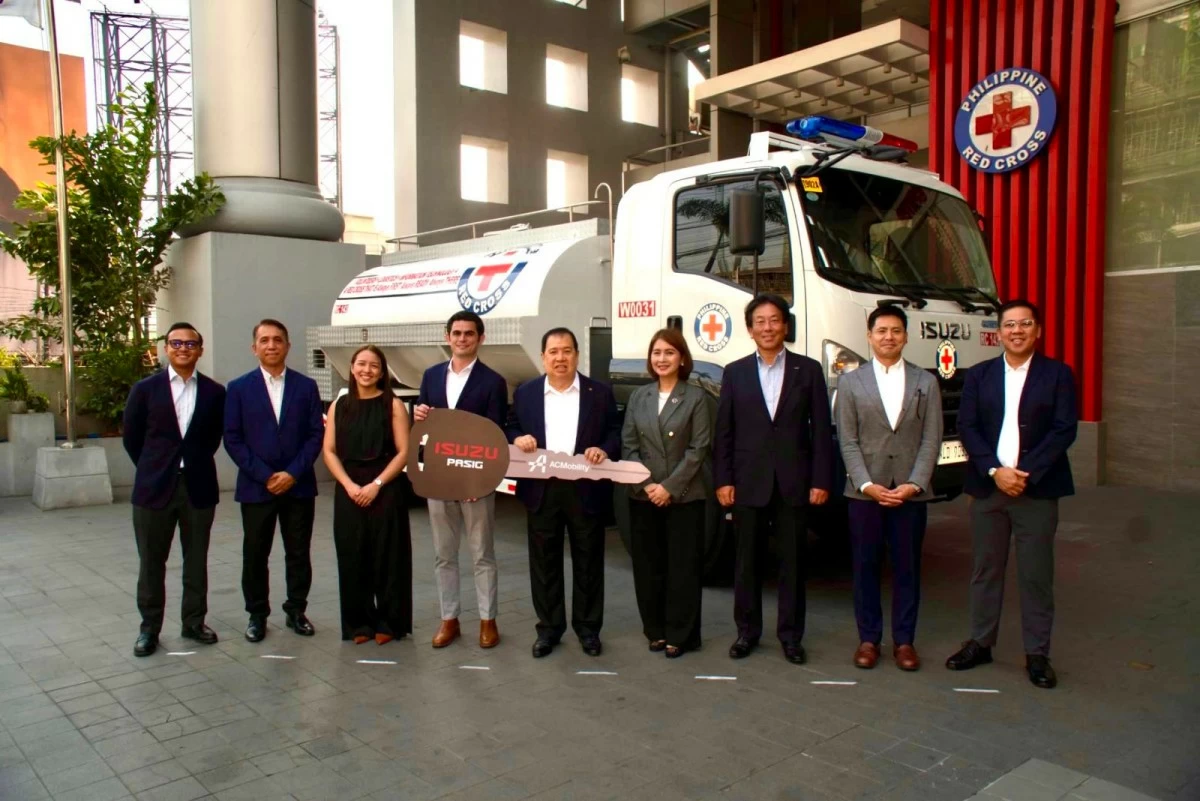
(Photo: Philippine Red Cross)
The Philippine Red Cross (PRC) said Monday, May 18, that it has received a new water tanker from the private sector, further expanding its emergency water delivery fleet to 31 units and strengthening its disaster response operations nationwide.
The new tanker was turned over at the PRC National Headquarters in Mandaluyong City by ACMobility, the mobility solutions arm of the Ayala Group of Companies, along with its automotive partner Isuzu Philippines Corporation.
The water tanker is a 2025 Isuzu FVR Medium Duty Truck equipped with an 8,000-liter water tank, cab air-conditioning unit, emergency lightbar, public address system, and siren.
PRC Chairman and CEO Richard J. Gordon said the additional tanker would help the organization respond faster during emergencies when access to clean water becomes limited.
“The need for clean water becomes immediate after disasters strike. Every additional tanker strengthens our ability to respond faster, reach more communities in need, and to always be first, always ready, and always there,” Gordon said in a statement.
The PRC has expanded its water delivery operations in recent years as typhoons, fires, droughts, and flooding continue to affect vulnerable communities nationwide.
The organization regularly deploys water tankers during calamities to supply evacuation centers and isolated villages where water systems have been damaged.
Meanwhile, ACMobility CEO Jaime Alfonso Antonio Zobel de Ayala said the partnership reflected a shared commitment between the private sector and humanitarian groups.
“We see this not just as a turnover, but as a reflection of how two institutions can come together to help address real problems faced by communities,” he said, adding that ACMobility is proud to support the PRC’s humanitarian response efforts.

(Photo: Philippine Red Cross)
The latest donation also highlighted the continuing partnership between the PRC and Isuzu Philippines, which has supplied several vehicles for relief operations over the years.
According to the PRC, nearly half of the total fleet – 15 water tankers – are now Isuzu units deployed for humanitarian operations across the country.
Isuzu Philippines Corporation President Mikio Tsukui said the company’s role went beyond providing transport vehicles.
“Through the donated water tanker, the Philippine Red Cross will be better equipped to deliver safe and accessible water to communities affected by disasters and emergencies, reinforcing the importance of partnerships between the private sector and humanitarian organizations,” Tsukui said.
PRC Secretary General Gwendolyn T. Pang also said the additional unit would strengthen water distribution operations during disasters.
“This new tanker increases our capacity to deliver safe water quickly and efficiently during emergencies,” Pang said. “We are deeply grateful to ACMobility and Isuzu Philippines Corporation for helping us serve vulnerable communities across the country.”
The PRC said it continues to invest in equipment and partnerships to strengthen disaster response capabilities as climate-related emergencies and large-scale disasters place increasing pressure on humanitarian services nationwide.

Related Tags

Philippine Red Cross ACMobility Isuzu Philippines water tanker private sector disaster response
ADVERTISEMENT
.most-popular .layout-ratio{ padding-bottom: 79.13%; } @media (min-width: 768px) and (max-width: 1024px) { .widget-title { font-size: 15px !important; } }

{{ articles_filter_1561_widget.title }}

.most-popular .layout-ratio{ padding-bottom: 79.13%; } @media (min-width: 768px) and (max-width: 1024px) { .widget-title { font-size: 15px !important; } }

{{ articles_filter_1562_widget.title }}

.most-popular .layout-ratio{ padding-bottom: 79.13%; } @media (min-width: 768px) and (max-width: 1024px) { .widget-title { font-size: 15px !important; } }

{{ articles_filter_1563_widget.title }}

{{ articles_filter_1564_widget.title }}

.mb-article-details { position: relative; } .mb-article-details .article-body-preview, .mb-article-details .article-body-summary{ font-size: 17px; line-height: 30px; font-family: "Libre Caslon Text", serif; color: #000; } .mb-article-details .article-body-preview iframe , .mb-article-details .article-body-summary iframe{ width: 100%; margin: auto; } .read-more-background { background: linear-gradient(180deg, color(display-p3 1.000 1.000 1.000 / 0) 13.75%, color(display-p3 1.000 1.000 1.000 / 0.8) 30.79%, color(display-p3 1.000 1.000 1.000) 72.5%); position: absolute; height: 200px; width: 100%; bottom: 0; display: flex; justify-content: center; align-items: center; padding: 0; } .read-more-background a{ color: #000; } .read-more-btn { padding: 17px 45px; font-family: Inter; font-weight: 700; font-size: 18px; line-height: 16px; text-align: center; vertical-align: middle; border: 1px solid black; background-color: white; } .hidden { display: none; }
function initializeAllSwipers() { // Get all hidden inputs with cms_article_id document.querySelectorAll('[id^="cms_article_id_"]').forEach(function (input) { const cmsArticleId = input.value; const articleSelector = '#article-' + cmsArticleId + ' .body_images'; const swiperElement = document.querySelector(articleSelector); if (swiperElement && !swiperElement.classList.contains('swiper-initialized')) { new Swiper(articleSelector, { loop: true, pagination: false, navigation: { nextEl: '#article-' + cmsArticleId + ' .swiper-button-next', prevEl: '#article-' + cmsArticleId + ' .swiper-button-prev', }, }); } }); } setTimeout(initializeAllSwipers, 3000); const intersectionObserver = new IntersectionObserver( (entries) => { entries.forEach((entry) => { if (entry.isIntersecting) { const newUrl = entry.target.getAttribute("data-url"); if (newUrl) { history.pushState(null, null, newUrl); let article = entry.target; // Extract metadata const author = article.querySelector('.author-section').textContent.replace('By', '').trim(); const section = article.querySelector('.section-info ').textContent.replace(' ', ' '); const title = article.querySelector('.article-title h1').textContent; // Parse URL for Chartbeat path format const parsedUrl = new URL(newUrl, window.location.origin); const cleanUrl = parsedUrl.host + parsedUrl.pathname; // Update Chartbeat configuration if (typeof window._sf_async_config !== 'undefined') { window._sf_async_config.path = cleanUrl; window._sf_async_config.sections = section; window._sf_async_config.authors = author; } // Track virtual page view with Chartbeat if (typeof pSUPERFLY !== 'undefined' && typeof pSUPERFLY.virtualPage === 'function') { try { pSUPERFLY.virtualPage({ path: cleanUrl, title: title, sections: section, authors: author }); } catch (error) { console.error('ping error', error); } } // Optional: Update document title if (title && title !== document.title) { document.title = title; } } } }); }, { threshold: 0.1 } ); function showArticleBody(button) { const article = button.closest("article"); const summary = article.querySelector(".article-body-summary"); const body = article.querySelector(".article-body-preview"); const readMoreSection = article.querySelector(".read-more-background"); // Hide summary and read-more section summary.style.display = "none"; readMoreSection.style.display = "none"; // Show the full article body body.classList.remove("hidden"); } document.addEventListener("DOMContentLoaded", () => { let loadCount = 0; // Track how many times articles are loaded const offset = [1, 2, 3, 4, 5, 6, 7, 8, 9, 10]; // Offset values const currentUrl = window.location.pathname.substring(1); let isLoading = false; // Prevent multiple calls if (!currentUrl) { console.log("Current URL is invalid."); return; } const sentinel = document.getElementById("load-more-sentinel"); if (!sentinel) { console.log("Sentinel element not found."); return; } function isSentinelVisible() { const rect = sentinel.getBoundingClientRect(); return ( rect.top < window.innerHeight && rect.bottom >= 0 ); } function onScroll() { if (isLoading) return; if (isSentinelVisible()) { if (loadCount >= offset.length) { console.log("Maximum load attempts reached."); window.removeEventListener("scroll", onScroll); return; } isLoading = true; const currentOffset = offset[loadCount]; window.loadMoreItems().then(() => { let article = document.querySelector('#widget_1690 > div:nth-last-of-type(2) article'); intersectionObserver.observe(article) loadCount++; }).catch(error => { console.error("Error loading more items:", error); }).finally(() => { isLoading = false; }); } } window.addEventListener("scroll", onScroll); });

Sign up by email to receive news.