

ADVERTISEMENT

In Metro Manila, every accent carries a story

Published May 18, 2026 02:42 pm

In a city where people arrive with suitcases, memories, recipes, songs, and dreams, language often becomes one of the last pieces of home they carry with them.

Metro Manila, long known as a place where cultures meet, is now home to at least 217 local and international languages, according to the blog article “Metro Manila’s Linguistic Paradox: A Melting Pot on the Brink” by Anna Mae Lamentillo published at London School of Economics.
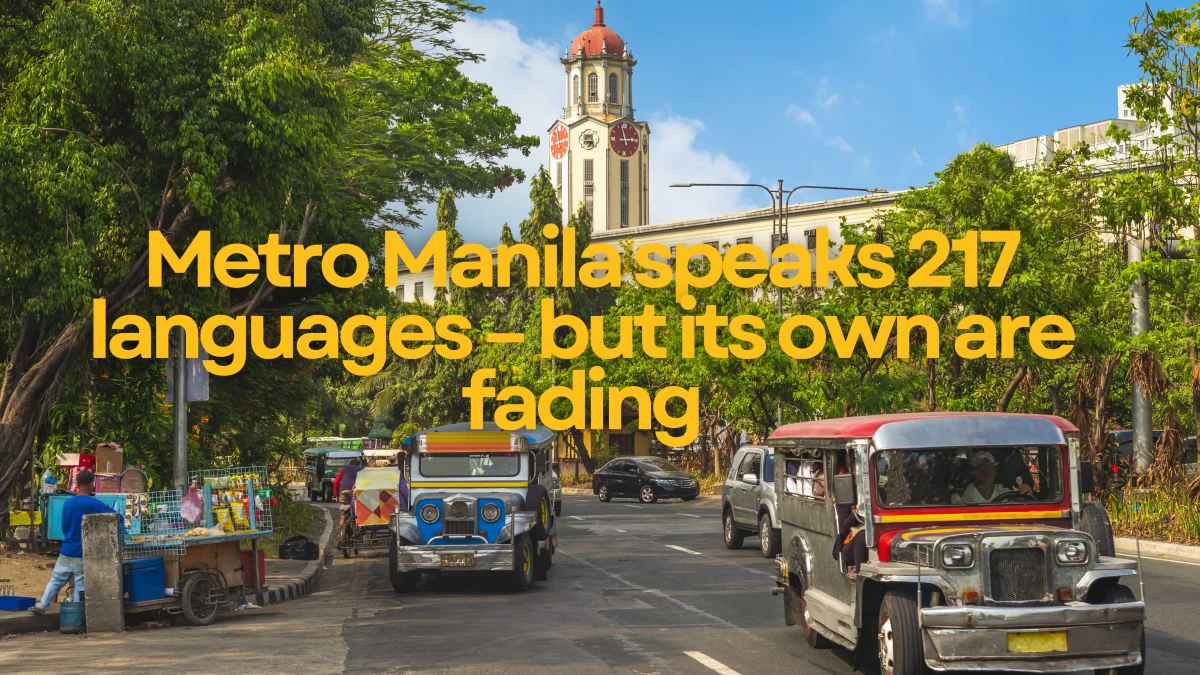
From market stalls and school corridors to family dining tables and social media chats, the capital region hums with many voices. Kapampangan, Pangasinan, Chavacano, Hokkien, Taglish, and other languages mix naturally in daily life. The blog also notes the presence of newer language communities, including Nepali speakers in Mandaluyong and Kyrgyz traders in Pasay.

But beneath this colorful soundscape is a quieter reality: many indigenous and regional languages are slowly disappearing.

For families who move to Metro Manila from the provinces, adapting to city life often means learning to speak the languages of work, school, and public life. Filipino, English, and Taglish become practical tools for belonging and getting ahead. Over time, the language once spoken at home may be used less often, especially by younger generations.

A grandmother may still speak in Kinaray-a, Cebuano, Hiligaynon, or Bikol, while her grandchildren respond in Taglish. A family story once told in a mother tongue may be retold in Filipino. A child may recognize the sound of an ancestral language but hesitate to speak it.

Lamentillo’s article reminds readers that language is more than communication. It carries lullabies, jokes, prayers, rituals, family histories, and ways of understanding nature and community. When a language fades, a part of everyday culture fades with it.

The article also points to social pressure as one reason people move away from their mother tongues. In the city, regional accents are sometimes teased or dismissed as “provincial.” For many, changing the way they speak becomes a way to avoid embarrassment or fit in. But in doing so, they may also lose the natural rhythm and identity tied to their roots.

Schools and public institutions also shape this shift. Many children who grow up speaking regional languages at home are taught mainly in Filipino or English. This can make local languages feel less important, as though they belong only to private conversations rather than classrooms, offices, media, or public spaces.

Despite the concern, the blog presents language preservation as something that can begin in familiar, everyday places. Families can bring back old words during meals. Communities can organize storytelling circles, language cafés, cultural nights, and workshops. Schools can support bilingual learning. Young people can use podcasts, short videos, mobile apps, and social media to make heritage languages feel alive and relevant again.

Metro Manila, with its mix of communities, may be one of the best places to begin. Its diversity makes it possible for languages to meet, evolve, and be celebrated. Instead of treating regional and indigenous languages as relics of the past, the city can help present them as living expressions of identity.

In “Metro Manila’s Linguistic Paradox: A Melting Pot on the Brink,” Lamentillo shows that the capital’s many languages are not just numbers in an audit. They are memories, relationships, and histories carried by people who have made the city their home.

And in a metropolis constantly changing, keeping those languages alive may begin with a simple choice: to speak, teach, and celebrate the words that first taught people who they are.

ADVERTISEMENT
.most-popular .layout-ratio{ padding-bottom: 79.13%; } @media (min-width: 768px) and (max-width: 1024px) { .widget-title { font-size: 15px !important; } }

{{ articles_filter_1561_widget.title }}

.most-popular .layout-ratio{ padding-bottom: 79.13%; } @media (min-width: 768px) and (max-width: 1024px) { .widget-title { font-size: 15px !important; } }

{{ articles_filter_1562_widget.title }}

.most-popular .layout-ratio{ padding-bottom: 79.13%; } @media (min-width: 768px) and (max-width: 1024px) { .widget-title { font-size: 15px !important; } }

{{ articles_filter_1563_widget.title }}

{{ articles_filter_1564_widget.title }}

.mb-article-details { position: relative; } .mb-article-details .article-body-preview, .mb-article-details .article-body-summary{ font-size: 17px; line-height: 30px; font-family: "Libre Caslon Text", serif; color: #000; } .mb-article-details .article-body-preview iframe , .mb-article-details .article-body-summary iframe{ width: 100%; margin: auto; } .read-more-background { background: linear-gradient(180deg, color(display-p3 1.000 1.000 1.000 / 0) 13.75%, color(display-p3 1.000 1.000 1.000 / 0.8) 30.79%, color(display-p3 1.000 1.000 1.000) 72.5%); position: absolute; height: 200px; width: 100%; bottom: 0; display: flex; justify-content: center; align-items: center; padding: 0; } .read-more-background a{ color: #000; } .read-more-btn { padding: 17px 45px; font-family: Inter; font-weight: 700; font-size: 18px; line-height: 16px; text-align: center; vertical-align: middle; border: 1px solid black; background-color: white; } .hidden { display: none; }
function initializeAllSwipers() { // Get all hidden inputs with cms_article_id document.querySelectorAll('[id^="cms_article_id_"]').forEach(function (input) { const cmsArticleId = input.value; const articleSelector = '#article-' + cmsArticleId + ' .body_images'; const swiperElement = document.querySelector(articleSelector); if (swiperElement && !swiperElement.classList.contains('swiper-initialized')) { new Swiper(articleSelector, { loop: true, pagination: false, navigation: { nextEl: '#article-' + cmsArticleId + ' .swiper-button-next', prevEl: '#article-' + cmsArticleId + ' .swiper-button-prev', }, }); } }); } setTimeout(initializeAllSwipers, 3000); const intersectionObserver = new IntersectionObserver( (entries) => { entries.forEach((entry) => { if (entry.isIntersecting) { const newUrl = entry.target.getAttribute("data-url"); if (newUrl) { history.pushState(null, null, newUrl); let article = entry.target; // Extract metadata const author = article.querySelector('.author-section').textContent.replace('By', '').trim(); const section = article.querySelector('.section-info ').textContent.replace(' ', ' '); const title = article.querySelector('.article-title h1').textContent; // Parse URL for Chartbeat path format const parsedUrl = new URL(newUrl, window.location.origin); const cleanUrl = parsedUrl.host + parsedUrl.pathname; // Update Chartbeat configuration if (typeof window._sf_async_config !== 'undefined') { window._sf_async_config.path = cleanUrl; window._sf_async_config.sections = section; window._sf_async_config.authors = author; } // Track virtual page view with Chartbeat if (typeof pSUPERFLY !== 'undefined' && typeof pSUPERFLY.virtualPage === 'function') { try { pSUPERFLY.virtualPage({ path: cleanUrl, title: title, sections: section, authors: author }); } catch (error) { console.error('ping error', error); } } // Optional: Update document title if (title && title !== document.title) { document.title = title; } } } }); }, { threshold: 0.1 } ); function showArticleBody(button) { const article = button.closest("article"); const summary = article.querySelector(".article-body-summary"); const body = article.querySelector(".article-body-preview"); const readMoreSection = article.querySelector(".read-more-background"); // Hide summary and read-more section summary.style.display = "none"; readMoreSection.style.display = "none"; // Show the full article body body.classList.remove("hidden"); } document.addEventListener("DOMContentLoaded", () => { let loadCount = 0; // Track how many times articles are loaded const offset = [1, 2, 3, 4, 5, 6, 7, 8, 9, 10]; // Offset values const currentUrl = window.location.pathname.substring(1); let isLoading = false; // Prevent multiple calls if (!currentUrl) { console.log("Current URL is invalid."); return; } const sentinel = document.getElementById("load-more-sentinel"); if (!sentinel) { console.log("Sentinel element not found."); return; } function isSentinelVisible() { const rect = sentinel.getBoundingClientRect(); return ( rect.top < window.innerHeight && rect.bottom >= 0 ); } function onScroll() { if (isLoading) return; if (isSentinelVisible()) { if (loadCount >= offset.length) { console.log("Maximum load attempts reached."); window.removeEventListener("scroll", onScroll); return; } isLoading = true; const currentOffset = offset[loadCount]; window.loadMoreItems().then(() => { let article = document.querySelector('#widget_1690 > div:nth-last-of-type(2) article'); intersectionObserver.observe(article) loadCount++; }).catch(error => { console.error("Error loading more items:", error); }).finally(() => { isLoading = false; }); } } window.addEventListener("scroll", onScroll); });

Sign up by email to receive news.