






Manila Bulletin
 Property and Living
Seoul's most surreal subway station: unknown story of Noksapyeong Station
Property and Living
Seoul's most surreal subway station: unknown story of Noksapyeong Station
Property and Living
Seoul's most surreal subway station: unknown story of Noksapyeong Station
Seoul's most surreal subway station: unknown story of Noksapyeong Station
From wedding hall to public art gallery, subway station attempts to find true purpose for vast space
Published May 17, 2026 06:41 am


By Lee Hae-rin
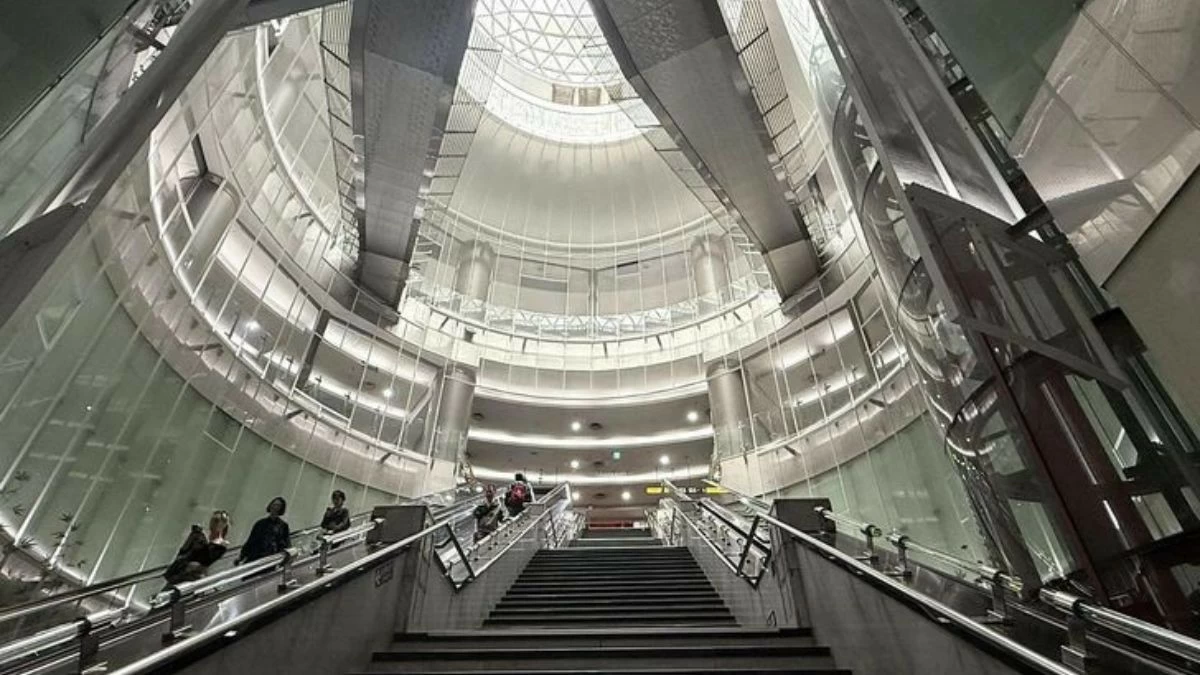
Passengers ride escalators at Noksapyeong Station in Seoul, Monday (Photo: The Korea Times/Lee Hae-rin)
The notes of Chopin’s Nocturne drifted up through the deep underground air inside Noksapyeong Station in Seoul on Monday afternoon this week, echoing off curved walls and bouncing against translucent glass banisters. A commuter sat at an upright piano in the concourse — one of the station’s cultural fixtures — and for a few unannounced minutes, the cavernous hall felt less like a subway station and more like a dream that missed its exit.
That is precisely the effect Noksapyeong Station tends to have on people. Even after 25 years of operation, Seoul Metro Line 6’s most architecturally audacious station can still make passengers pause mid-escalator, compelled to look up, down or sideways, at a structure that seems more like a science-fiction film set than a city subway system.
In a sense, it was built for a world that never quite materialized.
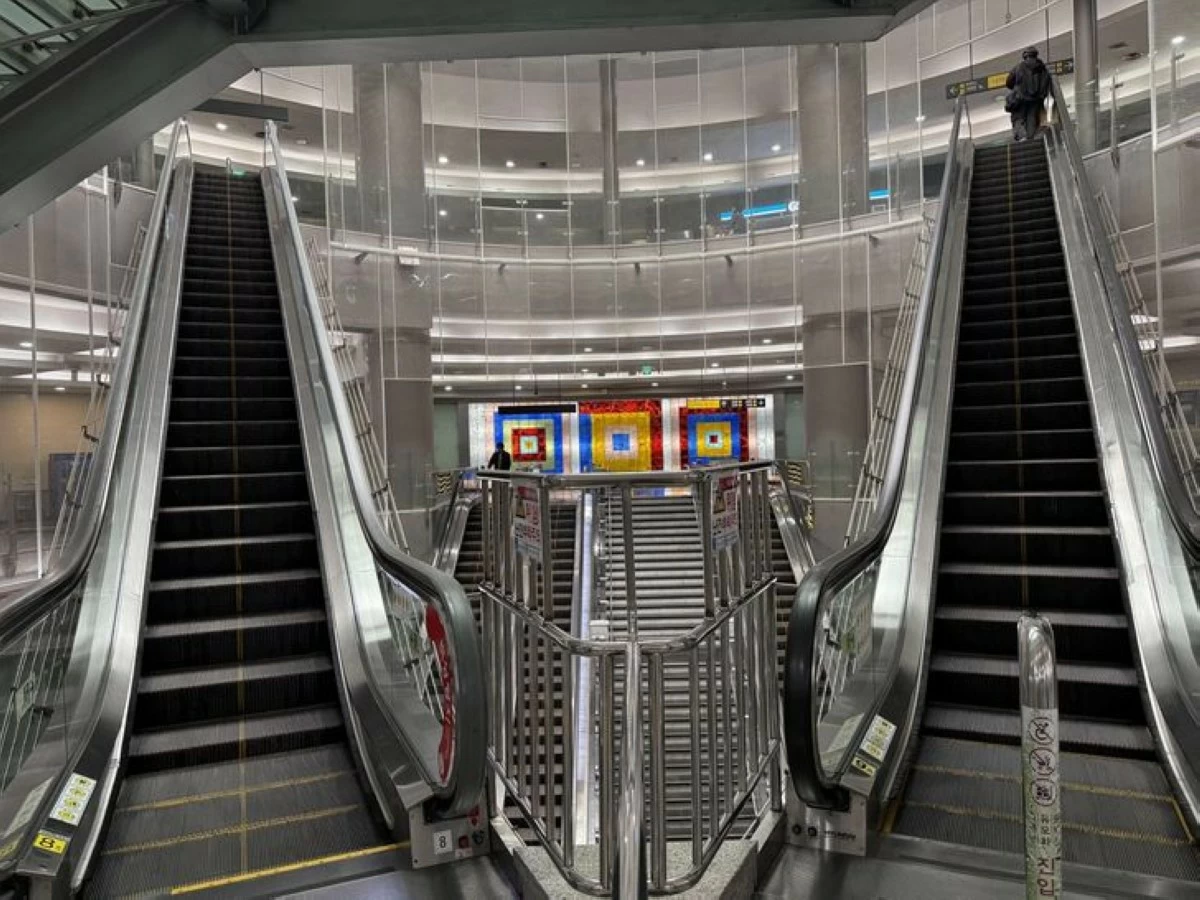
Escalators connect floors of Noksapyeong Station's cylindrical atrium in Seoul, Monday. (Photo: The Korea Times/Lee Hae-rin)
Station with grand ambitions
When Seoul began constructing its sixth metro line in the mid-1990s, planners had a reason to dream big around the Noksapyeong area. Officials were considering relocating City Hall to the site of the current Yongsan District Office, a five-minute walk from the new station.To serve the future City Hall Station with proper dignity, planning documents indicated the new metro line was supposed to have a stop at Noksapyeong, making it a major transit hub at the heart of capital.
The result was a station built to a scale that its actual surroundings could not justify. Builders carved five levels into the Earth to a depth of 34.22 meters, making it one of the city's deepest stations. The cylindrical atrium was given a 21-meter-diameter glass dome at street level, allowing natural light to cascade down four underground floors.
Long escalators were installed to carry passengers through the full vertical journey, each ride offering a slowly shifting panoramic view of illuminated walls, steel geometry and depth — a different composition at every meter of descent.
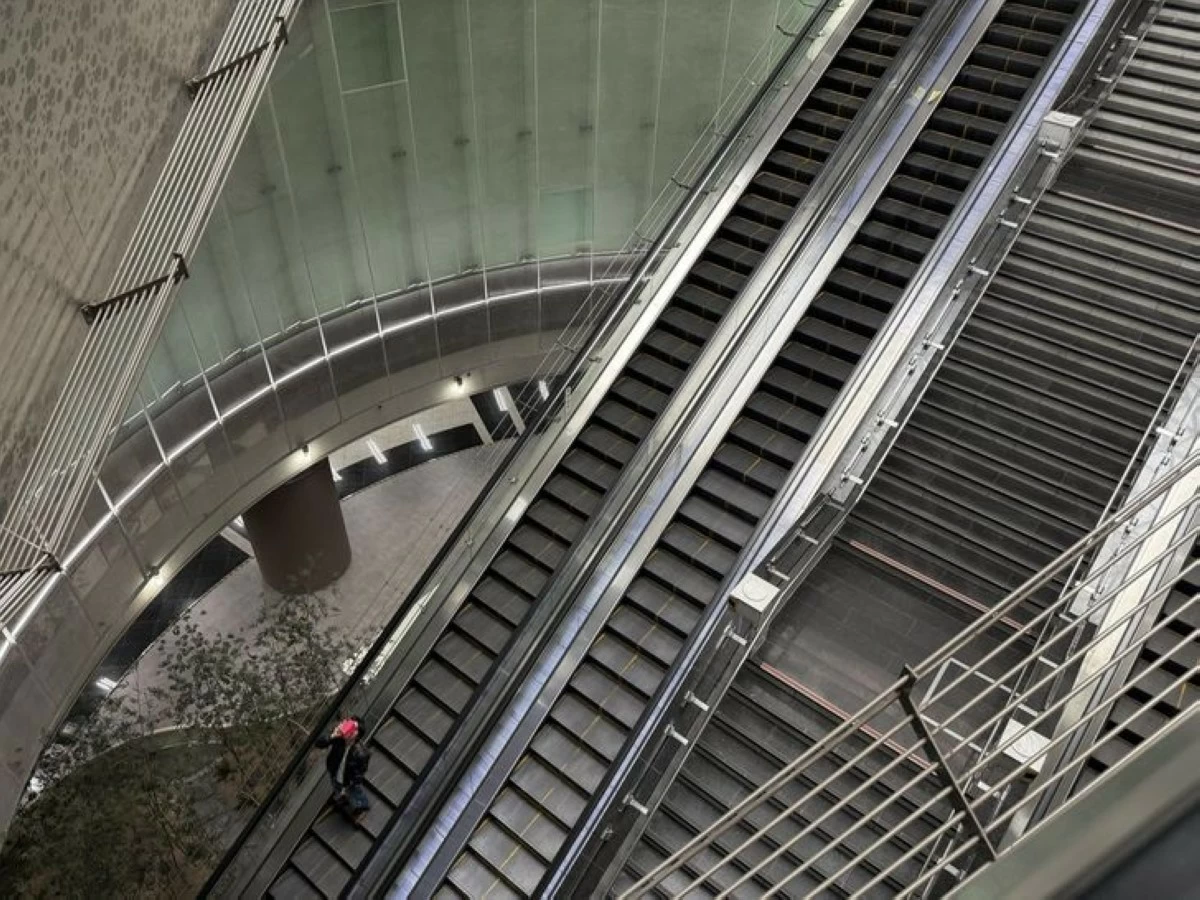
A commuter looks up to take a photo of Noksapyeong Station's glass domed ceiling in Seoul, Monday. (Photo: The Korea Times/Lee Hae-rin)
Compared to other stations, Noksapyeong cost significantly more to construct — and critics were not quiet about it. When ridership in the early years hovered around 7,000 daily — against a backdrop of a station dimensioned for tens of thousands — local media labeled Noksapyeong as one of the capital’s most egregious budget excesses.
The City Hall relocation never happened. The new Seoul City Hall was eventually built downtown, right next to the existing building, now Seoul Metropolitan Library. The plan for a new metro line was scrapped when the broader third subway plan collapsed in the wake of the 1997 IMF financial crisis. Only Seoul Metro Line 9 survived from that generation of planning.
Underground wedding hall
With an oversized hall, city traffic authorities decided to put the space to work. Starting in early 2001, just weeks after the station opened on Dec. 15, 2000, Noksapyeong became Seoul’s most unusual wedding venue.The logic was cheerfully pragmatic. Couples could marry beneath the glass dome, exchange vows on the escalators descending from B2 to B4 and then board the train to Gongdeok Station, transferring to Line 5 and heading directly to Gimpo Airport — bound for a honeymoon within the hour.
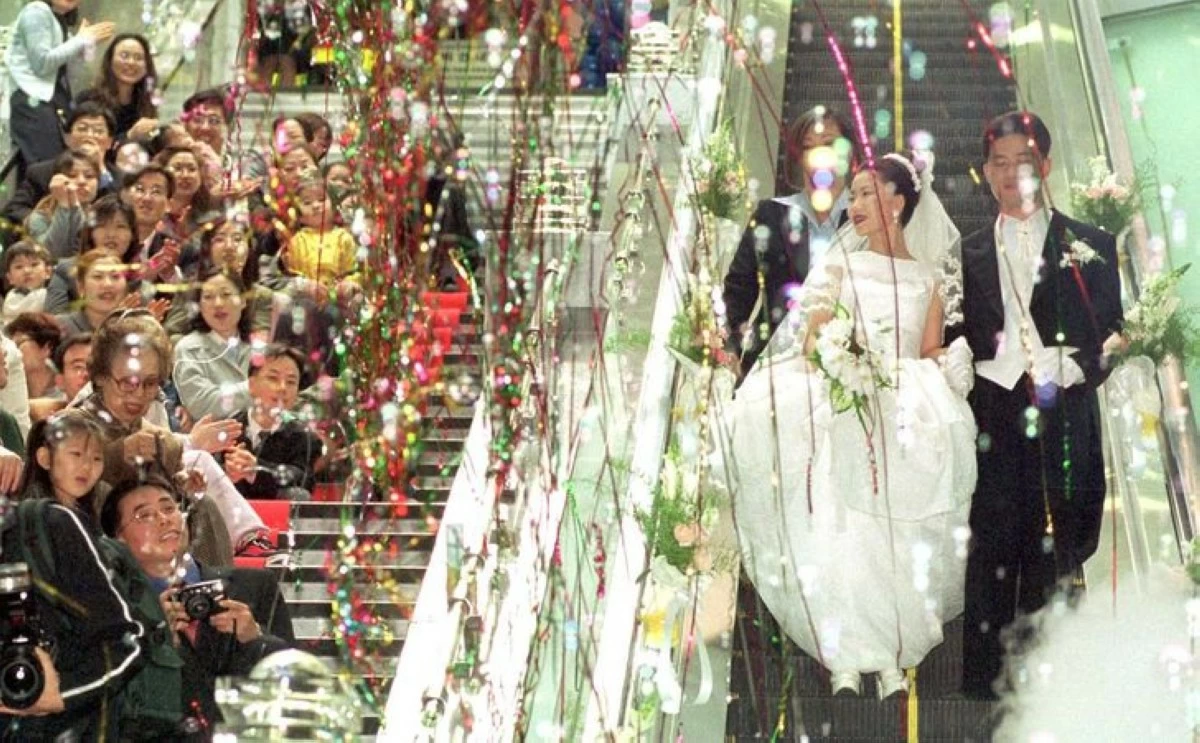
A newlywed couple rides an escalator during their wedding ceremony at Noksapyeong Station in Seoul in this 2001 file photo. (Photo: The Korea Times)
With filtered natural light, high vaulted ceiling and gleaming floors, the venue drew comparisons to the interior of a luxury hotel at the time. It was rented out for free, becoming a coveted wedding hall for young couples looking to save money.
Local news reports from 2001 recounted guests seated along corridor railings four stories down while a bride and groom descended and ascended the escalator instead of walking the aisle.
The program ran successfully for several years, expanding to include a wedding expo in 2005 that brought 24 bridal industrial vendors in the venue, selling merchandise at 30 percent below market price. But the free venue program was quietly abolished in July 2006 as ridership had grown enough.
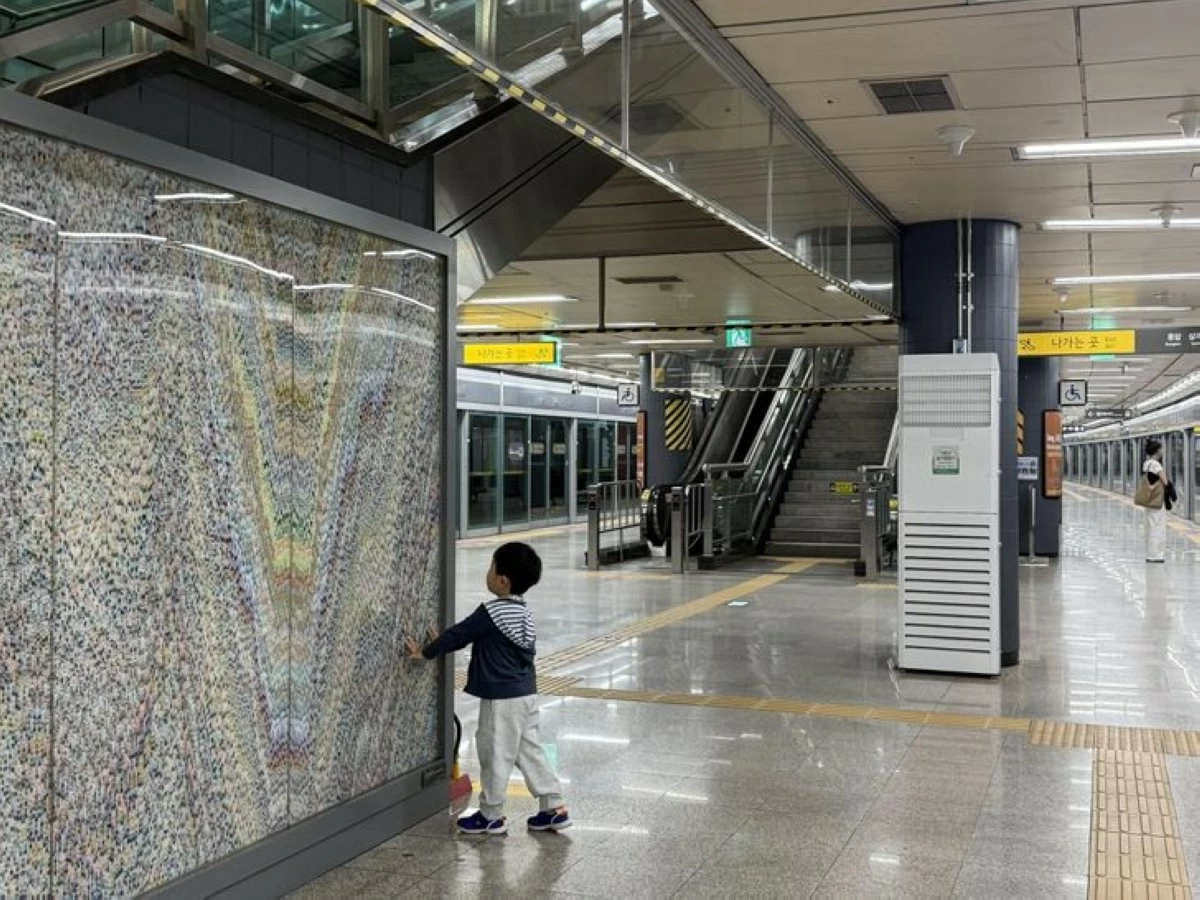
A child plays with an art piece by Kim Won-jin, titled "The Depth of Distance - A Chronicle of the Moment 6," inside Noksapyeong Station in Seoul before boarding a subway, Monday. (Photo: Korea Times/Lee Hae-rin)
Art stepped in
In the late 2000s, transit managers tried other approaches to fill the hall with meaning. In 2009, the partnership with the Korea University Invention Association turned the B4 level into the world’s first “subway invention theme station,” complete with exhibition halls, an inventors’ hall of fame and a YTN Science Channel studio that broadcast weekly from the concourse.The more lasting transformation came years later. In 2016, the Seoul Metropolitan Government launched its “Seoul Is a Museum” public art initiative.
The winners were Tokyo-based Yuri Naruse and Jun Inokuma. Their project, unveiled in March 2019, is called “Dance of Light.” Its centerpiece is a large white dome constructed from expanded metal mesh, suspended inside the atrium. As natural light enters through the glass dome above and filters downward, it catches the metallic mesh at different angles throughout the day, casting slow-moving, large-scale light patterns across the walls and floors.
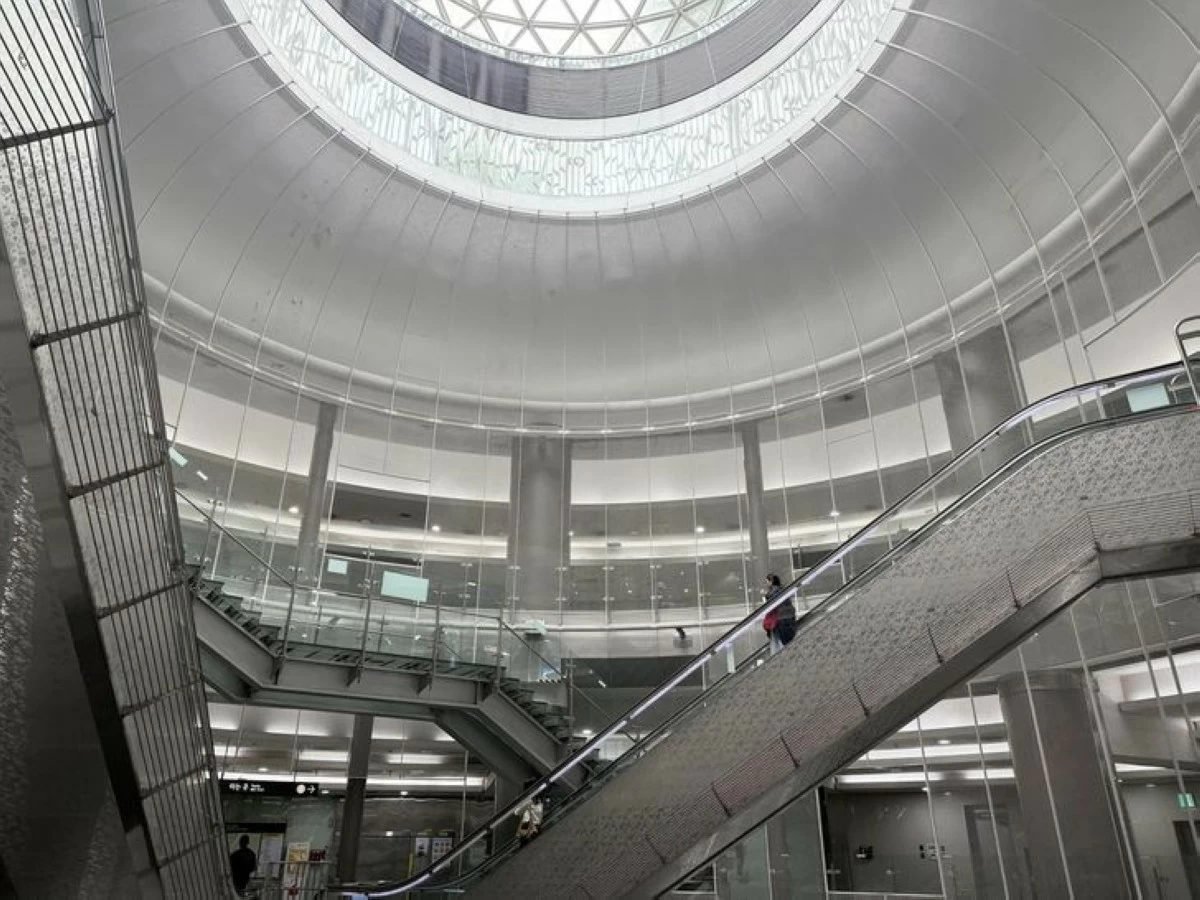
Passengers ride escalators at Noksapyeong Station in Seoul, Monday. (Photo: The Korea Times/Lee Hae-rin)
Separately, the three-level art garden assigned different themes to each underground floor: “Light” at B1, “Forest” at B4 and “Earth” at B5 platform levels.
Among the art on display is artist Kim Ah-yeon's installation at B4 that recreates a hillside forest on nearby Mount Nam, using native tree species arranged around benches and pathways. The video work “Flow” by Chung Jin-soo, an artist more known as the director of a music video for indie band HYUKOH, projects footage of natural landscapes on corridor walls.
Attractions around station
As the station is still looking for the right purpose for its vast space, the rising popularity of nearby Haebangchon brings in more people to the station and its neighborhood.Haebangchon is a neighborhood whose name translates loosely to “liberation village,” referring to 1950-53 Korean War refugees and post-colonial returnees who settled there in the late 1940s and 1950s. Today, the area is known for its steep alleys featuring a mix of restaurants and internationally operated cafes, bars and rooftop terraces.
Exit 2 points toward Gyeongnidan-gil which is lined with independent restaurants, wine bars and boutiques. The street peaked commercially around 2015 and has since evolved into a quiet version of itself, less a destination in its own after gentrification.
The station's Exit 3 brings visitors onto Noksapyeong-daero, where a pedestrian overpass immediately to the north has become one of Seoul’s most photographed vantage points. On a clear day, N Seoul Tower rises directly above the Haebangchon hillside from this spot — a cityscape that appeared in multiple Korean drama series including the 2020 TV drama "Itaewon Class."
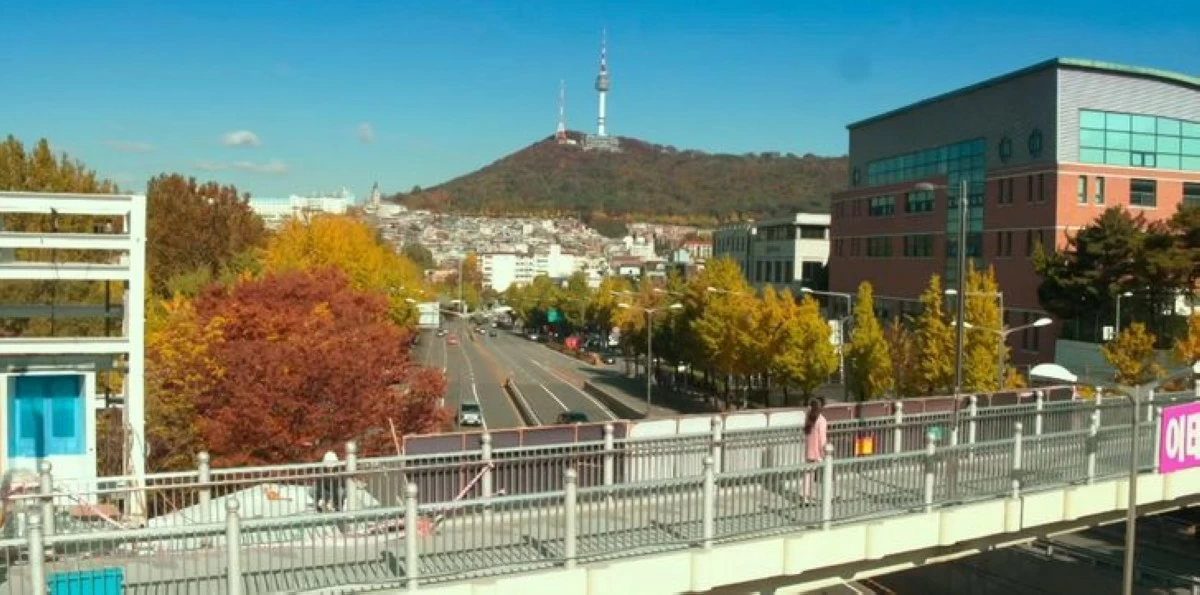
Korean TV drama "Itaewon Class" (2020) made the pedestrian overpass outside Noksapyeong Station a popular photo spot. (Photo: Netflix)
Just beside the overpass, the orange-tiled building of Itaewon Elementary School is home to a public swimming pool that reopened in October 2025 after renovation. Admission is priced at 3,000 won per session, making it one of Seoul’s most accessible urban lap pools for residents and visitors alike.
Book lovers should budget extra time around the station exits. Itaewon Books, Seoul’s oldest English-language used bookstore, has been open since 1973, with its shelves seeded by volumes left behind by departing U.S. military personnel, decade by decade, into an unpredictable trove of fiction, poetry, philosophy and travel writing. A few minutes further up leads to the boutique PDF Seoul that stocks art books, international design magazines, limited-edition publications and vinyl records.