ADVERTISEMENT

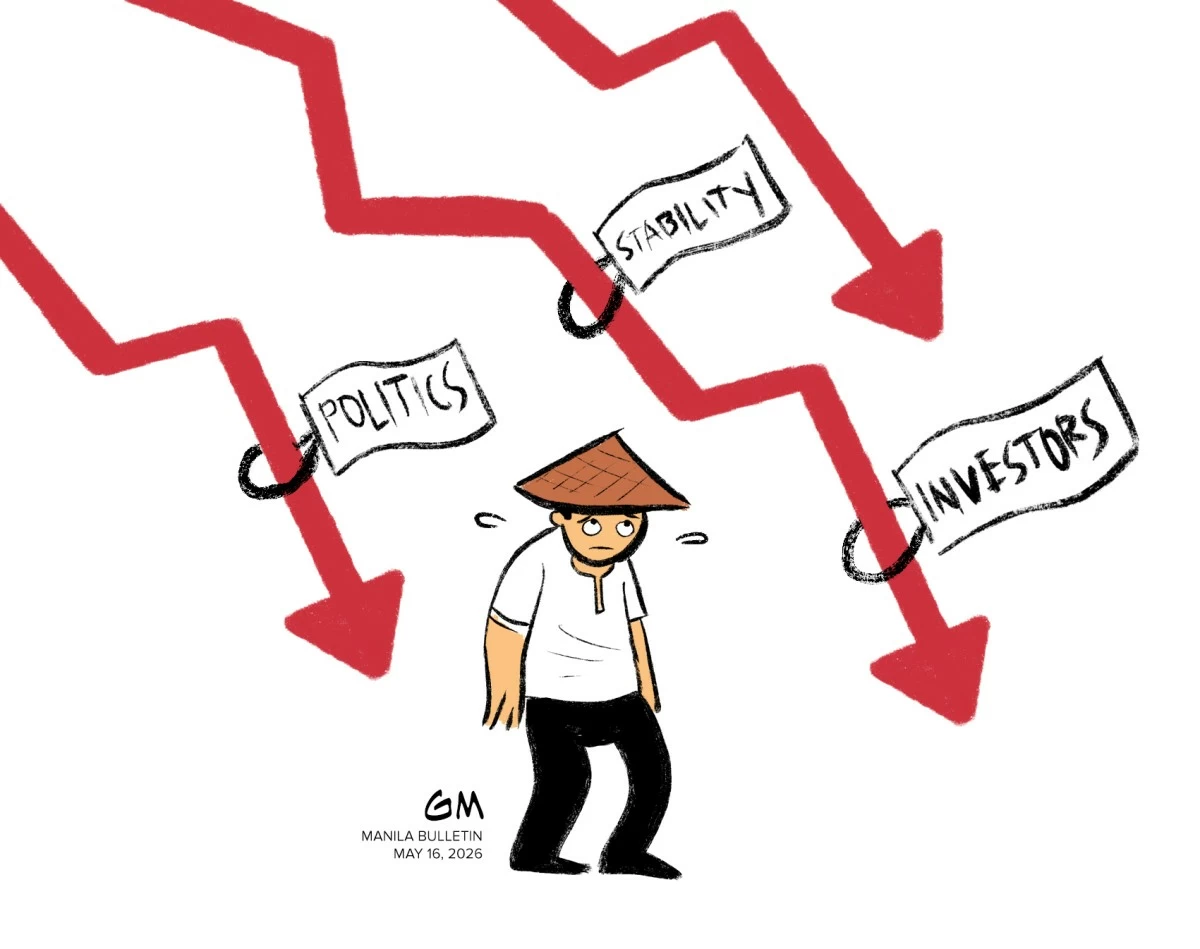
Politics, stability, and investor confidence

Published May 16, 2026 12:05 am  |  Updated May 15, 2026 05:47 pm
The Philippines finds itself navigating an increasingly difficult global environment. Even before the outbreak of war in the Middle East sent oil prices surging, the country was already grappling with slowing foreign direct investment (FDI) inflows, elevated inflation, and weakening economic growth. These external shocks are largely beyond the country’s control. What remains within its control, however, is how its institutions respond to political tensions at home.
The latest Bangko Sentral ng Pilipinas (BSP) data showed that net inflows of FDIs fell by 35 percent during the first two months of 2026 to just $1.03 billion. While economists point out that global caution has become widespread amid high interest rates and geopolitical uncertainty, investors also pay close attention to domestic conditions. Stability, predictability, and institutional credibility matter greatly when businesses decide where to place long-term capital.
There are still encouraging signs. Approved foreign investment pledges surged by more than 52 percent in the first quarter, the Philippine Statistics Authority (PSA) reported. South Korea, Singapore, and China continued to commit investments to the country, while sectors such as manufacturing, tourism, and recreation remained attractive. This indicates that many foreign investors still recognize the Philippines’ long-term strengths: a young population, a large consumer market, and improving infrastructure.
But beneath those positive numbers lies a more cautious picture. PSA data showed that total approved investments, including projects led by Filipino firms, declined by nearly 31 percent during the same period. That trend may reflect a broader “wait-and-see” stance among investors—both foreign and local—amid mounting uncertainties. Businesses naturally become more cautious when economic volatility is accompanied by political instability.
Financial markets are already reflecting these concerns. The peso last Thursday, May 14, plunged to a new record low of ₱61.64 against the United States (US) dollar, with Singapore-based Oversea-Chinese Banking Corp. Ltd. (OCBC) warning that “political noise may also be adding a layer of caution at a time when oil, rates, and risk-off dynamics are already unfavorable.” Japanese financial giant MUFG Bank Ltd. also flagged recent political developments in the Philippines in its reports distributed to clients worldwide, underscoring how domestic events are being monitored closely by the international investment community.
This does not mean the Philippines is suddenly becoming uninvestable, as investors understand that democracies naturally go through periods of political disagreement and institutional friction. What matters more is whether institutions continue to function properly, transparently, and within the bounds of the Constitution and the rule of law.
This is why the appeal by influential business and civil society groups deserves careful attention. They emphasized that constitutional processes must be handled fairly and credibly. Their statement was not about taking political sides. Rather, it was about preserving institutional integrity and demonstrating that the country’s democratic mechanisms remain reliable even during contentious periods.
For investors, institutional predictability often matters as much as economic incentives. Tax perks, infrastructure projects, and reform programs can attract attention, but confidence is sustained when laws are applied consistently and government institutions act professionally regardless of political pressure.
The Philippines still possesses many advantages that can support long-term growth. The challenge now is ensuring that political tensions do not overshadow these strengths. Amid global uncertainty, the country can least afford self-inflicted instability that may discourage investments, weaken the peso further, or delay job-creating projects.
At the end of the day, government institutions must continue to behave as they should—properly, responsibly, and always in the best interest of the country and the Filipino people. By upholding the rule of law, constitutional processes, and institutional professionalism, the Philippines can reassure both foreign and local investors that it remains a stable and credible destination for long-term investments.

Related Tags

Editorial Middle East
ADVERTISEMENT
.most-popular .layout-ratio{ padding-bottom: 79.13%; } @media (min-width: 768px) and (max-width: 1024px) { .widget-title { font-size: 15px !important; } }

{{ articles_filter_1561_widget.title }}

.most-popular .layout-ratio{ padding-bottom: 79.13%; } @media (min-width: 768px) and (max-width: 1024px) { .widget-title { font-size: 15px !important; } }

{{ articles_filter_1562_widget.title }}

.most-popular .layout-ratio{ padding-bottom: 79.13%; } @media (min-width: 768px) and (max-width: 1024px) { .widget-title { font-size: 15px !important; } }

{{ articles_filter_1563_widget.title }}

{{ articles_filter_1564_widget.title }}

.mb-article-details { position: relative; } .mb-article-details .article-body-preview, .mb-article-details .article-body-summary{ font-size: 17px; line-height: 30px; font-family: "Libre Caslon Text", serif; color: #000; } .mb-article-details .article-body-preview iframe , .mb-article-details .article-body-summary iframe{ width: 100%; margin: auto; } .read-more-background { background: linear-gradient(180deg, color(display-p3 1.000 1.000 1.000 / 0) 13.75%, color(display-p3 1.000 1.000 1.000 / 0.8) 30.79%, color(display-p3 1.000 1.000 1.000) 72.5%); position: absolute; height: 200px; width: 100%; bottom: 0; display: flex; justify-content: center; align-items: center; padding: 0; } .read-more-background a{ color: #000; } .read-more-btn { padding: 17px 45px; font-family: Inter; font-weight: 700; font-size: 18px; line-height: 16px; text-align: center; vertical-align: middle; border: 1px solid black; background-color: white; } .hidden { display: none; }
function initializeAllSwipers() { // Get all hidden inputs with cms_article_id document.querySelectorAll('[id^="cms_article_id_"]').forEach(function (input) { const cmsArticleId = input.value; const articleSelector = '#article-' + cmsArticleId + ' .body_images'; const swiperElement = document.querySelector(articleSelector); if (swiperElement && !swiperElement.classList.contains('swiper-initialized')) { new Swiper(articleSelector, { loop: true, pagination: false, navigation: { nextEl: '#article-' + cmsArticleId + ' .swiper-button-next', prevEl: '#article-' + cmsArticleId + ' .swiper-button-prev', }, }); } }); } setTimeout(initializeAllSwipers, 3000); const intersectionObserver = new IntersectionObserver( (entries) => { entries.forEach((entry) => { if (entry.isIntersecting) { const newUrl = entry.target.getAttribute("data-url"); if (newUrl) { history.pushState(null, null, newUrl); let article = entry.target; // Extract metadata const author = article.querySelector('.author-section').textContent.replace('By', '').trim(); const section = article.querySelector('.section-info ').textContent.replace(' ', ' '); const title = article.querySelector('.article-title h1').textContent; // Parse URL for Chartbeat path format const parsedUrl = new URL(newUrl, window.location.origin); const cleanUrl = parsedUrl.host + parsedUrl.pathname; // Update Chartbeat configuration if (typeof window._sf_async_config !== 'undefined') { window._sf_async_config.path = cleanUrl; window._sf_async_config.sections = section; window._sf_async_config.authors = author; } // Track virtual page view with Chartbeat if (typeof pSUPERFLY !== 'undefined' && typeof pSUPERFLY.virtualPage === 'function') { try { pSUPERFLY.virtualPage({ path: cleanUrl, title: title, sections: section, authors: author }); } catch (error) { console.error('ping error', error); } } // Optional: Update document title if (title && title !== document.title) { document.title = title; } } } }); }, { threshold: 0.1 } ); function showArticleBody(button) { const article = button.closest("article"); const summary = article.querySelector(".article-body-summary"); const body = article.querySelector(".article-body-preview"); const readMoreSection = article.querySelector(".read-more-background"); // Hide summary and read-more section summary.style.display = "none"; readMoreSection.style.display = "none"; // Show the full article body body.classList.remove("hidden"); } document.addEventListener("DOMContentLoaded", () => { let loadCount = 0; // Track how many times articles are loaded const offset = [1, 2, 3, 4, 5, 6, 7, 8, 9, 10]; // Offset values const currentUrl = window.location.pathname.substring(1); let isLoading = false; // Prevent multiple calls if (!currentUrl) { console.log("Current URL is invalid."); return; } const sentinel = document.getElementById("load-more-sentinel"); if (!sentinel) { console.log("Sentinel element not found."); return; } function isSentinelVisible() { const rect = sentinel.getBoundingClientRect(); return ( rect.top < window.innerHeight && rect.bottom >= 0 ); } function onScroll() { if (isLoading) return; if (isSentinelVisible()) { if (loadCount >= offset.length) { console.log("Maximum load attempts reached."); window.removeEventListener("scroll", onScroll); return; } isLoading = true; const currentOffset = offset[loadCount]; window.loadMoreItems().then(() => { let article = document.querySelector('#widget_1690 > div:nth-last-of-type(2) article'); intersectionObserver.observe(article) loadCount++; }).catch(error => { console.error("Error loading more items:", error); }).finally(() => { isLoading = false; }); } } window.addEventListener("scroll", onScroll); });

Sign up by email to receive news.