






Manila Bulletin
 Business
The Stock Market
Stocks sink below 6,000 as peso slump triggers profit-taking
Business
The Stock Market
Stocks sink below 6,000 as peso slump triggers profit-taking
Business
The Stock Market
Stocks sink below 6,000 as peso slump triggers profit-taking
Stocks sink below 6,000 as peso slump triggers profit-taking
Published May 15, 2026 05:51 pm


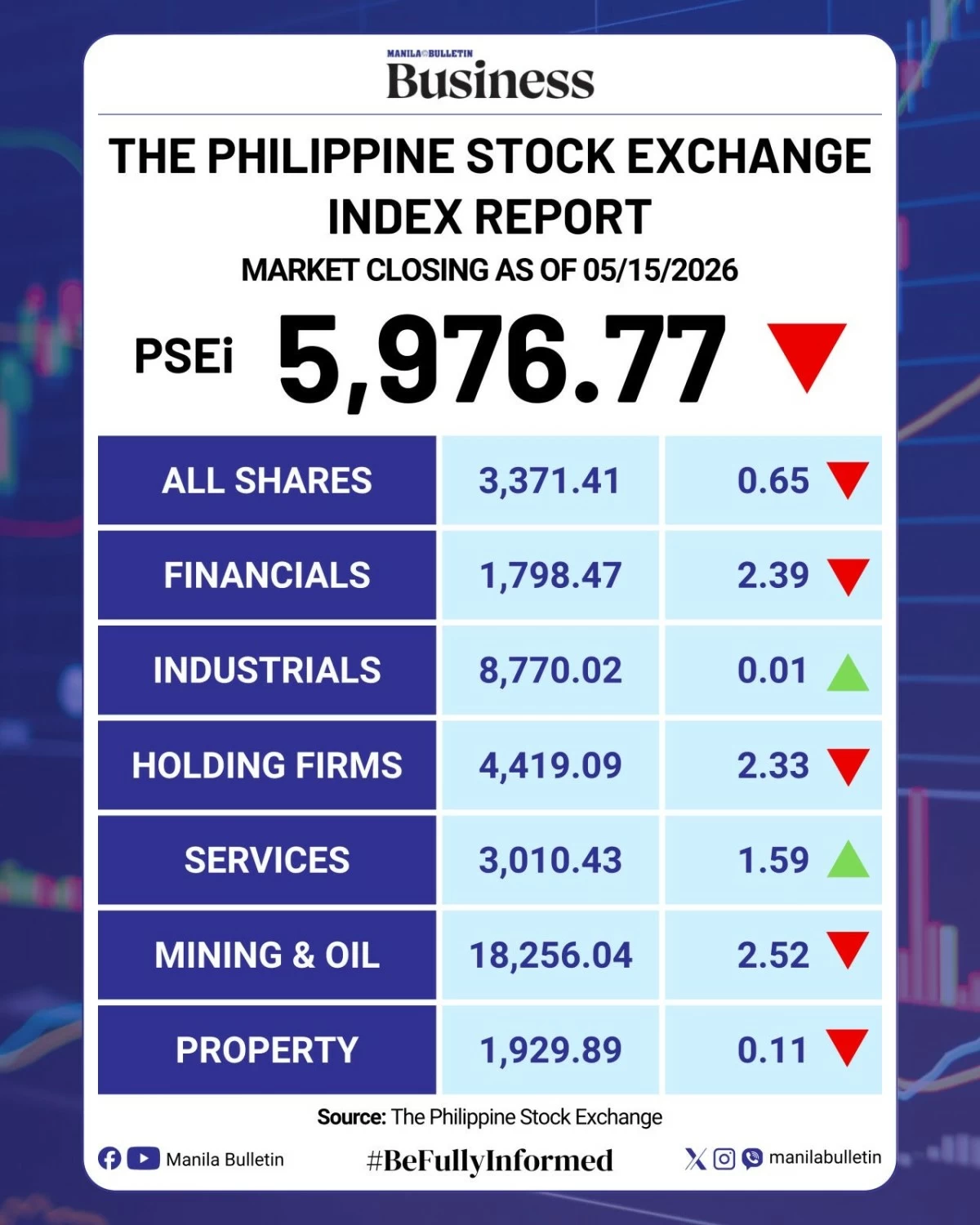
Local stocks retreated on Friday, May 15, pulling the benchmark index back below the 6,000 psychological threshold as sliding peso and cooling remittance data prompted investors to reduce exposure ahead of the weekend.
The Philippine Stock Exchange index (PSEi) fell 38.26 points, or 0.64 percent, to close at 5,976.77. The decline snapped a brief recovery from the previous session, with mining issues leading the broad-based retreat.
While the services and industrial sectors managed modest gains, they were insufficient to offset the drag from heavyweights sensitive to currency fluctuations and macroeconomic headwinds.
Market participation showed signs of life but remained categorized as thin by historical standards. Roughly 591 million shares changed hands, valued at ₱6.29 billion. Market breadth was negative, with 103 losers outpacing 77 gainers, while 66 stocks remained unchanged.
Luis Limlingan, managing director at Regina Capital Development Corp., noted that the currency’s weakness effectively triggered a wave of profit-taking.
According to Limlingan, the depreciation dampened overall sentiment, forcing traders to lock in gains from the prior day’s rally rather than betting on a sustained breakout.
Japhet Tantiangco, research manager at Philstocks Financial, observed that the market proved unable to defend the 6,000 level.
He pointed to a confluence of “lingering concerns,” including the threat of stagflation and domestic political uncertainties, which have kept institutional buyers on the sidelines.
Further pressure came from the fundamental side, with first-quarter corporate earnings and macroeconomic data missing the mark.
Michael Ricafort, chief economist at Rizal Commercial Banking Corp., said the PSEi’s downward trajectory was exacerbated by a year-on-year decline in earnings for several listed companies.
Additionally, government data showing softer volume in overseas Filipino workers’ remittances—a critical pillar of the domestic economy—added to the bearish narrative.
As the peso continues its volatile trek, analysts expect the market to remain sensitive to central bank signals and global dollar strength.