ADVERTISEMENT

Malaysia says Iranian oil transfers near its waters exploit a maritime loophole

Published May 14, 2026 02:40 pm
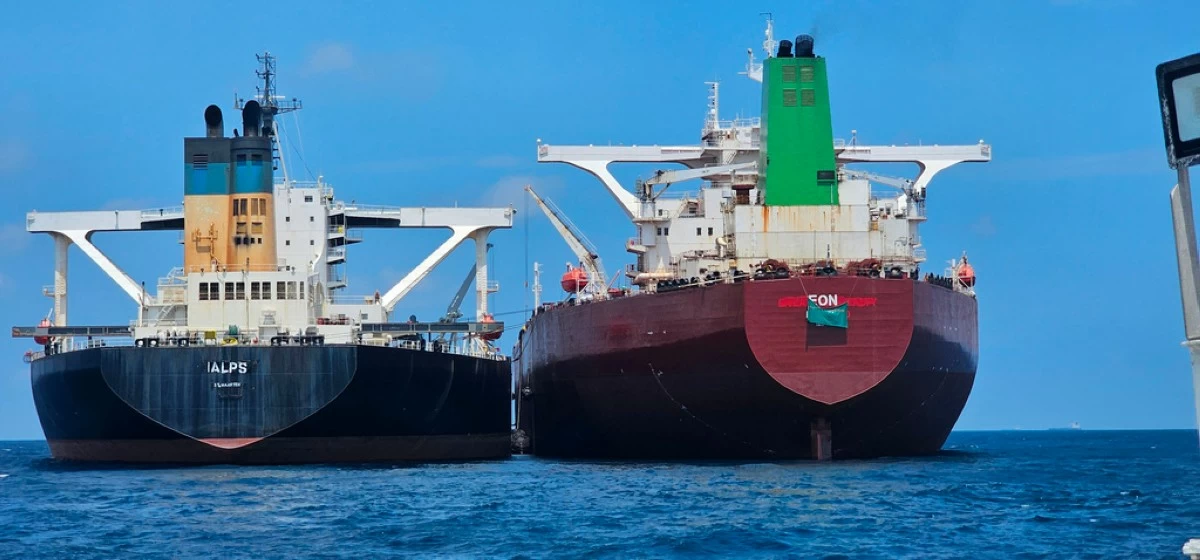
This handout photo from United Against Nuclear Iran shows two oil tankers making a ship-to-ship transfer of Iranian oil in the Eastern Outer Port Limits (EOPL), 70 kilometers off Malaysia's coast in international waters on 28 July 2025. (Charlie Brown/United Against Nuclear Iran via AP)
KUALA LUMPUR, Malaysia (AP) — Malaysia ’s maritime agency says Iranian-linked tankers are exploiting “jurisdictional gaps” to conduct ship-to-ship transfers of sanctioned oil near its waters, rejecting allegations that authorities ignored a long-running trade allowing Iran to evade U.S. sanctions.
U.S.-based advocacy group United Against Nuclear Iran (UANI) and shipping industry observers say waters near Malaysia’s southern Johor state have become a key hub for ship-to-ship transfers involving Iran’s “shadow fleet” — aging tankers that often operate with disabled tracking systems, false identities and opaque ownership structures to conceal the origins of crude bound largely for China.
The area, known as the Eastern Outer Port Limits, or EOPL, in the South China Sea is about 70 kilometers (45 miles) off Johor. It lies along one of the world’s busiest maritime trade routes and is about halfway between Iran and China, which buys about 90% of Iranian oil.
U.S. officials have previously said Iranian oil exports rely heavily on service providers and ship-to-ship transfers operating near Malaysian waters.
UANI says there have been 42 ship-to-ship transfers of Iranian oil conducted in the EOPL area since Feb. 28, when the U.S. and Israel attacked Iran, starting a war in the Middle East. UANI used satellite imagery to observe the operations.
“Because of Malaysia’s inaction, it is facilitating this business model by Iran and China and dark fleet actors,” senior UANI adviser Charlie Brown said, warning Malaysia is becoming “a facilitator rather than merely a transit point” for illicit activity.
Malaysian Maritime Enforcement Agency Director-General Mohamad Rosli Abdullah said the transfers are often done outside the country's territorial waters and in remote areas beyond radar coverage, especially in locations near maritime boundaries or international shipping routes.
"The selection of such locations is intended to exploit jurisdictional gaps and limit direct enforcement action by local authorities,” he told The Associated Press.
The UANI allegations "do not align with the actual situation on the ground and do not reflect the operational realities of maritime enforcement conducted by the MMEA,” he said, adding that the lack of real-time intelligence-sharing among domestic and international agencies also hampers effective action.
Iranian oil flows despite a US blockade
Clandestine high-seas transfers from Iranian-linked tankers have persisted for years, allowing Tehran to sell its crude while offering buyers plausible deniability about the oil’s source.
While not illegal, Malaysia discourages unsanctioned transfers outside designated areas, where such operations can be supervised, as they greatly increase the likelihood of a spill, involve aging vessels and are carried out far from ports where mistakes could be more easily contained.
Despite a U.S. blockade of Iranian ports that started in mid-April, UANI said it has tracked Iranian-linked tankers still operating, though it is not clear how many are now getting through.
Neither the Iranian Embassy in Kuala Lumpur nor the Iranian mission to the U.N. answered requests for comment. The U.S. State Department declined to comment.
As of Tuesday, two dozen Iranian-linked tankers tracked by UANI were anchored or loitering near the EOPL area used for transfers off Johor, though it was not clear how many had sailed before the blockade began.
“It’s business as usual,” UANI's Brown told the AP.
UANI maintains that Malaysia could enforce environmental regulations for advance notification of ship-to-ship transfers, prevent Malaysian companies from providing support to ships involved and require all ships to carry adequate insurance against accidents and oil spills, among other things.
The MMEA director general said enforcement is conducted strictly under Malaysian law and relevant international conventions, and authorities have “never compromised nor provided any special treatment or privileges to any country.”

Related Tags

world news oil crisis
ADVERTISEMENT
.most-popular .layout-ratio{ padding-bottom: 79.13%; } @media (min-width: 768px) and (max-width: 1024px) { .widget-title { font-size: 15px !important; } }

{{ articles_filter_1561_widget.title }}

.most-popular .layout-ratio{ padding-bottom: 79.13%; } @media (min-width: 768px) and (max-width: 1024px) { .widget-title { font-size: 15px !important; } }

{{ articles_filter_1562_widget.title }}

.most-popular .layout-ratio{ padding-bottom: 79.13%; } @media (min-width: 768px) and (max-width: 1024px) { .widget-title { font-size: 15px !important; } }

{{ articles_filter_1563_widget.title }}

{{ articles_filter_1564_widget.title }}

.mb-article-details { position: relative; } .mb-article-details .article-body-preview, .mb-article-details .article-body-summary{ font-size: 17px; line-height: 30px; font-family: "Libre Caslon Text", serif; color: #000; } .mb-article-details .article-body-preview iframe , .mb-article-details .article-body-summary iframe{ width: 100%; margin: auto; } .read-more-background { background: linear-gradient(180deg, color(display-p3 1.000 1.000 1.000 / 0) 13.75%, color(display-p3 1.000 1.000 1.000 / 0.8) 30.79%, color(display-p3 1.000 1.000 1.000) 72.5%); position: absolute; height: 200px; width: 100%; bottom: 0; display: flex; justify-content: center; align-items: center; padding: 0; } .read-more-background a{ color: #000; } .read-more-btn { padding: 17px 45px; font-family: Inter; font-weight: 700; font-size: 18px; line-height: 16px; text-align: center; vertical-align: middle; border: 1px solid black; background-color: white; } .hidden { display: none; }
function initializeAllSwipers() { // Get all hidden inputs with cms_article_id document.querySelectorAll('[id^="cms_article_id_"]').forEach(function (input) { const cmsArticleId = input.value; const articleSelector = '#article-' + cmsArticleId + ' .body_images'; const swiperElement = document.querySelector(articleSelector); if (swiperElement && !swiperElement.classList.contains('swiper-initialized')) { new Swiper(articleSelector, { loop: true, pagination: false, navigation: { nextEl: '#article-' + cmsArticleId + ' .swiper-button-next', prevEl: '#article-' + cmsArticleId + ' .swiper-button-prev', }, }); } }); } setTimeout(initializeAllSwipers, 3000); const intersectionObserver = new IntersectionObserver( (entries) => { entries.forEach((entry) => { if (entry.isIntersecting) { const newUrl = entry.target.getAttribute("data-url"); if (newUrl) { history.pushState(null, null, newUrl); let article = entry.target; // Extract metadata const author = article.querySelector('.author-section').textContent.replace('By', '').trim(); const section = article.querySelector('.section-info ').textContent.replace(' ', ' '); const title = article.querySelector('.article-title h1').textContent; // Parse URL for Chartbeat path format const parsedUrl = new URL(newUrl, window.location.origin); const cleanUrl = parsedUrl.host + parsedUrl.pathname; // Update Chartbeat configuration if (typeof window._sf_async_config !== 'undefined') { window._sf_async_config.path = cleanUrl; window._sf_async_config.sections = section; window._sf_async_config.authors = author; } // Track virtual page view with Chartbeat if (typeof pSUPERFLY !== 'undefined' && typeof pSUPERFLY.virtualPage === 'function') { try { pSUPERFLY.virtualPage({ path: cleanUrl, title: title, sections: section, authors: author }); } catch (error) { console.error('ping error', error); } } // Optional: Update document title if (title && title !== document.title) { document.title = title; } } } }); }, { threshold: 0.1 } ); function showArticleBody(button) { const article = button.closest("article"); const summary = article.querySelector(".article-body-summary"); const body = article.querySelector(".article-body-preview"); const readMoreSection = article.querySelector(".read-more-background"); // Hide summary and read-more section summary.style.display = "none"; readMoreSection.style.display = "none"; // Show the full article body body.classList.remove("hidden"); } document.addEventListener("DOMContentLoaded", () => { let loadCount = 0; // Track how many times articles are loaded const offset = [1, 2, 3, 4, 5, 6, 7, 8, 9, 10]; // Offset values const currentUrl = window.location.pathname.substring(1); let isLoading = false; // Prevent multiple calls if (!currentUrl) { console.log("Current URL is invalid."); return; } const sentinel = document.getElementById("load-more-sentinel"); if (!sentinel) { console.log("Sentinel element not found."); return; } function isSentinelVisible() { const rect = sentinel.getBoundingClientRect(); return ( rect.top < window.innerHeight && rect.bottom >= 0 ); } function onScroll() { if (isLoading) return; if (isSentinelVisible()) { if (loadCount >= offset.length) { console.log("Maximum load attempts reached."); window.removeEventListener("scroll", onScroll); return; } isLoading = true; const currentOffset = offset[loadCount]; window.loadMoreItems().then(() => { let article = document.querySelector('#widget_1690 > div:nth-last-of-type(2) article'); intersectionObserver.observe(article) loadCount++; }).catch(error => { console.error("Error loading more items:", error); }).finally(() => { isLoading = false; }); } } window.addEventListener("scroll", onScroll); });

Sign up by email to receive news.