ADVERTISEMENT

BRICS foreign ministers meet in India as Iran war, oil prices and divisions test the bloc's unity

Published May 14, 2026 02:28 pm
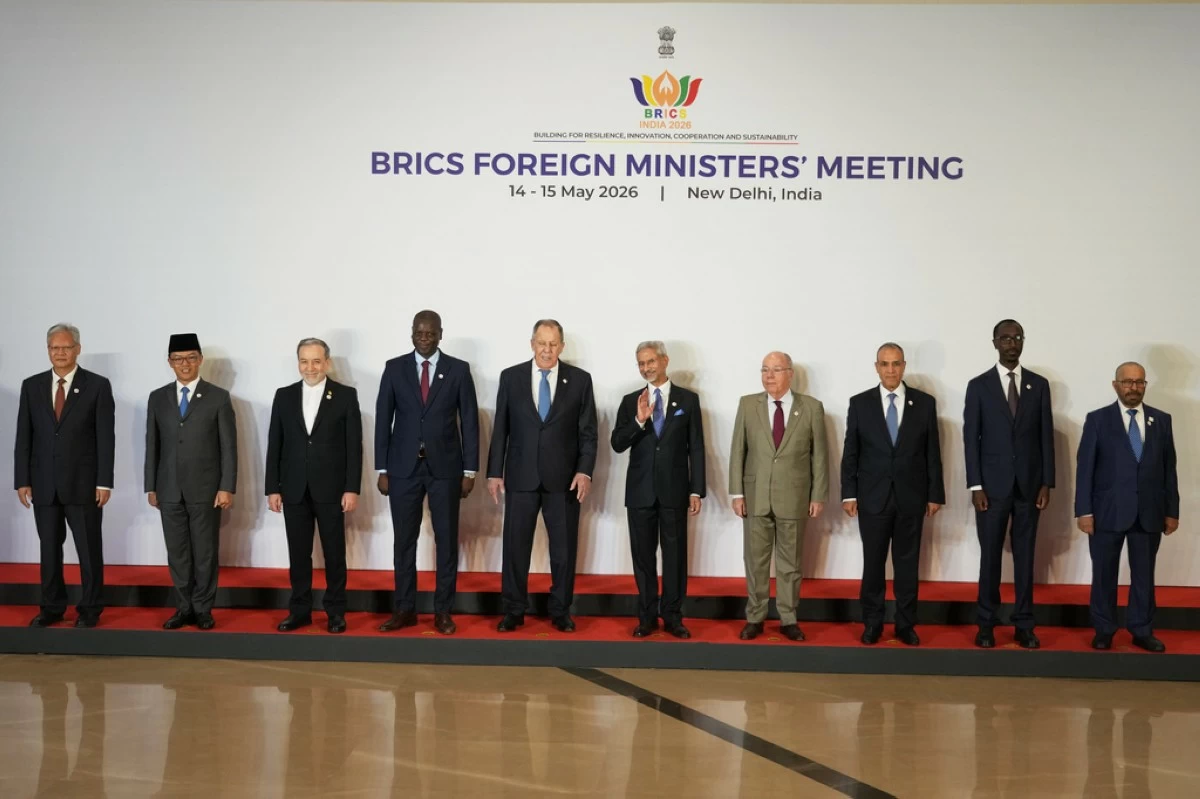
Foreign ministers and representatives of the BRICS nations, from right, UAE's Minister of State for International Cooperation Reem Al Hashimy, Ethiopia's Minister of Foreign Affairs Gedion Timothewos, Egypt's Foreign Minister Badr Abdelatty, Brazil's Foreign Minister Mauro Vieira, India's Foreign Minister S.Jaishankar, Russia's Foreign Minister Sergey Lavrov, South Africa's Minister of Foreign Affairs Ronald Lamola, Iranian Foreign Minister Abbas Araghchi, Indonesia's Foreign Minister Sugiono and Chinese Ambassador to India Xu Feihong pose for a group photo during a two-day meeting in New Delhi, India, Thursday, May 14, 2026. (AP Photo/Manish Swarup)
NEW DELHI (AP) — Foreign ministers from the BRICS nations began a two-day meeting in New Delhi on Thursday as the expanding bloc faces divisions over the war in Iran, rising energy prices and growing global economic uncertainty.
The meeting brings together diplomats from Brazil, Russia, India, China and South Africa along with newer member countries. It comes as the war in Iran has disrupted global energy supplies and driven up oil prices and coincides with U.S. President Donald Trump's meeting with Chinese leader Xi Jinping in Beijing.
Iranian Foreign Minister Abbas Araqchi and Russia’s top diplomat Sergey Lavrov are attending. China is represented by Ambassador Xu Feihong while Foreign Minister Wang Yi remains in the Chinese capital during Trump’s visit.
India Foreign Minister Subrahmanyam Jaishankar said the talks would focus on global and regional challenges and ways to deepen cooperation among member nations.
In opening remarks, Jaishankar said BRICS could help developing countries more effectively respond to the health and financing challenges they face as well as high prices for energy, food and fertilizer.
“We meet at a time of considerable flux in international relations,” he said, adding that emerging and developing countries increasingly expect BRICS to play a “constructive and stabilizing role.”
BRICS has sought to expand its influence
Founded by Brazil, Russia, India and China, BRICS was formed as a grouping of major emerging economies seen as a counterbalance to Western-led institutions such as the G7. South Africa joined in 2010 and the bloc expanded further in 2024 with the addition of Egypt, Ethiopia, Iran and the United Arab Emirates. Indonesia became a full member in 2025.
The group has sought to expand its influence by pushing for a bigger role in a global order long dominated by the United States and its Western allies. It has gained support across parts of the Global South, where many countries have criticized Western-led financial institutions.
But BRICS nations remain divided on key issues.
India and China continue to compete for regional influence, while member countries often differ in their ties with the West. Russia’s war in Ukraine has further exposed those differences.
New divisions test global ambitions
The bloc’s expansion also has added strains. Competing regional interests have increased the difficulty of presenting a unified position.
Divisions have sharpened further during the growing conflict in the Middle East. Iran and the UAE are BRICS members despite pursuing competing interests in the region.
Iran’s deputy foreign minister said Wednesday that disagreements within BRICS over the conflict had prevented the bloc from reaching a unified position.
Kazem Gharibabadi told news agency Press Trust of India that “one member country” had pushed for language condemning Iran, complicating efforts to build consensus within the grouping.
“We want India’s BRICS chairship to be successful. It is not a good approach to send a signal to the world that the BRICS is divided. One country is insisting on condemning Iran,” Gharibabadi said.

Related Tags

world news BRICS bloc
ADVERTISEMENT
.most-popular .layout-ratio{ padding-bottom: 79.13%; } @media (min-width: 768px) and (max-width: 1024px) { .widget-title { font-size: 15px !important; } }

{{ articles_filter_1561_widget.title }}

.most-popular .layout-ratio{ padding-bottom: 79.13%; } @media (min-width: 768px) and (max-width: 1024px) { .widget-title { font-size: 15px !important; } }

{{ articles_filter_1562_widget.title }}

.most-popular .layout-ratio{ padding-bottom: 79.13%; } @media (min-width: 768px) and (max-width: 1024px) { .widget-title { font-size: 15px !important; } }

{{ articles_filter_1563_widget.title }}

{{ articles_filter_1564_widget.title }}

.mb-article-details { position: relative; } .mb-article-details .article-body-preview, .mb-article-details .article-body-summary{ font-size: 17px; line-height: 30px; font-family: "Libre Caslon Text", serif; color: #000; } .mb-article-details .article-body-preview iframe , .mb-article-details .article-body-summary iframe{ width: 100%; margin: auto; } .read-more-background { background: linear-gradient(180deg, color(display-p3 1.000 1.000 1.000 / 0) 13.75%, color(display-p3 1.000 1.000 1.000 / 0.8) 30.79%, color(display-p3 1.000 1.000 1.000) 72.5%); position: absolute; height: 200px; width: 100%; bottom: 0; display: flex; justify-content: center; align-items: center; padding: 0; } .read-more-background a{ color: #000; } .read-more-btn { padding: 17px 45px; font-family: Inter; font-weight: 700; font-size: 18px; line-height: 16px; text-align: center; vertical-align: middle; border: 1px solid black; background-color: white; } .hidden { display: none; }
function initializeAllSwipers() { // Get all hidden inputs with cms_article_id document.querySelectorAll('[id^="cms_article_id_"]').forEach(function (input) { const cmsArticleId = input.value; const articleSelector = '#article-' + cmsArticleId + ' .body_images'; const swiperElement = document.querySelector(articleSelector); if (swiperElement && !swiperElement.classList.contains('swiper-initialized')) { new Swiper(articleSelector, { loop: true, pagination: false, navigation: { nextEl: '#article-' + cmsArticleId + ' .swiper-button-next', prevEl: '#article-' + cmsArticleId + ' .swiper-button-prev', }, }); } }); } setTimeout(initializeAllSwipers, 3000); const intersectionObserver = new IntersectionObserver( (entries) => { entries.forEach((entry) => { if (entry.isIntersecting) { const newUrl = entry.target.getAttribute("data-url"); if (newUrl) { history.pushState(null, null, newUrl); let article = entry.target; // Extract metadata const author = article.querySelector('.author-section').textContent.replace('By', '').trim(); const section = article.querySelector('.section-info ').textContent.replace(' ', ' '); const title = article.querySelector('.article-title h1').textContent; // Parse URL for Chartbeat path format const parsedUrl = new URL(newUrl, window.location.origin); const cleanUrl = parsedUrl.host + parsedUrl.pathname; // Update Chartbeat configuration if (typeof window._sf_async_config !== 'undefined') { window._sf_async_config.path = cleanUrl; window._sf_async_config.sections = section; window._sf_async_config.authors = author; } // Track virtual page view with Chartbeat if (typeof pSUPERFLY !== 'undefined' && typeof pSUPERFLY.virtualPage === 'function') { try { pSUPERFLY.virtualPage({ path: cleanUrl, title: title, sections: section, authors: author }); } catch (error) { console.error('ping error', error); } } // Optional: Update document title if (title && title !== document.title) { document.title = title; } } } }); }, { threshold: 0.1 } ); function showArticleBody(button) { const article = button.closest("article"); const summary = article.querySelector(".article-body-summary"); const body = article.querySelector(".article-body-preview"); const readMoreSection = article.querySelector(".read-more-background"); // Hide summary and read-more section summary.style.display = "none"; readMoreSection.style.display = "none"; // Show the full article body body.classList.remove("hidden"); } document.addEventListener("DOMContentLoaded", () => { let loadCount = 0; // Track how many times articles are loaded const offset = [1, 2, 3, 4, 5, 6, 7, 8, 9, 10]; // Offset values const currentUrl = window.location.pathname.substring(1); let isLoading = false; // Prevent multiple calls if (!currentUrl) { console.log("Current URL is invalid."); return; } const sentinel = document.getElementById("load-more-sentinel"); if (!sentinel) { console.log("Sentinel element not found."); return; } function isSentinelVisible() { const rect = sentinel.getBoundingClientRect(); return ( rect.top < window.innerHeight && rect.bottom >= 0 ); } function onScroll() { if (isLoading) return; if (isSentinelVisible()) { if (loadCount >= offset.length) { console.log("Maximum load attempts reached."); window.removeEventListener("scroll", onScroll); return; } isLoading = true; const currentOffset = offset[loadCount]; window.loadMoreItems().then(() => { let article = document.querySelector('#widget_1690 > div:nth-last-of-type(2) article'); intersectionObserver.observe(article) loadCount++; }).catch(error => { console.error("Error loading more items:", error); }).finally(() => { isLoading = false; }); } } window.addEventListener("scroll", onScroll); });

Sign up by email to receive news.