






Manila Bulletin
 Technews
Philippine organizations race to close cybersecurity gap as AI threats accelerate, Fortinet study finds
Technews
Philippine organizations race to close cybersecurity gap as AI threats accelerate, Fortinet study finds
Technews
Philippine organizations race to close cybersecurity gap as AI threats accelerate, Fortinet study finds
Philippine organizations race to close cybersecurity gap as AI threats accelerate, Fortinet study finds
Published May 13, 2026 09:53 am


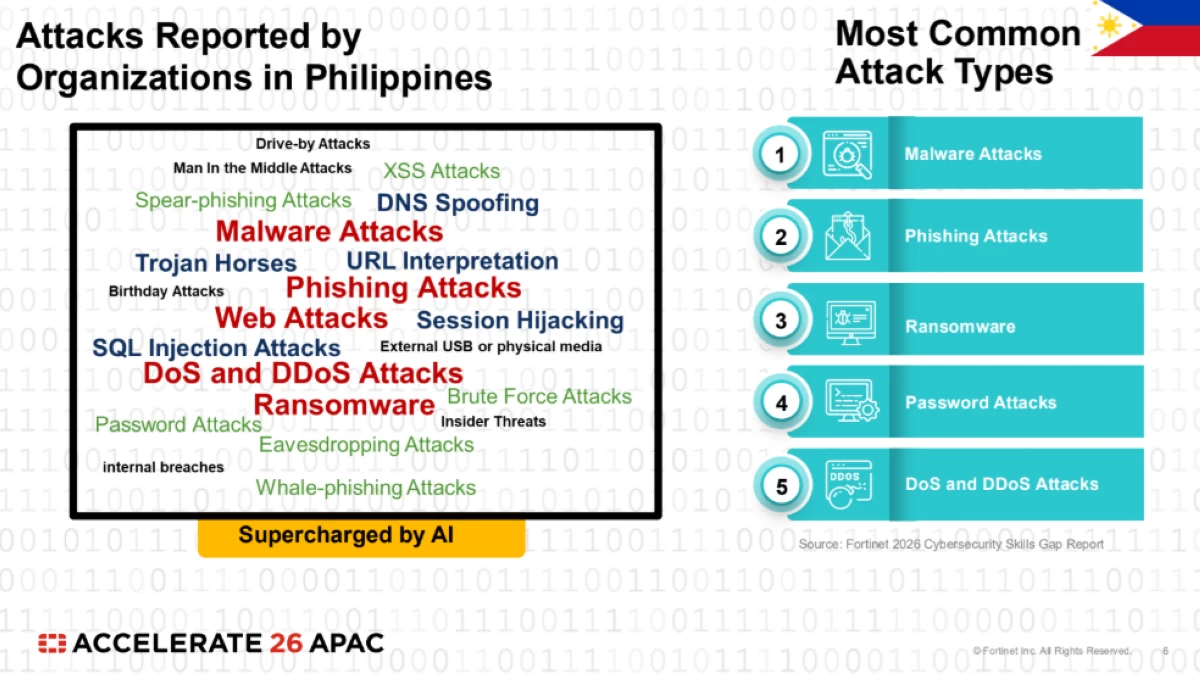
Philippine and Asia Pacific organizations are struggling to keep up with a rapidly escalating cybersecurity landscape, according to new research commissioned by Fortinet and conducted by Forrester Consulting. The study reveals a widening gap between the sophistication of modern cyber threats and the operational readiness of organizations tasked with defending against them.
AI-driven threats now a top concern for Filipino and APAC security teams
More than half of organizations surveyed, 57%, identified AI-driven cyberattacks as a primary concern, signaling a turning point in how security teams must think about adversarial capabilities. Attackers are increasingly leveraging artificial intelligence to automate intrusions, craft more convincing phishing campaigns, and identify vulnerabilities at machine speed.
Yet internal challenges are compounding the external threat. Fifty-four percent of respondents flagged fragmented security tools and architecture as a top issue, while the same share cited overwhelming alert volumes as a persistent drain on analyst capacity. Half of all organizations (50%) said the sheer volume of alerts makes it genuinely difficult to distinguish real threats from noise, a condition that creates dangerous blind spots in security operations.
Manual workflows remain deeply entrenched: 48% of organizations still rely on them for core security processes, leaving response times slower than the threats they face.
Cybersecurity maturity remains low across the region
The study paints a stark picture of security maturity in the Asia Pacific region. Sixty-eight percent of organizations sit at an intermediate maturity level, while only 16% have achieved an advanced security posture. This means the vast majority of organizations, including those in the Philippines, are operating with meaningful gaps in their defenses even as threats grow more complex and automated.
The platform consolidation shift: From fragmented tools to unified security
In response to these pressures, organizations are moving away from multi-vendor, fragmented toolsets toward unified, platform-based security architectures. Currently, only 20% of organizations operate a consolidated security platform — but that figure is expected to nearly triple to 59% within the next 12 to 24 months.
The drivers behind this shift are clear:
58% want to reduce tool sprawl
52% are seeking better integration across security functions
49% are managing growing hybrid IT complexity
The expected payoff is substantial. Ninety percent of organizations anticipate measurable operational improvements from consolidation, with more than 60% projecting at least a 10% gain in detection and response times, analyst productivity, and overall security operations center (SOC) efficiency.
Still, barriers remain. Fifty-one percent of organizations cite migration costs and disruption risk as obstacles to consolidation, while 46% express uncertainty about whether platform solutions can adequately cover all security domains they require.
AI investment is rising, but readiness isn't keeping pace
Artificial intelligence is emerging as both a threat multiplier and a critical defensive tool, and organizations are betting heavily on the latter. Ninety-one percent of organizations plan to grow their AI security budgets, with more than half expecting double-digit investment increases.
The anticipated benefits are wide-ranging:
Over 60% expect AI to improve threat detection accuracy and accelerate incident response
58% expect AI to enforce security policies more consistently
57% anticipate centralized control and visibility
56% expect reduced reliance on manual workflows
However, the study highlights a critical gap between AI ambition and AI readiness. Fragmented environments, limited automation maturity, and the absence of unified data foundations are undermining organizations' ability to operationalize AI at scale. Many are still building the baseline capabilities that effective AI-driven security requires.
What this means for Philippine organizations
For businesses and government agencies in the Philippines, the findings carry direct implications. As cloud adoption deepens, hybrid workforces expand, and digital services multiply, the attack surface continues to grow. Organizations that remain at intermediate security maturity — with fragmented tools, manual workflows, and no AI integration — face mounting exposure to threats that are already AI-augmented on the attacker's side.
The research suggests that the organizations best positioned to close this gap will be those that:
Consolidate onto integrated, platform-based security architectures
Build the data and automation foundations needed to make AI operational — not just aspirational
Prioritize SOC automation and improved threat visibility alongside detection and response capabilities
The window for incremental approaches is narrowing. With 91% of regional peers increasing AI security investment and platform adoption set to nearly triple, the cost of standing still is rising alongside the threats themselves.