ADVERTISEMENT

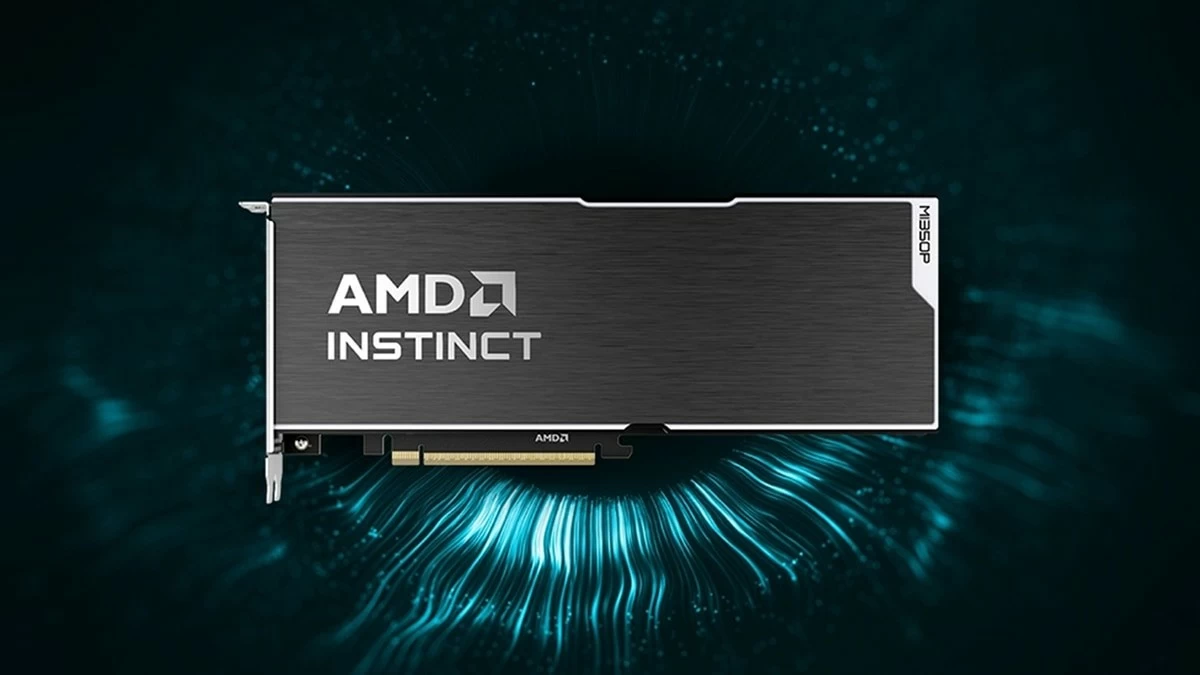
AMD launches Instinct MI350P PCIe GPUs to bring enterprise AI into existing data centers

AMD's newest GPU accelerator cards promise top-tier AI inference performance without requiring costly data center overhauls, a move that could reshape how enterprises approach on-premises AI deployment.

Published May 13, 2026 08:28 am
Advanced Micro Devices (AMD) has unveiled the AMD Instinct MI350P PCIe GPU cards, a new line of enterprise-grade AI accelerators engineered to slot into standard air-cooled server racks without requiring infrastructure upgrades. The launch targets a fast-growing segment of organizations that need serious AI computing power but aren't ready or able to rebuild their data centers around dedicated GPU platforms.
Drop-in AI performance for standard server racks
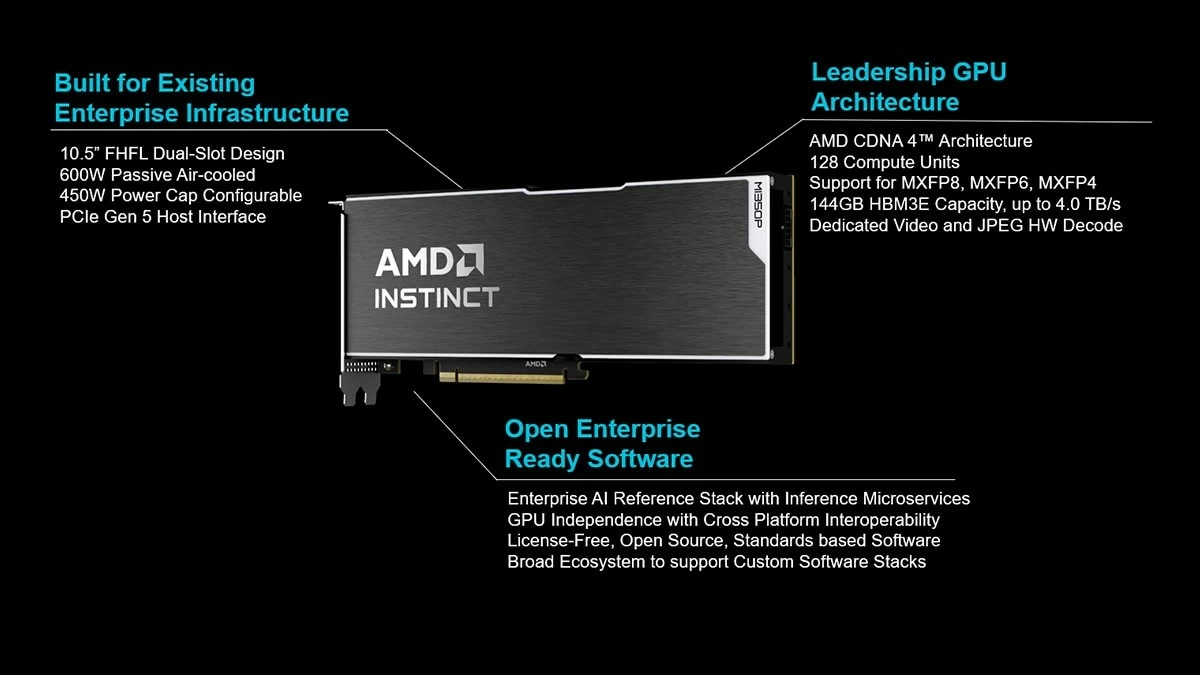
The MI350P cards are dual-slot, PCIe form factor accelerators designed to work within existing power, cooling, and rack infrastructure. For IT decision-makers weighing the costs of cloud AI versus on-premises deployment, the new cards offer a middle path: high-throughput AI inference on hardware organizations already own.
The cards are available in air-cooled systems supporting up to eight accelerator cards per server, making them suitable for a wide range of deployment scales from small business AI pilots to large enterprise inference pipelines.
Headline Specs: 4,600 Peak TFLOPS and 144GB HBM3E Memory
AMD is positioning the MI350P as the highest-performing enterprise PCIe card currently on the market, citing an estimated 2,299 TFLOPS of AI compute with peak performance reaching 4,600 TFLOPS at MXFP4 precision. The cards are also equipped with 144GB of HBM3E memory running at up to 4TB/s bandwidth — figures that place them at the top end of the PCIe accelerator market.
Key hardware features include:
Native support for lower-precision MXFP6 and MXFP4 formats for maximum throughput
Sparsity acceleration for mainstream 8-bit and 16-bit precision workloads
Support for FP8, MXFP8, INT8, and BF16 — covering the full range of enterprise AI model precision requirements
The breadth of supported precision formats is central to AMD's pitch: the MI350P can handle today's most demanding inference workloads without requiring liquid cooling or specialized power infrastructure.
Open ecosystem, no per-token licensing costs
Beyond the hardware, AMD is emphasizing the economics of its software stack. The company provides an open-source AMD enterprise AI reference stack to partners at no licensing cost, with the goal of lowering operating expenses compared to cloud-based AI services that charge per token.
The software ecosystem includes native support for PyTorch, a Kubernetes GPU Operator for full lifecycle management, and AMD Inference Microservices, all designed to enable organizations to migrate existing inference workloads with minimal code changes. AMD frames the stack as interoperable with a wide range of existing AI tools and pipelines.
Why this matters: The on-prem AI dilemma
Enterprises adopting AI at scale face a genuine infrastructure dilemma. Cloud AI services offer flexibility but can introduce data privacy concerns and unpredictable costs that scale with usage. Purpose-built GPU accelerator platforms offer raw performance but often demand expensive data center redesigns to accommodate new power and cooling requirements.
The MI350P is AMD's answer to this gap, positioning PCIe accelerator cards as a practical on-ramp for organizations that need to move beyond CPU-only inference but aren't ready to commit to a full GPU-native infrastructure buildout.
The cards are designed to support retrieval-augmented generation (RAG) pipelines and small-to-large model inference, two workload categories that have become central to enterprise AI deployments in 2025 and 2026.
Competing in the enterprise PCIe accelerator market
The MI350P enters a market where NVIDIA has long dominated with products like the L40S and the recently released Blackwell-based PCIe cards. AMD's pitch centers on the openness of its software stack and the total cost of ownership advantages of avoiding proprietary licensing fees, a strategy the company has used in its broader campaign to gain ground in the AI accelerator market.
With the MI350P, AMD is signaling that enterprise AI doesn't have to mean starting from scratch. For the many organizations sitting on racks of standard air-cooled servers and weighing their next AI infrastructure move, that message may land at exactly the right moment.

Related Tags

AMD AI enterprise AI
ADVERTISEMENT
.most-popular .layout-ratio{ padding-bottom: 79.13%; } @media (min-width: 768px) and (max-width: 1024px) { .widget-title { font-size: 15px !important; } }

{{ articles_filter_1561_widget.title }}

.most-popular .layout-ratio{ padding-bottom: 79.13%; } @media (min-width: 768px) and (max-width: 1024px) { .widget-title { font-size: 15px !important; } }

{{ articles_filter_1562_widget.title }}

.most-popular .layout-ratio{ padding-bottom: 79.13%; } @media (min-width: 768px) and (max-width: 1024px) { .widget-title { font-size: 15px !important; } }

{{ articles_filter_1563_widget.title }}

{{ articles_filter_1564_widget.title }}

.mb-article-details { position: relative; } .mb-article-details .article-body-preview, .mb-article-details .article-body-summary{ font-size: 17px; line-height: 30px; font-family: "Libre Caslon Text", serif; color: #000; } .mb-article-details .article-body-preview iframe , .mb-article-details .article-body-summary iframe{ width: 100%; margin: auto; } .read-more-background { background: linear-gradient(180deg, color(display-p3 1.000 1.000 1.000 / 0) 13.75%, color(display-p3 1.000 1.000 1.000 / 0.8) 30.79%, color(display-p3 1.000 1.000 1.000) 72.5%); position: absolute; height: 200px; width: 100%; bottom: 0; display: flex; justify-content: center; align-items: center; padding: 0; } .read-more-background a{ color: #000; } .read-more-btn { padding: 17px 45px; font-family: Inter; font-weight: 700; font-size: 18px; line-height: 16px; text-align: center; vertical-align: middle; border: 1px solid black; background-color: white; } .hidden { display: none; }
function initializeAllSwipers() { // Get all hidden inputs with cms_article_id document.querySelectorAll('[id^="cms_article_id_"]').forEach(function (input) { const cmsArticleId = input.value; const articleSelector = '#article-' + cmsArticleId + ' .body_images'; const swiperElement = document.querySelector(articleSelector); if (swiperElement && !swiperElement.classList.contains('swiper-initialized')) { new Swiper(articleSelector, { loop: true, pagination: false, navigation: { nextEl: '#article-' + cmsArticleId + ' .swiper-button-next', prevEl: '#article-' + cmsArticleId + ' .swiper-button-prev', }, }); } }); } setTimeout(initializeAllSwipers, 3000); const intersectionObserver = new IntersectionObserver( (entries) => { entries.forEach((entry) => { if (entry.isIntersecting) { const newUrl = entry.target.getAttribute("data-url"); if (newUrl) { history.pushState(null, null, newUrl); let article = entry.target; // Extract metadata const author = article.querySelector('.author-section').textContent.replace('By', '').trim(); const section = article.querySelector('.section-info ').textContent.replace(' ', ' '); const title = article.querySelector('.article-title h1').textContent; // Parse URL for Chartbeat path format const parsedUrl = new URL(newUrl, window.location.origin); const cleanUrl = parsedUrl.host + parsedUrl.pathname; // Update Chartbeat configuration if (typeof window._sf_async_config !== 'undefined') { window._sf_async_config.path = cleanUrl; window._sf_async_config.sections = section; window._sf_async_config.authors = author; } // Track virtual page view with Chartbeat if (typeof pSUPERFLY !== 'undefined' && typeof pSUPERFLY.virtualPage === 'function') { try { pSUPERFLY.virtualPage({ path: cleanUrl, title: title, sections: section, authors: author }); } catch (error) { console.error('ping error', error); } } // Optional: Update document title if (title && title !== document.title) { document.title = title; } } } }); }, { threshold: 0.1 } ); function showArticleBody(button) { const article = button.closest("article"); const summary = article.querySelector(".article-body-summary"); const body = article.querySelector(".article-body-preview"); const readMoreSection = article.querySelector(".read-more-background"); // Hide summary and read-more section summary.style.display = "none"; readMoreSection.style.display = "none"; // Show the full article body body.classList.remove("hidden"); } document.addEventListener("DOMContentLoaded", () => { let loadCount = 0; // Track how many times articles are loaded const offset = [1, 2, 3, 4, 5, 6, 7, 8, 9, 10]; // Offset values const currentUrl = window.location.pathname.substring(1); let isLoading = false; // Prevent multiple calls if (!currentUrl) { console.log("Current URL is invalid."); return; } const sentinel = document.getElementById("load-more-sentinel"); if (!sentinel) { console.log("Sentinel element not found."); return; } function isSentinelVisible() { const rect = sentinel.getBoundingClientRect(); return ( rect.top < window.innerHeight && rect.bottom >= 0 ); } function onScroll() { if (isLoading) return; if (isSentinelVisible()) { if (loadCount >= offset.length) { console.log("Maximum load attempts reached."); window.removeEventListener("scroll", onScroll); return; } isLoading = true; const currentOffset = offset[loadCount]; window.loadMoreItems().then(() => { let article = document.querySelector('#widget_1690 > div:nth-last-of-type(2) article'); intersectionObserver.observe(article) loadCount++; }).catch(error => { console.error("Error loading more items:", error); }).finally(() => { isLoading = false; }); } } window.addEventListener("scroll", onScroll); });

Sign up by email to receive news.