






Manila Bulletin
 Business
Trade & Industry
77% of Filipino workers are happy—but the reason isn't their salary
Business
Trade & Industry
77% of Filipino workers are happy—but the reason isn't their salary
Business
Trade & Industry
77% of Filipino workers are happy—but the reason isn't their salary
77% of Filipino workers are happy—but the reason isn't their salary
Published May 13, 2026 12:05 pm
|
Updated May 13, 2026 01:59 pm



Filipino workers rank as the second-happiest in the Asia-Pacific, though this upbeat sentiment is increasingly threatened by the rise in employee burnout and anxiety over the impact of artificial intelligence (AI).
Based on Jobstreet by SEEK’s Workplace Happiness Index: Philippines 2025, 77 percent of Filipino workers identify as either “extremely happy” or “somewhat happy,” a sentiment driven more by a sense of purpose and personal well-being than by financial compensation.
The survey, conducted between October and November 2025, gathered data from 10,500 employees across the region, including 1,000 respondents in the Philippines.
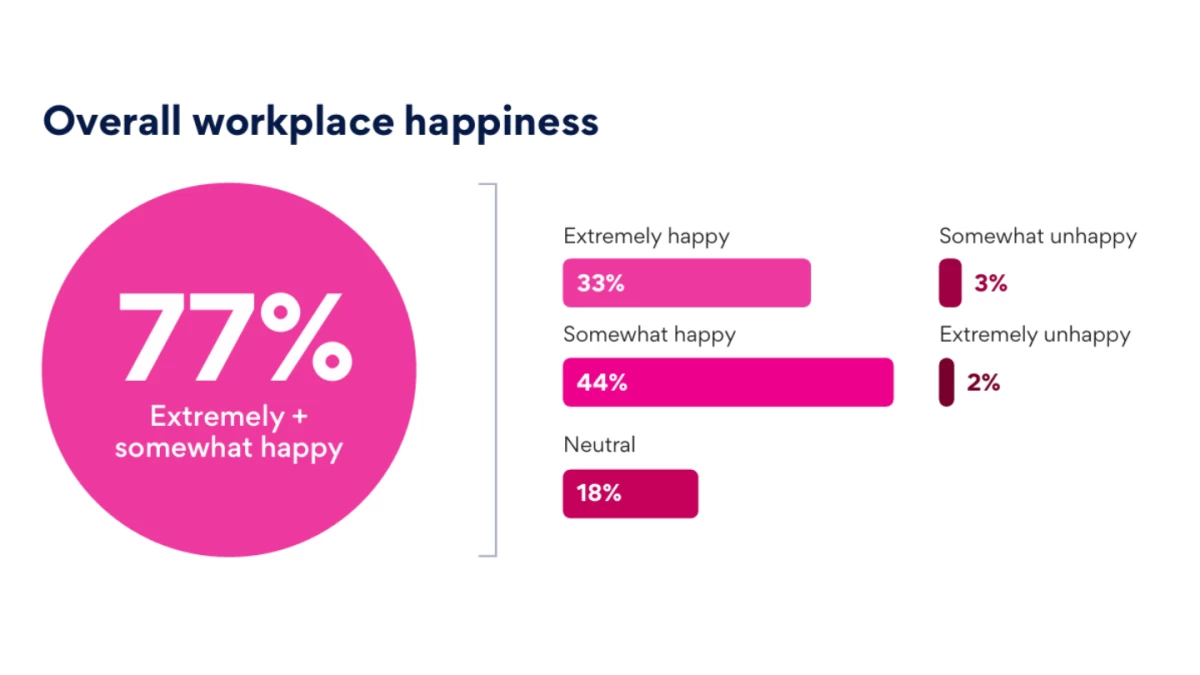
While Indonesia led the index with an 82 percent happiness rating, the Philippines secured the second spot, significantly outperforming regional peers like Singapore and Hong Kong.
Happiness levels across the Philippines remained largely consistent, suggesting a unified national sentiment. Residents of the Visayas reported the highest satisfaction at 82 percent, followed by the National Capital Region at 77 percent. Luzon and Mindanao followed closely, with both regions reporting a 76 percent happiness rate.
While salary remains the primary driver for attracting and retaining talent, the report found that “purpose”—defined as the alignment of individual work with company goals—has a more profound impact on long-term engagement.
Approximately 77 percent of respondents said they feel valued by their employers, and 74 percent described their roles as personally fulfilling.
However, the report also highlighted significant underlying pressures. Despite high satisfaction scores, 38 percent of Filipino workers said they are suffering from burnout or extreme exhaustion. Only 41 percent of respondents felt they had sufficient control over their daily stress levels. Career progression is another point of friction; 55 percent of workers admitted to frequently considering a career change, often citing the lack of clear development pathways as a reason for potential departure.
Emerging technologies are also weighing on the workforce. Roughly 41 percent of employees expressed concern regarding the impact of artificial intelligence on their job security. While these concerns have not yet dampened overall happiness, they represent a growing challenge for firms navigating digital transformations.
Dannah Majarocon, managing director of Jobstreet by SEEK in the Philippines, said the data shows that the work environment is the primary factor in shaping an employee’s sense of purpose.
Businesses that prioritize a culture of happiness are nearly twice as likely to see employees go beyond their basic job requirements, the report added, linking satisfaction directly to productivity and retention.