ADVERTISEMENT

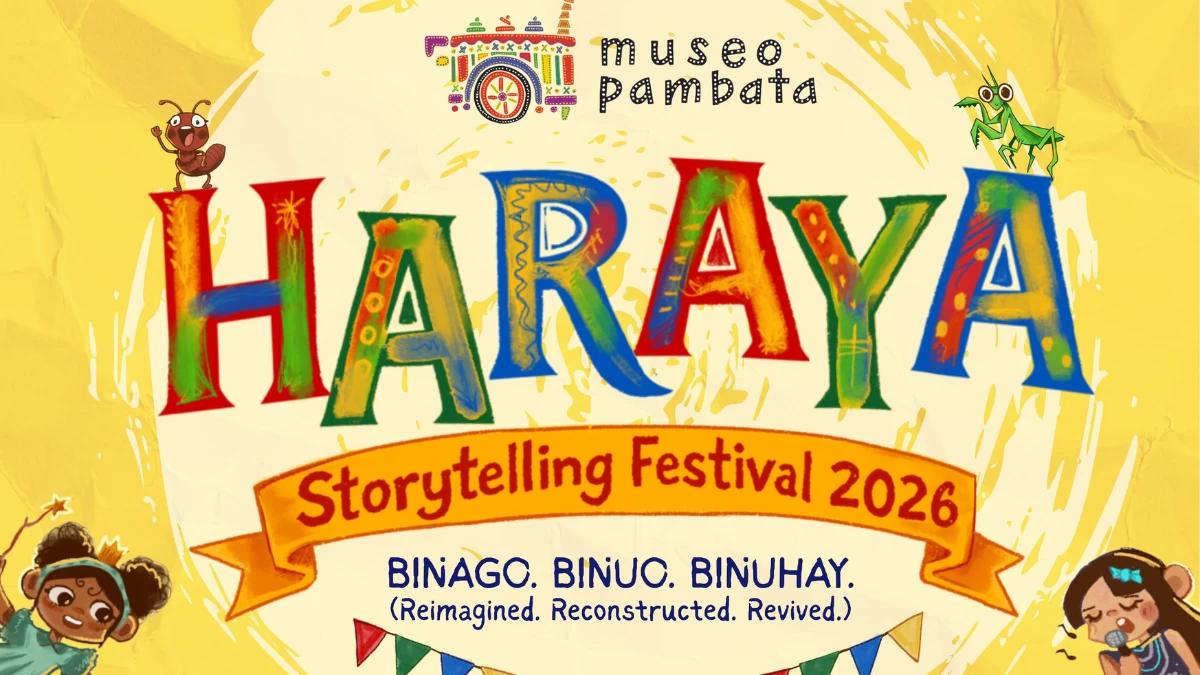
Haraya Storytelling Festival 2026 returns to Museo Pambata with the theme "Binago. Binuo. Binuhay."

Published May 12, 2026 09:41 am
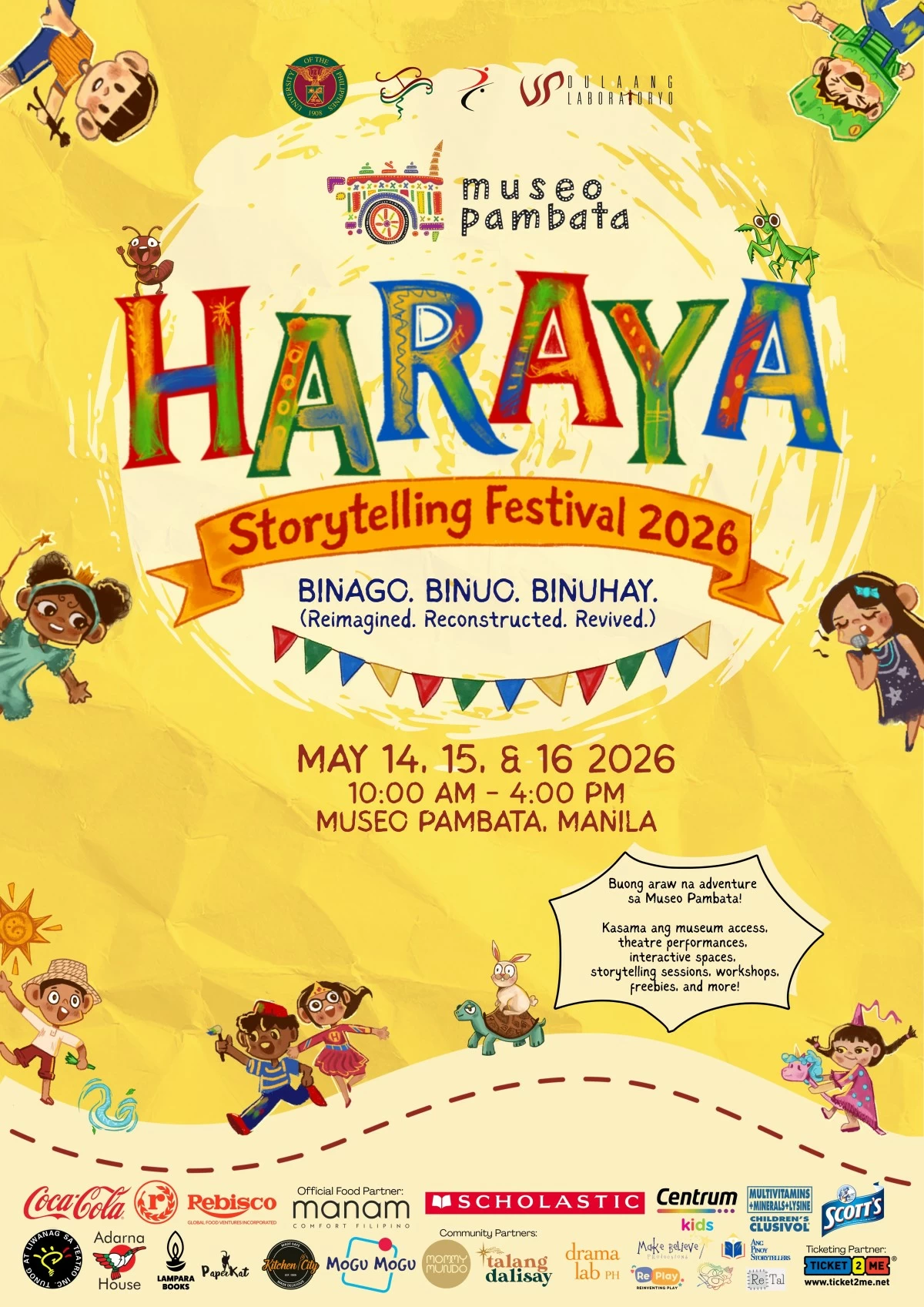
This May 14–16, 2026, Haraya Storytelling Festival returns to Museo Pambata, Manila, for a three-day celebration of storytelling, theatre, imagination, and creative play for children, families, educators, and communities.
Carrying the theme “Binago. Binuo. Binuhay.” (Reimagined. Reconstructed. Revived.), HARAYA 2026 invites audiences to experience familiar stories in new ways—through Filipino values, participatory performance, sustainable design, and immersive festival spaces that center children not merely as spectators, but as active co-creators of meaning.
Now in its new edition, HARAYA continues its mission of using storytelling and theatre as powerful tools for children’s holistic development, cultural identity, and community-building. The festival transforms Museo Pambata into a vibrant landscape of story worlds where children can watch, listen, move, imagine, make, and play.
(Check this link for Haraya 2025 highlights: https://www.youtube.com/watch?v=GxuhyxrsIzI&t=2s)
This year’s festival will feature three original performance works, three interactive workshops, and three immersive creative spaces, offering a full-day experience that merges art, learning, and play. Inspired by the theme, the performances revisit well-loved fables and inherited narratives through a more local, relational, and socially responsive lens.
Among the featured plays are:
BINAGO (Reimagined): Isa, Dalawa, Takbo!
Inspired by The Tortoise and the Hare, this adaptation transforms competition into collaboration, reframing the story through the spirit of fiesta, play, and bayanihan.
BINUO (Reconstructed): Bag(Y)o
Drawing from The Ant and the Grasshopper, this piece reconstructs the narrative around resilience, community care, and collective rebuilding after a storm.
BINUHAY (Revived): Si Amihan at Apolaki
Inspired by The North Wind and the Sun, this puppet performance revives the story through gentleness, empathy, and the quiet strength of malasakit.
Beyond the stage, HARAYA 2026 also highlights the role of festival scenography as pedagogy—where space, objects, sound, light, and audience interaction become part of the storytelling experience. Families can explore interactive installations, reading and play corners, imaginative environments, and hands-on activities designed to spark curiosity and creativity.
The festival also offers workshops for children, parents, teachers, artists, and facilitators, expanding HARAYA’s vision of storytelling as both an artistic practice and an educational tool. By bridging performance, literacy, play, and cultural engagement, HARAYA creates a shared space where stories are not only told, but lived. Workshops include storytelling for parents and teachers, improv for children, puppetry, and devising stories.
At its heart, HARAYA 2026 is also a call to rethink the stories we inherit. Through “Binago. Binuo. Binuhay.”, the festival asks: How might stories change when told through kapwa, bayanihan, and care? How can performance help children imagine new ways of being with others and with the world?
Haraya is a family-centered cultural and educational event and expects to gather children, parents, teachers, social workers, artists, volunteers, and partner communities across the three-day festival. Born from Kei Mamangun Sison’s MA creative research on performative storytelling for children’s holistic development, HARAYA is now an ongoing research platform in partnership with Museo Pambata and in collaboration with the University of the Philippines DSCTA through Dulaang Laboratoryo.
HARAYA Storytelling Festival 2026 will take place on May 14–16, 2026, at Museo Pambata, Manila.
Tickets available at https://forms.gle/aBR3BFAHwXCKiYeo6 or https://ticket2me.net/event/22931

Related Tags

Arts and Culture Haraya Storytelling Festival
ADVERTISEMENT
.most-popular .layout-ratio{ padding-bottom: 79.13%; } @media (min-width: 768px) and (max-width: 1024px) { .widget-title { font-size: 15px !important; } }

{{ articles_filter_1561_widget.title }}

.most-popular .layout-ratio{ padding-bottom: 79.13%; } @media (min-width: 768px) and (max-width: 1024px) { .widget-title { font-size: 15px !important; } }

{{ articles_filter_1562_widget.title }}

.most-popular .layout-ratio{ padding-bottom: 79.13%; } @media (min-width: 768px) and (max-width: 1024px) { .widget-title { font-size: 15px !important; } }

{{ articles_filter_1563_widget.title }}

{{ articles_filter_1564_widget.title }}

.mb-article-details { position: relative; } .mb-article-details .article-body-preview, .mb-article-details .article-body-summary{ font-size: 17px; line-height: 30px; font-family: "Libre Caslon Text", serif; color: #000; } .mb-article-details .article-body-preview iframe , .mb-article-details .article-body-summary iframe{ width: 100%; margin: auto; } .read-more-background { background: linear-gradient(180deg, color(display-p3 1.000 1.000 1.000 / 0) 13.75%, color(display-p3 1.000 1.000 1.000 / 0.8) 30.79%, color(display-p3 1.000 1.000 1.000) 72.5%); position: absolute; height: 200px; width: 100%; bottom: 0; display: flex; justify-content: center; align-items: center; padding: 0; } .read-more-background a{ color: #000; } .read-more-btn { padding: 17px 45px; font-family: Inter; font-weight: 700; font-size: 18px; line-height: 16px; text-align: center; vertical-align: middle; border: 1px solid black; background-color: white; } .hidden { display: none; }
function initializeAllSwipers() { // Get all hidden inputs with cms_article_id document.querySelectorAll('[id^="cms_article_id_"]').forEach(function (input) { const cmsArticleId = input.value; const articleSelector = '#article-' + cmsArticleId + ' .body_images'; const swiperElement = document.querySelector(articleSelector); if (swiperElement && !swiperElement.classList.contains('swiper-initialized')) { new Swiper(articleSelector, { loop: true, pagination: false, navigation: { nextEl: '#article-' + cmsArticleId + ' .swiper-button-next', prevEl: '#article-' + cmsArticleId + ' .swiper-button-prev', }, }); } }); } setTimeout(initializeAllSwipers, 3000); const intersectionObserver = new IntersectionObserver( (entries) => { entries.forEach((entry) => { if (entry.isIntersecting) { const newUrl = entry.target.getAttribute("data-url"); if (newUrl) { history.pushState(null, null, newUrl); let article = entry.target; // Extract metadata const author = article.querySelector('.author-section').textContent.replace('By', '').trim(); const section = article.querySelector('.section-info ').textContent.replace(' ', ' '); const title = article.querySelector('.article-title h1').textContent; // Parse URL for Chartbeat path format const parsedUrl = new URL(newUrl, window.location.origin); const cleanUrl = parsedUrl.host + parsedUrl.pathname; // Update Chartbeat configuration if (typeof window._sf_async_config !== 'undefined') { window._sf_async_config.path = cleanUrl; window._sf_async_config.sections = section; window._sf_async_config.authors = author; } // Track virtual page view with Chartbeat if (typeof pSUPERFLY !== 'undefined' && typeof pSUPERFLY.virtualPage === 'function') { try { pSUPERFLY.virtualPage({ path: cleanUrl, title: title, sections: section, authors: author }); } catch (error) { console.error('ping error', error); } } // Optional: Update document title if (title && title !== document.title) { document.title = title; } } } }); }, { threshold: 0.1 } ); function showArticleBody(button) { const article = button.closest("article"); const summary = article.querySelector(".article-body-summary"); const body = article.querySelector(".article-body-preview"); const readMoreSection = article.querySelector(".read-more-background"); // Hide summary and read-more section summary.style.display = "none"; readMoreSection.style.display = "none"; // Show the full article body body.classList.remove("hidden"); } document.addEventListener("DOMContentLoaded", () => { let loadCount = 0; // Track how many times articles are loaded const offset = [1, 2, 3, 4, 5, 6, 7, 8, 9, 10]; // Offset values const currentUrl = window.location.pathname.substring(1); let isLoading = false; // Prevent multiple calls if (!currentUrl) { console.log("Current URL is invalid."); return; } const sentinel = document.getElementById("load-more-sentinel"); if (!sentinel) { console.log("Sentinel element not found."); return; } function isSentinelVisible() { const rect = sentinel.getBoundingClientRect(); return ( rect.top < window.innerHeight && rect.bottom >= 0 ); } function onScroll() { if (isLoading) return; if (isSentinelVisible()) { if (loadCount >= offset.length) { console.log("Maximum load attempts reached."); window.removeEventListener("scroll", onScroll); return; } isLoading = true; const currentOffset = offset[loadCount]; window.loadMoreItems().then(() => { let article = document.querySelector('#widget_1690 > div:nth-last-of-type(2) article'); intersectionObserver.observe(article) loadCount++; }).catch(error => { console.error("Error loading more items:", error); }).finally(() => { isLoading = false; }); } } window.addEventListener("scroll", onScroll); });

Sign up by email to receive news.