ADVERTISEMENT

Samsung announces fainting prediction with Galaxy Watch

Published May 11, 2026 07:58 am
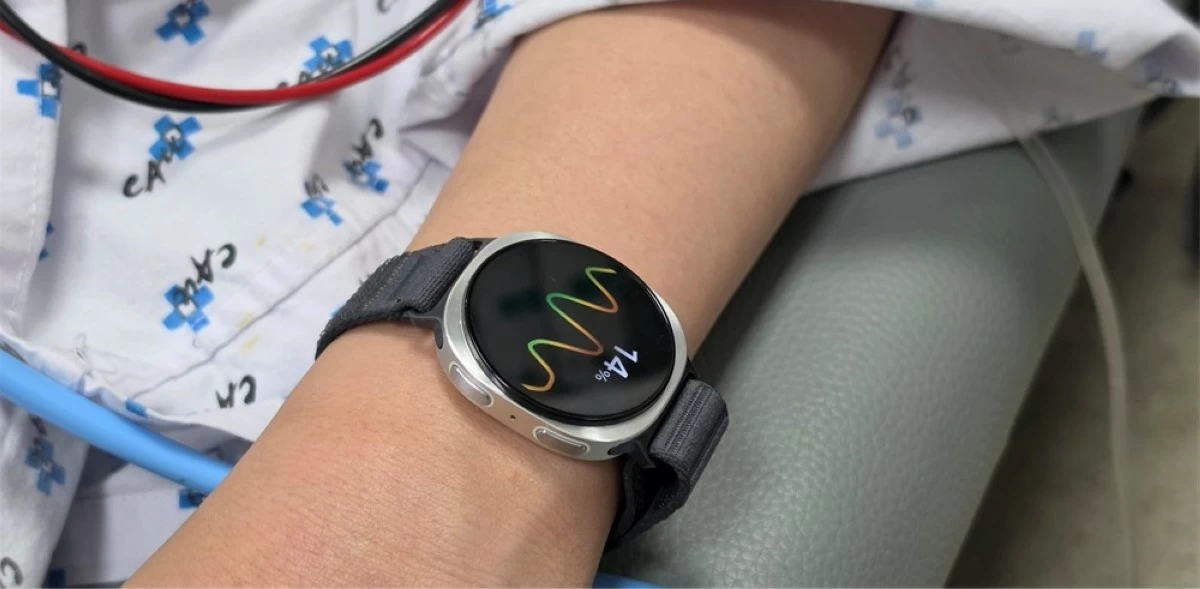
Samsung announced that a joint clinical study with Chung-Ang University Gwangmyeong Hospital in Korea has successfully validated the ability to predict vasovagal syncope (VVS) with high accuracy by utilizing biosignals obtained from Galaxy Watch6.
Vasovagal syncope occurs when a person’s heart rate and blood pressure drop abruptly due to factors like excessive stress, leading to a temporary loss of consciousness. While the fainting spell itself is typically not life-threatening, sudden falls can cause severe secondary injuries like fractures or concussions, making early prediction critically important for prevention.
“Up to 40% of people experience vasovagal syncope over their lifetime, with one-third experiencing recurrent episodes,” said Professor Junhwan Cho, Department of Cardiology, Chung-Ang University Gwangmyeong Hospital. “An early warning could give patients advance time to get into a safe position or call for help, which would dramatically reduce the incidence of secondary injuries.”
The joint research team, led by Professor Cho, conducted evaluations on 132 patients with suspected VVS symptoms during induced fainting tests. Using a Galaxy Watch equipped with a photoplethysmography (PPG) sensor, the team analyzed the watch’s heart rate variability (HRV) data with an AI algorithm. The model successfully predicted impending fainting episodes up to five minutes in advance with 84.6 percent accuracy, at a clinically meaningful sensitivity of 90 percent and a specificity of 64 percent.
“This study is an example of how wearable technology can help shift healthcare from being designed for ‘post-care’ to a model of ‘preventive care,’” said Jongmin Choi, head of health R&D Group, mobile eXperience (MX) Business, Samsung Electronics. “We are committed to driving technological innovation that empowers our users to lead healthier everyday lives.”
The research findings were published in Volume 7, Issue 4 of “European Heart Journal – Digital Health,” a leading medical journal and they represent the world’s first study to successfully demonstrate the potential for a commercial smartwatch to provide early prediction of syncope.
Samsung plans to further advance the health monitoring capabilities of its wearable portfolio and expand collaboration with leading medical institutions. Through these efforts, the company aims to lead the digital health industry and accelerate the implementation of personalized, preventive health solutions.

Related Tags

Samsung Galaxy Watch Galaxy Watch6 Fainting Prediction
ADVERTISEMENT
.most-popular .layout-ratio{ padding-bottom: 79.13%; } @media (min-width: 768px) and (max-width: 1024px) { .widget-title { font-size: 15px !important; } }

{{ articles_filter_1561_widget.title }}

.most-popular .layout-ratio{ padding-bottom: 79.13%; } @media (min-width: 768px) and (max-width: 1024px) { .widget-title { font-size: 15px !important; } }

{{ articles_filter_1562_widget.title }}

.most-popular .layout-ratio{ padding-bottom: 79.13%; } @media (min-width: 768px) and (max-width: 1024px) { .widget-title { font-size: 15px !important; } }

{{ articles_filter_1563_widget.title }}

{{ articles_filter_1564_widget.title }}

.mb-article-details { position: relative; } .mb-article-details .article-body-preview, .mb-article-details .article-body-summary{ font-size: 17px; line-height: 30px; font-family: "Libre Caslon Text", serif; color: #000; } .mb-article-details .article-body-preview iframe , .mb-article-details .article-body-summary iframe{ width: 100%; margin: auto; } .read-more-background { background: linear-gradient(180deg, color(display-p3 1.000 1.000 1.000 / 0) 13.75%, color(display-p3 1.000 1.000 1.000 / 0.8) 30.79%, color(display-p3 1.000 1.000 1.000) 72.5%); position: absolute; height: 200px; width: 100%; bottom: 0; display: flex; justify-content: center; align-items: center; padding: 0; } .read-more-background a{ color: #000; } .read-more-btn { padding: 17px 45px; font-family: Inter; font-weight: 700; font-size: 18px; line-height: 16px; text-align: center; vertical-align: middle; border: 1px solid black; background-color: white; } .hidden { display: none; }
function initializeAllSwipers() { // Get all hidden inputs with cms_article_id document.querySelectorAll('[id^="cms_article_id_"]').forEach(function (input) { const cmsArticleId = input.value; const articleSelector = '#article-' + cmsArticleId + ' .body_images'; const swiperElement = document.querySelector(articleSelector); if (swiperElement && !swiperElement.classList.contains('swiper-initialized')) { new Swiper(articleSelector, { loop: true, pagination: false, navigation: { nextEl: '#article-' + cmsArticleId + ' .swiper-button-next', prevEl: '#article-' + cmsArticleId + ' .swiper-button-prev', }, }); } }); } setTimeout(initializeAllSwipers, 3000); const intersectionObserver = new IntersectionObserver( (entries) => { entries.forEach((entry) => { if (entry.isIntersecting) { const newUrl = entry.target.getAttribute("data-url"); if (newUrl) { history.pushState(null, null, newUrl); let article = entry.target; // Extract metadata const author = article.querySelector('.author-section').textContent.replace('By', '').trim(); const section = article.querySelector('.section-info ').textContent.replace(' ', ' '); const title = article.querySelector('.article-title h1').textContent; // Parse URL for Chartbeat path format const parsedUrl = new URL(newUrl, window.location.origin); const cleanUrl = parsedUrl.host + parsedUrl.pathname; // Update Chartbeat configuration if (typeof window._sf_async_config !== 'undefined') { window._sf_async_config.path = cleanUrl; window._sf_async_config.sections = section; window._sf_async_config.authors = author; } // Track virtual page view with Chartbeat if (typeof pSUPERFLY !== 'undefined' && typeof pSUPERFLY.virtualPage === 'function') { try { pSUPERFLY.virtualPage({ path: cleanUrl, title: title, sections: section, authors: author }); } catch (error) { console.error('ping error', error); } } // Optional: Update document title if (title && title !== document.title) { document.title = title; } } } }); }, { threshold: 0.1 } ); function showArticleBody(button) { const article = button.closest("article"); const summary = article.querySelector(".article-body-summary"); const body = article.querySelector(".article-body-preview"); const readMoreSection = article.querySelector(".read-more-background"); // Hide summary and read-more section summary.style.display = "none"; readMoreSection.style.display = "none"; // Show the full article body body.classList.remove("hidden"); } document.addEventListener("DOMContentLoaded", () => { let loadCount = 0; // Track how many times articles are loaded const offset = [1, 2, 3, 4, 5, 6, 7, 8, 9, 10]; // Offset values const currentUrl = window.location.pathname.substring(1); let isLoading = false; // Prevent multiple calls if (!currentUrl) { console.log("Current URL is invalid."); return; } const sentinel = document.getElementById("load-more-sentinel"); if (!sentinel) { console.log("Sentinel element not found."); return; } function isSentinelVisible() { const rect = sentinel.getBoundingClientRect(); return ( rect.top < window.innerHeight && rect.bottom >= 0 ); } function onScroll() { if (isLoading) return; if (isSentinelVisible()) { if (loadCount >= offset.length) { console.log("Maximum load attempts reached."); window.removeEventListener("scroll", onScroll); return; } isLoading = true; const currentOffset = offset[loadCount]; window.loadMoreItems().then(() => { let article = document.querySelector('#widget_1690 > div:nth-last-of-type(2) article'); intersectionObserver.observe(article) loadCount++; }).catch(error => { console.error("Error loading more items:", error); }).finally(() => { isLoading = false; }); } } window.addEventListener("scroll", onScroll); });

Sign up by email to receive news.