

ADVERTISEMENT

Are you suitable for a MINT session?

Here's what you need to know about this Korean procedure

Published May 11, 2026 11:46 am

At A Glance

  • In practice, a MINT session looks unspectacular, which is part of its appeal.
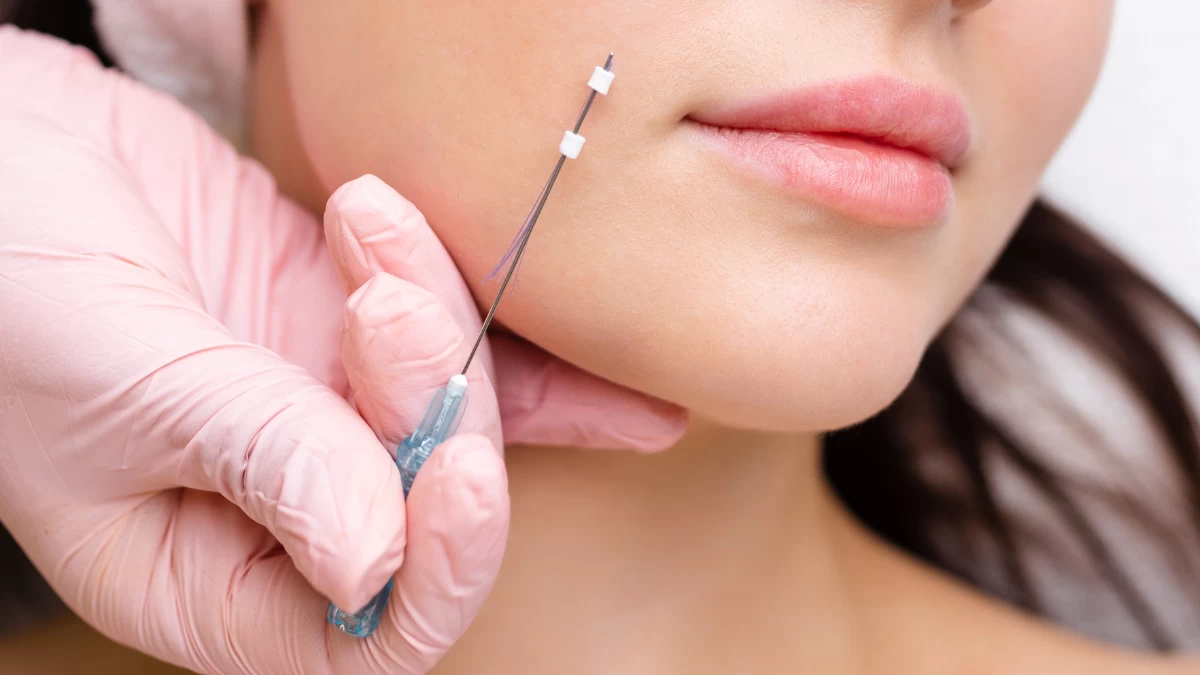
Every few years, a procedure comes along that seems to capture the imagination of patients faster than physicians can keep up. Lately, in my consultation room, the procedure is the thread lift, and more specifically, a Korean innovation called MINT.
The acronym stands for Minimally Invasive Nonsurgical Thread. It was developed by HansBiomed, a Seoul-based biotech company that built its reputation in tissue engineering, breast implants, and surgical sutures before turning its attention to facial rejuvenation. The threads themselves are made of polydioxanone (PDO), the same absorbable material cardiothoracic and orthopedic surgeons have used safely for more than three decades. What makes MINT different from the older PDO threads many of us have used since the 2010s is the way its barbs are made. Conventional cog threads are produced by cutting notches into the suture, which inevitably weakens the core. MINT uses a patented press-molded technology that forms barbs onto the surface of the thread in a 360-degree helical pattern, preserving tensile strength and giving the thread a more uniform grip in the tissue. The Korean Ministry of Food and Drug Safety cleared MINT Lift for facial soft tissue fixation, and between 2013 and 2022, it received three US FDA 510(k) clearances, the most recent for facial suspension surgery of the temporal area, midface, jowls, jawline, neck, and brow.
In practice, a MINT session looks unspectacular, which is part of its appeal. After mapping the lift vectors and infiltrating local anesthesia, threads are inserted through a fine cannula along the deep subcutaneous plane. The tissue is then gently advanced over the cogs and anchored. The whole procedure takes 30 to 90 minutes, depending on the number of threads and treatment areas. Patients walk out with an immediate, modest lift and return to ordinary life, work, school runs, dinners, within a day or two. Mild swelling, tenderness, and bruising are normal for a week; small areas of dimpling can occur and usually self-resolve.
The science behind the longer-term result is the more interesting part. PDO threads create a controlled micro-injury that activates fibroblasts. New collagen forms around the thread over several weeks, supported by neovascularization, the formation of small new blood vessels. By the time the thread itself is fully absorbed in six to eight months, a fibrous scaffold has taken its place. That is why visible results commonly hold for 12 to 18 months, sometimes up to two years, in patients with good skin quality and lifestyle habits. MINT comes in a family of products (Lift, Fine, Easy, Mono, among others), so the thread can be matched to the anatomy: thicker bidirectional barbed threads for the jowls and neck, finer multidirectional threads for the cheeks, and smooth mono threads purely for collagen induction.
Who is it for? In my experience, the ideal candidate is between her late 30s and late 50s, with mild to moderate skin laxity, early jowling, a softening jawline, descending midface, marionette lines, or a heavy brow, and reasonable skin thickness. It is not a substitute for a surgical facelift in patients with significant excess skin, deep platysmal banding, or heavy submental fat; in those cases, threads may disappoint or, worse, dimple visibly. Pregnancy, active infection, autoimmune flares, bleeding disorders, and known keloid tendency are reasons to defer.
Compared with other thread systems we see locally, Silhouette InstaLift (PLLA cones, longer-lasting collagen stimulation but a different lift mechanism) and APTOS (Russian-origin, with PDO and caprolactone variants), MINT’s distinguishing claim is that of a molded helical barb and the depth of its regulatory paper trail. Honesty compels me to add that no thread, regardless of brand, performs miracles in the wrong hands. Published meta-analyses report complication rates of roughly 30–35 percent, mostly transient swelling and bruising, but also dimpling, palpability, asymmetry, infection (around two percent), and rarely nerve injury or thread extrusion. The single most important determinant of a good result is the physician’s training, anatomical knowledge, and restraint.
MINT fits neatly into a global aesthetic mood I find genuinely refreshing. After years of overfilled cheeks and frozen foreheads, 2025 and 2026 have ushered in what colleagues abroad are calling the InvisiLift or quiet luxury face, undetectable, regenerative, mobile. Filipino patients, in my observation, were always more inclined this way. The brief we hear most often is not “I want to look different,” but “I want to look rested.” Threads, used judiciously and combined with good skincare, sun protection, and energy-based devices like ultrasound or radiofrequency, can deliver exactly that.
A final reminder, as always: a thread is only a tool. The hand that places it, the face it is placed in, and the realistic conversation that precedes it are what determine whether you walk out looking lifted, or simply looking like yourself, on a very good day.

Related Tags

HEALTH MINT Health and Wellness
ADVERTISEMENT
.most-popular .layout-ratio{ padding-bottom: 79.13%; } @media (min-width: 768px) and (max-width: 1024px) { .widget-title { font-size: 15px !important; } }

{{ articles_filter_1561_widget.title }}

.most-popular .layout-ratio{ padding-bottom: 79.13%; } @media (min-width: 768px) and (max-width: 1024px) { .widget-title { font-size: 15px !important; } }

{{ articles_filter_1562_widget.title }}

.most-popular .layout-ratio{ padding-bottom: 79.13%; } @media (min-width: 768px) and (max-width: 1024px) { .widget-title { font-size: 15px !important; } }

{{ articles_filter_1563_widget.title }}

{{ articles_filter_1564_widget.title }}

.mb-article-details { position: relative; } .mb-article-details .article-body-preview, .mb-article-details .article-body-summary{ font-size: 17px; line-height: 30px; font-family: "Libre Caslon Text", serif; color: #000; } .mb-article-details .article-body-preview iframe , .mb-article-details .article-body-summary iframe{ width: 100%; margin: auto; } .read-more-background { background: linear-gradient(180deg, color(display-p3 1.000 1.000 1.000 / 0) 13.75%, color(display-p3 1.000 1.000 1.000 / 0.8) 30.79%, color(display-p3 1.000 1.000 1.000) 72.5%); position: absolute; height: 200px; width: 100%; bottom: 0; display: flex; justify-content: center; align-items: center; padding: 0; } .read-more-background a{ color: #000; } .read-more-btn { padding: 17px 45px; font-family: Inter; font-weight: 700; font-size: 18px; line-height: 16px; text-align: center; vertical-align: middle; border: 1px solid black; background-color: white; } .hidden { display: none; }
function initializeAllSwipers() { // Get all hidden inputs with cms_article_id document.querySelectorAll('[id^="cms_article_id_"]').forEach(function (input) { const cmsArticleId = input.value; const articleSelector = '#article-' + cmsArticleId + ' .body_images'; const swiperElement = document.querySelector(articleSelector); if (swiperElement && !swiperElement.classList.contains('swiper-initialized')) { new Swiper(articleSelector, { loop: true, pagination: false, navigation: { nextEl: '#article-' + cmsArticleId + ' .swiper-button-next', prevEl: '#article-' + cmsArticleId + ' .swiper-button-prev', }, }); } }); } setTimeout(initializeAllSwipers, 3000); const intersectionObserver = new IntersectionObserver( (entries) => { entries.forEach((entry) => { if (entry.isIntersecting) { const newUrl = entry.target.getAttribute("data-url"); if (newUrl) { history.pushState(null, null, newUrl); let article = entry.target; // Extract metadata const author = article.querySelector('.author-section').textContent.replace('By', '').trim(); const section = article.querySelector('.section-info ').textContent.replace(' ', ' '); const title = article.querySelector('.article-title h1').textContent; // Parse URL for Chartbeat path format const parsedUrl = new URL(newUrl, window.location.origin); const cleanUrl = parsedUrl.host + parsedUrl.pathname; // Update Chartbeat configuration if (typeof window._sf_async_config !== 'undefined') { window._sf_async_config.path = cleanUrl; window._sf_async_config.sections = section; window._sf_async_config.authors = author; } // Track virtual page view with Chartbeat if (typeof pSUPERFLY !== 'undefined' && typeof pSUPERFLY.virtualPage === 'function') { try { pSUPERFLY.virtualPage({ path: cleanUrl, title: title, sections: section, authors: author }); } catch (error) { console.error('ping error', error); } } // Optional: Update document title if (title && title !== document.title) { document.title = title; } } } }); }, { threshold: 0.1 } ); function showArticleBody(button) { const article = button.closest("article"); const summary = article.querySelector(".article-body-summary"); const body = article.querySelector(".article-body-preview"); const readMoreSection = article.querySelector(".read-more-background"); // Hide summary and read-more section summary.style.display = "none"; readMoreSection.style.display = "none"; // Show the full article body body.classList.remove("hidden"); } document.addEventListener("DOMContentLoaded", () => { let loadCount = 0; // Track how many times articles are loaded const offset = [1, 2, 3, 4, 5, 6, 7, 8, 9, 10]; // Offset values const currentUrl = window.location.pathname.substring(1); let isLoading = false; // Prevent multiple calls if (!currentUrl) { console.log("Current URL is invalid."); return; } const sentinel = document.getElementById("load-more-sentinel"); if (!sentinel) { console.log("Sentinel element not found."); return; } function isSentinelVisible() { const rect = sentinel.getBoundingClientRect(); return ( rect.top < window.innerHeight && rect.bottom >= 0 ); } function onScroll() { if (isLoading) return; if (isSentinelVisible()) { if (loadCount >= offset.length) { console.log("Maximum load attempts reached."); window.removeEventListener("scroll", onScroll); return; } isLoading = true; const currentOffset = offset[loadCount]; window.loadMoreItems().then(() => { let article = document.querySelector('#widget_1690 > div:nth-last-of-type(2) article'); intersectionObserver.observe(article) loadCount++; }).catch(error => { console.error("Error loading more items:", error); }).finally(() => { isLoading = false; }); } } window.addEventListener("scroll", onScroll); });

Sign up by email to receive news.