






Manila Bulletin
 World
Plane carrying Spanish passengers from hantavirus-stricken MV Hondius cruise ship leaves for Madrid
World
Plane carrying Spanish passengers from hantavirus-stricken MV Hondius cruise ship leaves for Madrid
World
Plane carrying Spanish passengers from hantavirus-stricken MV Hondius cruise ship leaves for Madrid
Plane carrying Spanish passengers from hantavirus-stricken MV Hondius cruise ship leaves for Madrid
Published May 10, 2026 06:10 pm


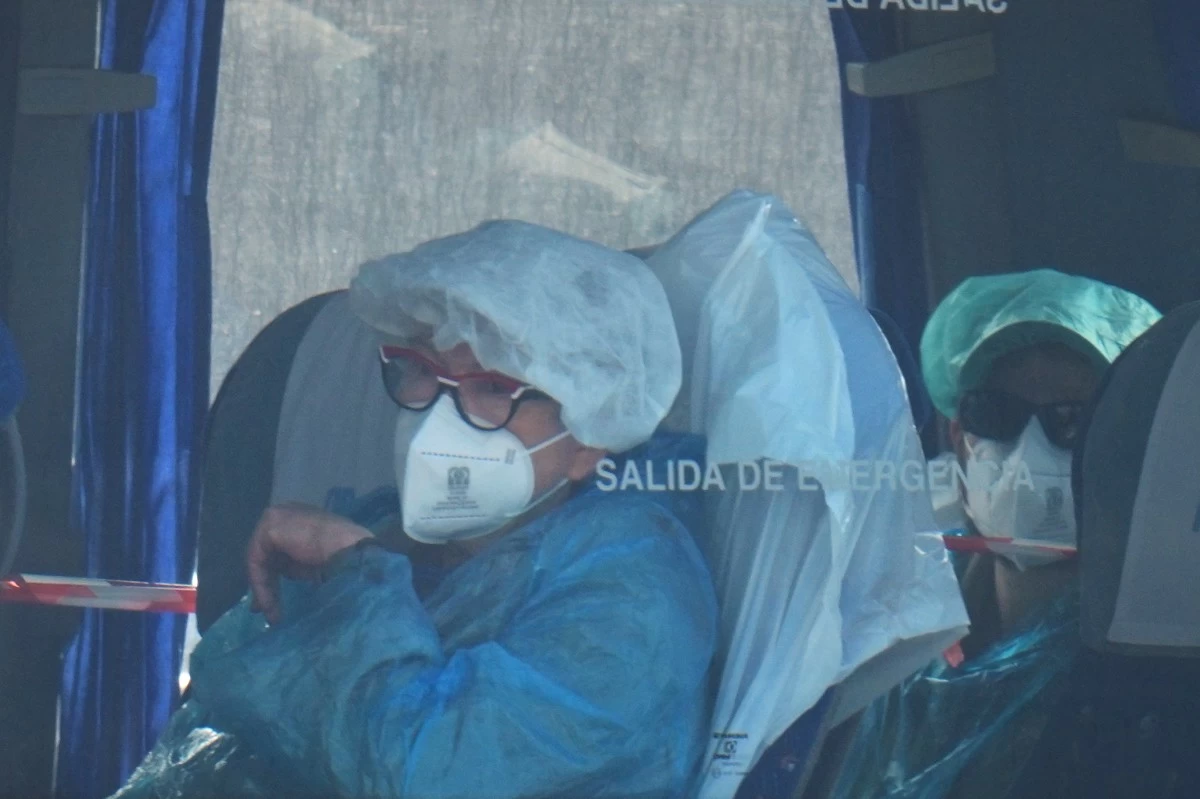
Passengers sit inside a bus after being disembarked from the hantavirus-stricken cruise ship MV Hondius at the port of Granadilla in Tenerife, Canary Islands, Spain, Sunday, May 10, 2026. (AP Photo/Manu Fernandez)
TENERIFE, Canary Islands (AP) — The first plane carrying passengers evacuated from the hantavirus-hit cruise ship departed from Tenerife in Spain's Canary Islands on Sunday for Madrid, where they will go to a military hospital.
Spanish nationals were the first to leave the MV Hondius, which remains anchored off Tenerife after arriving hours earlier, and they will be under quarantine after they reach Madrid, Spanish health authorities say. Only Spanish nationals will quarantine in the country.
The cruise operator Oceanwide Expeditions listed 13 Spanish passengers and one Spanish crew member on board.
Nobody among the more than 140 people on the Hondius is showing symptoms of the virus, Spain's health ministry, the World Health Organization and cruise company Oceanwide Expeditions said.
Passengers and some crew members of other nationalities will be evacuated throughout Sunday into Monday. There were people of more than 20 different nationalities on board.
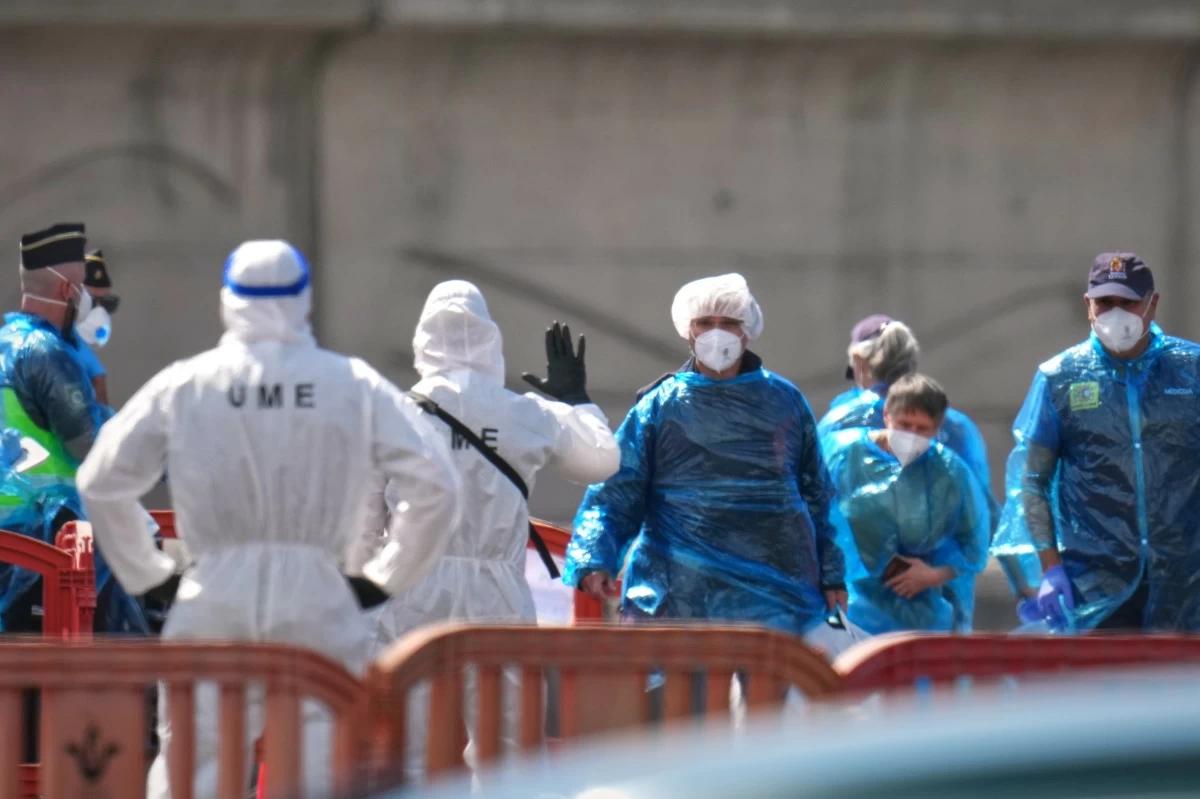
Passengers are disembarked from the hantavirus-stricken cruise ship MV Hondius at the port of Granadilla in Tenerife, Canary Islands, Spain, Sunday, May 10, 2026. (AP Photo/Manu Fernandez)
Those disembarking and personnel working at the port of Granadilla in Tenerife were wearing protective gear during the evacuation process, including face masks, hazmat suits and respirators.
The cruise ship reached Tenerife early Sunday morning, after leaving Cape Verde on May 6.
Three people have died since the outbreak, and five passengers who left the ship are infected with hantavirus, which can cause life-threatening illness.
Everyone disembarking will be checked for symptoms, and are being taken off the ship only once evacuation flights are ready to fly them to their destinations.
"The entire operation is proceeding normally," Spanish Health Minister Mónica García said.
WHO Director-General Tedros Adhanom Ghebreyesus, along with Spain's health and interior ministers, are supervising the operation in Tenerife, the largest of Spain's Canary Islands off the coast of West Africa.
Authorities have said the passengers and crew members who will disembark will have no contact with the local population.
Hantavirus usually spreads when people inhale contaminated residue of rodent droppings and isn't easily transmitted between people. But the Andes virus detected in the cruise ship outbreak may be able to spread between people in rare cases. Symptoms usually show between one and eight weeks after exposure.
Passengers and crew members disembarking are leaving behind their luggage, and are allowed to take only a small bag with essential items, a cellphone, charger and documentation.
Some crew, as well as the body of a passenger who died on board, will remain on the ship, which will sail on to Rotterdam, Netherlands where it will undergo disinfection, Spanish authorities said.
The expected sailing time to Rotterdam is around five days, the cruise company said.
Evacuation and quarantine plans
The U.S., the U.K. and the Netherlands are sending planes to evacuate their citizens. Americans on board will be quarantined at a medical center in Nebraska.
Twenty-nine people will be on board the Dutch charter flight, including Dutch nationals and people of other nationalities, the Dutch Foreign Ministry said.
Five French passengers will be repatriated Sunday, and will be hospitalized for 72 hours for monitoring, after which they will quarantine at home for 45 days, France's Foreign Ministry said.
U.K. passengers and crew will be hospitalized for observation once they are flown home, British authorities say.
Australia is sending a plane expected to arrive Monday to evacuate its nationals and those from nearby countries like New Zealand, García said. Its plane will be the last to leave Tenerife, she said.
Norway has sent an ambulance plane to Tenerife with personnel trained for the transport of patients with high-risk infections, its Directorate for Civil Protection told public broadcaster NRK.
The ambulance plane is owned by the European Union, but operated by Norway.
Countries monitor suspected cases
British Army medics have parachuted onto the remote south Atlantic territory of Tristan da Cunha, where one of the 221 residents has a suspected case of hantavirus.
The patient was a passenger on the MV Hondius and disembarked last month.
The U.K. defense ministry says a team of six paratroopers and two medical clinicians jumped Saturday from an Royal Air Force transport plane, which also dropped oxygen and medical equipment.
Tristan da Cunha is Britain's most remote inhabited overseas territory, about 1,500 miles (2,400 kilometers) from the nearest inhabited island, St. Helena. The group of volcanic islands has no airstrip and is usually accessible only by boat on a six-day voyage from Cape Town, South Africa.
Meanwhile, a Spanish woman in the southeastern province of Alicante suspected of being infected tested negative for hantavirus, Spanish health authorities said Saturday.
The woman was a passenger on the same flight as the Dutch woman who died in Johannesburg after traveling on the cruise ship.