






Manila Bulletin
 Business
The Stock Market
PSEi snaps rally on disappointing growth, geopolitical risk
Business
The Stock Market
PSEi snaps rally on disappointing growth, geopolitical risk
Business
The Stock Market
PSEi snaps rally on disappointing growth, geopolitical risk
PSEi snaps rally on disappointing growth, geopolitical risk
Published May 8, 2026 05:23 pm


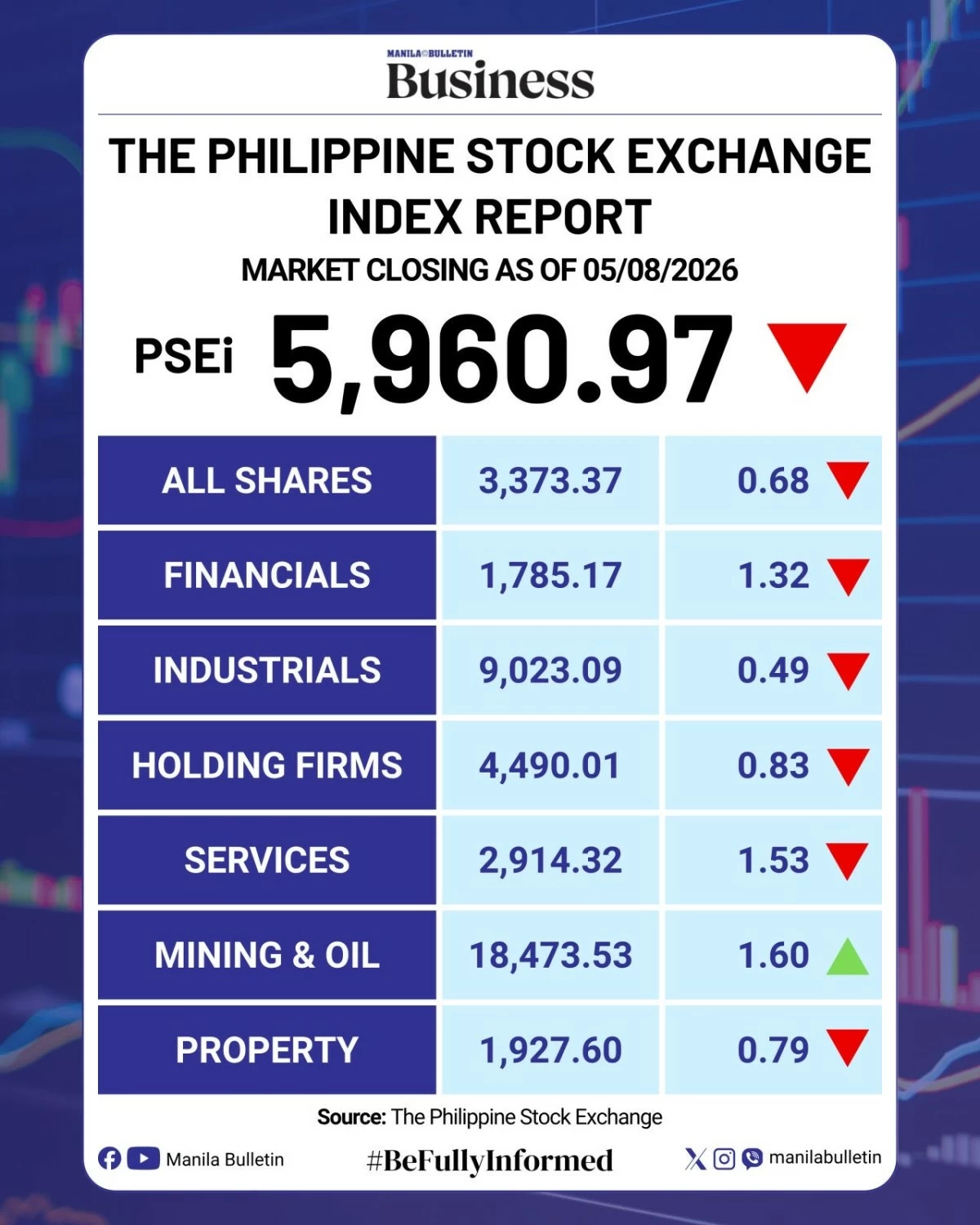
Local equities retreated as weaker-than-expected economic growth print and escalating tensions in the Middle East prompted investors to pocket gains before the weekend.
The Philippine Stock Exchange index fell 73.3 points, or 1.2 percent, to close at 5,960.97 on Friday, May 9. The Services sector led the decline as broader market sentiment soured, though Mining issues managed to buck the downward trend with a late-session advance.
Trading remained active with 1.16 billion shares changing hands, valued at ₱8.52 billion. Decliners narrowly outpaced gainers 97 to 93, while 63 stocks remained unchanged.
The selloff snapped a two-day winning streak for the local benchmark. Market participants cited the first-quarter gross domestic product (GDP) data, which showed the economy expanded by 2.8 percent, trailing the 3.5 percent median estimate of economists.
“The PSEi ended lower as investors took profits following the weaker-than-expected GDP print,” said Luis Limlingan, Managing Director at Regina Capital Development Corp.
Limlingan noted that while a fragile ceasefire in the Middle East remains technically in place, the underlying geopolitical friction is keeping capital on the sidelines. “Sentiment turned cautious amid lingering uncertainty. As a result, investors adopted a more defensive stance heading into the weekend.”
Geopolitical anxieties were further stoked by reports of direct military friction between the US and Iran near the Strait of Hormuz. Japhet Tantiangco, Research Manager at Philstocks Financial, said the market was particularly sensitive to the volatility in the energy-critical waterway.
“Worries over the situation between the US and Iran, following reports that the two exchanged fire at the Strait of Hormuz, weighed heavily on the market,” Tantiangco said.
Despite the immediate market reaction to the naval skirmishes, some analysts pointed to potential diplomatic stabilizers.
Michael Ricafort, Chief Economist at Rizal Commercial Banking Corp., noted that while the latest clashes near the Strait of Hormuz pressured the index, the downside was somewhat mitigated by rhetoric from Washington.
US President Donald Trump signaled that the ceasefire remains intact and suggested that a broader deal could still be reached, providing a sliver of optimism for a volatile region.