






Manila Bulletin
 World
Pope Leo XIV sought a pastoral role in his first year, but verbal sparring with Trump intervened
World
Pope Leo XIV sought a pastoral role in his first year, but verbal sparring with Trump intervened
World
Pope Leo XIV sought a pastoral role in his first year, but verbal sparring with Trump intervened
Pope Leo XIV sought a pastoral role in his first year, but verbal sparring with Trump intervened
Published May 8, 2026 02:10 pm


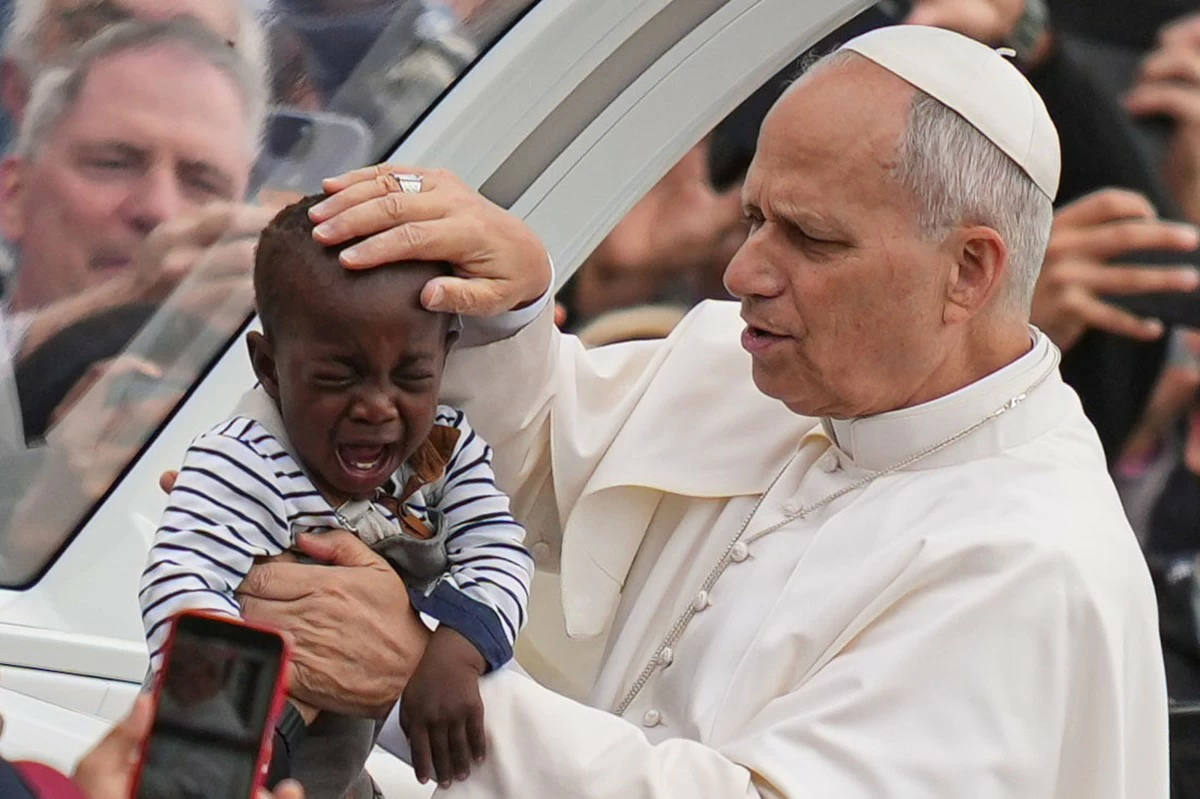
POPE Leo XIV blesses a child at the end of a Mass for the Jubilee of Migrants and Missionaries in Saint Peter's Square at the Vatican, Sunday, Oct. 5, 2025. (AP)
VATICAN CITY (AP) – Pope Leo XIV had tried during his first year as pontiff to insist that his essential role was that of a pastor accompanying his flock. President Donald Trump’s continuing criticisms – and Leo’s increasingly bold retorts – complicated the effort and overshadowed Friday’s anniversary of Leo’s election.
Leo spent the eve of the one-year mark meeting with US Secretary of State Marco Rubio, who had come to the Vatican on a fence-mending visit. Trump’s repeated broadsides against history’s first US pope created an unprecedented back-and-forth on issues of the Iran war and peace that strained US-Holy See relations.
By the end of the visit, both the Vatican and the State Department stressed their strong bilateral ties. But the episode nevertheless pushed Leo out of his comfort zone and onto the global stage to make zingers like the one this week, after Trump's latest misrepresentation of his views. “If someone wants to criticize me for announcing the Gospel, let him do it with the truth,” Leo said.
It’s all a bit out of character for Leo who – the world has come to learn in this first year – is at heart a mild-mannered, 70-year-old Midwestern missionary priest, and a reserved one at that. He likes to play the solitary game of tennis, quotes the 5th century philosopher Saint Augustine from memory, and insists he is merely quoting the Bible when he calls for peace.
The Trump-Leo feud aside, the former Robert Prevost seems driven not by the dramatic gesture or headline-grabbing tensions that often fueled his predecessor, Pope Francis. Rather, Leo seems inspired by the calm, persistent zeal to preach the Gospel and – thanks to his Augustinian spirituality – emphasize community and harmony.
Leo began his improbable papacy promising to work for unity in a polarized world and church, and at the one-year mark, he seems to be delivering.
After Francis’ revolutionary and sometimes divisive 12-year papacy, Leo has brought a calming balm to the Vatican and church at large. He seems intent on healing divisions, even as new threats of schism emerge.
That has certainly been the case as he navigates some of the thorniest challenges facing the Catholic Church: Tensions between traditionalists and progressives, financial problems facing the Holy See, and the geopolitical crises at the heart of the Trump versus Leo dissonance.
“I think the challenge that the Holy Father has is to strengthen the unity of the church,” said Cardinal Wilton Gregory, a Chicago native like Leo and the retired archbishop of Washington. While there have always been divisions, Gregory said social media had amplified them, and that Leo seems intent on tamping them down.
“Social communication makes it possible for people to take sides, and sometimes taking sides adds to the divisiveness that we have to deal with and that the Holy Father, as the Bishop of Rome, has to respond to,” Gregory said in an interview. “He has to call us to our better angels,” he added.
That seemed to be Leo's modus operandi when, days into his recent Africa trip, he temporarily quelled the Trump broadsides by essentially declaring he was above the president's social media rants. While insisting he would continue preaching the Gospel message of peace, Leo said it "is not in my interest at all,” to debate Trump.
“I primarily come to Africa as a pastor, as the head of the Catholic Church to be with, to celebrate with, to encourage and accompany all the Catholics throughout Africa,” he said.
He repeated that message at the trip's conclusion, saying the political role that comes with being pope, a head of state and global moral authority, was simply not his priority.
For many, the shock of an American pope, who defied the taboo precluding a Rome-based moral counterweight to the White House, still hasn’t worn off.
“It’s been the first year of an American pope who has been critical of what America is doing for the most part,” said Anthea Butler, senior fellow at the Koch Institute, Oxford University.
She stressed that Leo is doing so “not coming full-on like Francis would,” but approaching issues from the side. He's not naming names, he's merely preaching the Gospel.
That approach has certainly helped some US Catholic institutions, after the American church developed an almost comically bad relationship with Francis. His criticism of American-style capitalism was amplified by US-based conservative Catholic media during his papacy.
For many Vatican watchers, the Argentine pope simply didn't “get” the US, and vice versa. Some US Catholics eventually soured on donating to the Holy See under Francis, following years of unrelenting stories of mismanagement, corruption and scandal.
But with a Chicago math major now pope, “he can’t be dismissed as being ignorant of the realities in the United States,” said Kerry Alys Robinson, chief executive of Catholic Charities USA, a national network of Catholic agencies.
Robinson said she had never seen US Catholic bishops so united as now, particularly in speaking about the dignity of migrants and poor people. She credits that to many factors, including the Trump administration’s immigration crackdown and funding cuts that have created a common purpose. But she doesn’t discount the unifying message from Leo, in English.
“It’s very different when you are hearing the message without it being mediated through translation,” she said.
Ward Fitzgerald, president of The Papal Foundation, which funds the pope's charity projects in the developing world, said an English-speaking pope has been a boon especially in the US and Europe, where there is anecdotal evidence of a “Leo effect” spurring new converts.
“I think there’s lots of reasons for it, but I certainly think that having a pope who speaks English helps young people understand the messages of the Holy Father,” Fitzgerald said in an interview. That also translates to donors to the church, especially from the US.
“When you tell a donor, ‘I really appreciate what you do’ in English – and they’re English – I think it resonates," Fitzgerald said. "And so, they give a little more.”
The Papal Foundation recently announced 25 new families had joined its ranks since Leo's election, a not-insignificant number given membership requires a minimum $1.25-million pledge.
Fitzgerald and members of the foundation met with Leo last week and gathered in Saint Peter’s Basilica for a Mass celebrated by Cardinal Timothy Dolan, the towering figure of the US Catholic hierarchy and a kingmaker in the 2025 conclave that elected Leo.
Dolan is also chummy with Trump, and is a member of his Religious Liberty Commission.
In his homily, Dolan extolled the attributes of Saint Joseph, the father of Christ and a figure so beloved in the church he is the patron saint of more causes than any other saint. Dolan also revealed his feelings about Leo, whom he had watched in the Sistine Chapel become the 267th pope a year ago Friday.
Saint Joseph was a man of silence, Dolan said, calm and secure in his place.
"A man who exuded a sense of depth and substance. A man who is shy, all right, a man who is focused on his mission,” he added. “A man, always attentive to God’s plan.”
Dolan then asked the Americans seated in the pews if they could think of anyone else who fit Saint Joseph's description. “I can," Dolan said. "Pope Leo reminds me of Joseph.”