






 Philippines
National
Marcos pushes ASEAN Maritime Center amid rising South China Sea tensions
Philippines
National
Marcos pushes ASEAN Maritime Center amid rising South China Sea tensions
Marcos pushes ASEAN Maritime Center amid rising South China Sea tensions


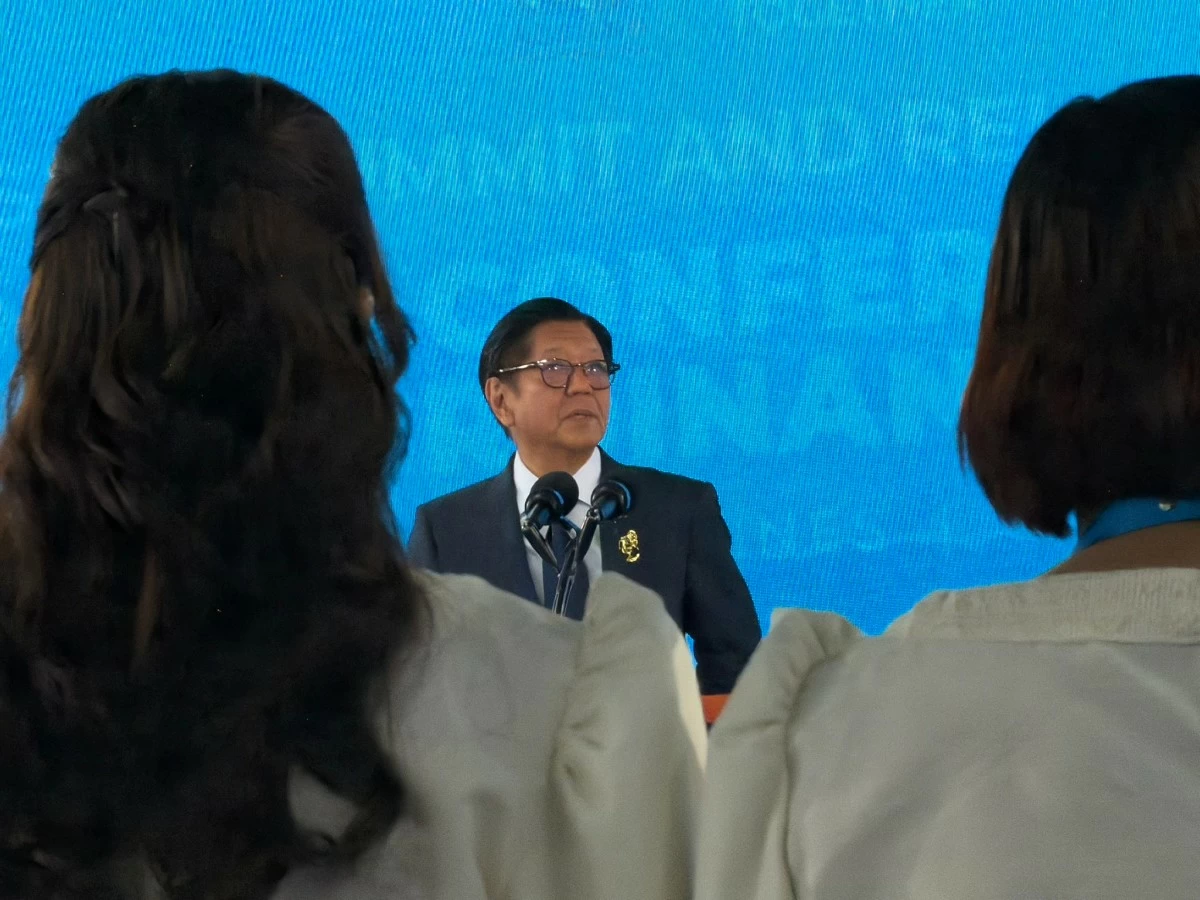
LAPU-LAPU CITY, Cebu — President Marcos has pushed for the establishment of an ASEAN Maritime Center in the Philippines, saying growing uncertainty in the South China Sea has made regional coordination and maritime cooperation more urgent.
Speaking at a press conference on the sidelines of the 48th Association of Southeast Asian Nations Summit here, Marcos said the proposed center would serve as a central repository for maritime concerns as the situation becomes “more unreadable.”
He, however, clarified that the proposed maritime center is not intended to confront or target any particular country.
“What we are looking for — or what is the ultimate reason for having this center, is not to confront or somehow push back on any single force or country,” Marcos said Friday, May 8.
“It has to be seen from this perspective: What we are working for is the continued freedom of navigation and the peaceful navigation in the South China Sea,” he added.
The South China Sea remains a major flashpoint in the region, with overlapping territorial claims involving China, the Philippines, Vietnam, Malaysia, Brunei, and Taiwan.
The proposed maritime center aims to maintain safety, freedom of navigation, and order in the South China Sea. This includes watching out for illegal fishing, smuggling, and human trafficking.
No objections
According to Marcos, there were basically no objections to the proposal to establish the ASEAN Maritime Center.
“The concept of it, the principle of it is very much fully agreed on. I did not hear any arguments against it,” he said.
“I’m very optimistic that it will, in fact, be established. There was a very wide consensus amongst all members,” he added.
The job before ASEAN now is to create a framework detailing how the maritime center would function, such as the role of each member, where it will be placed, and funding.
“This is a new concept, that is why we still have to put the structure in place,” the President said.
“We have to put the vision-mission in place. Although that, perhaps, is something we already have a fairly good idea about,” he added.
President Marcos said the Philippines has formally offered to host the proposed center.
“We proposed the idea. We are offering the Philippines to be the home of that center,” he said.
Trade routes at stake
Marcos stressed the importance of maintaining stability in the South China Sea because of its role in global trade and supply chains.
“As we all know, a large percentage of world trade goes through the South China Sea,” he said.
The President also referenced the recent disruptions caused by tensions in the Middle East and the Strait of Hormuz, warning that a similar disruption in the South China Sea would have severe global consequences.
“If such a thing would happen in the South China Sea, the inevitable consequences are alarming just to even think about,” Marcos said.
UNCLOS guiding principle
Marcos said the proposed ASEAN Maritime Center would also help ensure maritime safety, territorial respect, and adherence to international law.
“Of course, there is the attendant issues of assistance, of making sure that our waters are safe, our territories are respected, and UNCLOS is the single most important guiding principle that we adhere to,” he said.
The United Nations Convention on the Law of the Sea (UNCLOS) served as the basis for the landmark 2016 arbitral ruling that invalidated China’s sweeping claims in the South China Sea.