






Manila Bulletin
 Philippines
National
ASEAN, EU leaders seek stronger cooperation amid energy and sustainability challenges
Philippines
National
ASEAN, EU leaders seek stronger cooperation amid energy and sustainability challenges
Philippines
National
ASEAN, EU leaders seek stronger cooperation amid energy and sustainability challenges
ASEAN, EU leaders seek stronger cooperation amid energy and sustainability challenges
Cebu summit highlights urgent push for renewable energy, resilient supply chains, and climate action
Published May 8, 2026 03:03 pm


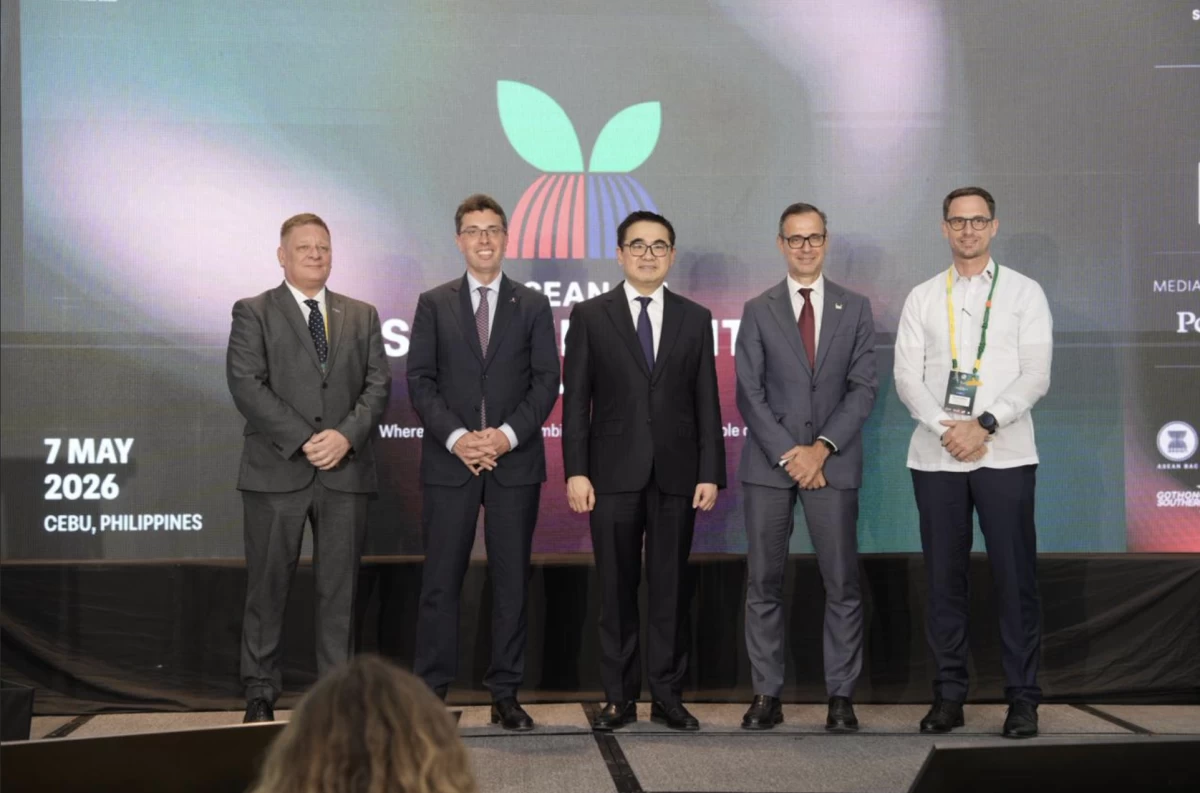
From left: EU-ABC Executive Director Chris Humphrey, EU Ambassador to the Philippines Massimo Santoro, Philippine Secretary of Finance Frederick Go, ECCP President Paulo Duarte, and ECCP Executive Director Florian Gottein, at the ASEAN-EU Sustainability Summit 2026.
Leaders from the Association of Southeast Asian Nations (ASEAN) and the European Union (EU) called for stronger regional cooperation and faster implementation of sustainability initiatives amid ongoing energy and economic pressures across Southeast Asia.
The call was made during the ASEAN-EU Sustainability Summit 2026 in Cebu on May 7, where more than 200 government officials, diplomats, policymakers, and business executives gathered to discuss renewable energy, climate resilience, food security, and sustainable economic growth.
Officials attending the summit included Philippine Finance Secretary Frederick Go, EU Ambassador to the Philippines Massimo Santoro, Indonesia Deputy Minister for National Development Planning Leonardo Teguh Sambodo, and Climate Change Commission Executive Director Robert Borje.
ASEAN-EU trade, financing seen key to green transition
During the discussions, leaders stressed that sustainability policies should now be treated as essential economic strategies rather than optional environmental programs.
Speaking at the summit, European Chamber of Commerce of the Philippines (ECCP) President Paulo Duarte said countries in the region are facing growing challenges from volatile energy prices, supply chain disruptions, and rising operational costs, making closer ASEAN-EU cooperation increasingly important.
“At a time of global uncertainty marked by energy volatility, supply chain disruptions, and rising costs, this Summit could not be more timely,” Duarte said.
“It reflects a shared recognition across the region that sustainability is no longer optional,” Duarte, who is also a member of the EU-ASEAN Business Council (EU-ABC)’s executive board, said. “It is central to economic resilience, competitiveness, and long-term growth,” he added.
Meanwhile, Go said the Philippines is working to strengthen its economic partnership with Europe while supporting sustainability and inclusive growth goals.
“Europe and the Philippines have a stable and evolving partnership, built on trade, investment, and development cooperation,” he said. “Today, it is also focused on sustainability, climate, and inclusive growth, and we remain committed to deepening our collaboration with the EU and advancing our shared priorities together,” he added.
He also cited the ongoing negotiations for the EU-Philippines Free Trade Agreement, which both parties aim to finalize this year, describing it as a major opportunity to boost trade and investment.
“This is a much-awaited milestone that will strengthen trade, unlock new opportunities for exporters, and deepen our economic partnership with the EU,” Go said.
Meanwhile, Borje said the current energy situation could create opportunities for investment in cleaner, greener energy sources in the Philippines.
“What can be seen right now as a challenge can be turned into an opportunity — an opportunity not just for investments to come into the Philippines, but an opportunity that provides co-benefits as we work towards a greener future and greener sources of energy,” he said.
Santoro also emphasized the need to align climate ambitions with adequate financing to ensure sustainability projects can be fully implemented.
“While we are rightly ambitious in setting our targets for climate and environmental action, we do not always synchronize the financial resources needed to implement that ambition,” he said. “Strengthening the link between ambition and financing is essential to turning policy into real, on-the-ground impact,” he added.
Santoro noted that cooperation on trade, climate action, and disaster risk reduction should not be treated separately, as these challenges are closely interconnected. “The current energy situation must become an opportunity to accelerate this integrated approach, including on renewable energy and economic resilience,” he added.
Business, government leaders push faster sustainability action
Several sessions during the summit focused on circular economy initiatives, environmental governance, food supply stability, and supply chain protection.
Department of Environment and Natural Resources (DENR) Undersecretary Jonas Leones said stronger collaboration with investors and private companies is necessary to successfully implement environmental programs.
“The best lesson there is that the government cannot do it alone,” he said. “We need investors and the private sector to really implement and move forward,” he added.
Private sector representatives likewise underscored the importance of industry participation in sustainability efforts across the region.
Coca-Cola Philippines President Antonio Del Rosario said that Extended Producer Responsibility — an environmental policy approach that makes producers responsible for the entire lifecycle of their products — can be a huge driver for the circular economy in ASEAN.
“It can bring together not only government and industry, but also NGOs and the informal waste sector, which plays a significant role in Southeast Asia, including here in the Philippines,” he said.
Rodney van Dooren, Director of Illicit Trade Prevention at Philip Morris International, also highlighted the need to strengthen supply chain integrity across the region.
“Legitimate companies contribute most effectively by reinforcing and scaling government-led frameworks, not substituting for regulation or enforcement,” he said. “As a private sector, our role is to embed integrity into our day-to-day operations and to share relevant information, such as risk indicators and supply chain data, to support government enforcement efforts,” he added.
Meanwhile, Cynderella Galimpin, Head of Animal Health for ASEAN, Korea, Australia & New Zealand at Boehringer Ingelheim, also underscored the impact of animal health on economic stability.
“We need to act fast when there is an outbreak,” she said. “Today, regulatory approval timelines for vaccines across Southeast Asia range from one to three years, but when the outbreak is already there, that is too late because it has already impacted food supply, trade, and the economy,” she added.
In his closing remarks, EU-ABC Executive Director Chris Humphrey urged participants to take responsibility for turning the day’s discussions into tangible results. “We need governments, businesses, and citizens to take sustainability more seriously in all its aspects, so we can all live longer, healthier lives while looking after our planet at the same time,” he said.
The ASEAN-EU Sustainability Summit 2026 was organized by the EU-ASEAN Business Council and the European Chamber of Commerce of the Philippines as part of the Philippines’ hosting of ASEAN-related meetings this year.