ADVERTISEMENT

DFA calls for ASEAN agility, unity, amid Middle East crisis

Published May 7, 2026 12:44 pm  |  Updated May 7, 2026 01:30 pm
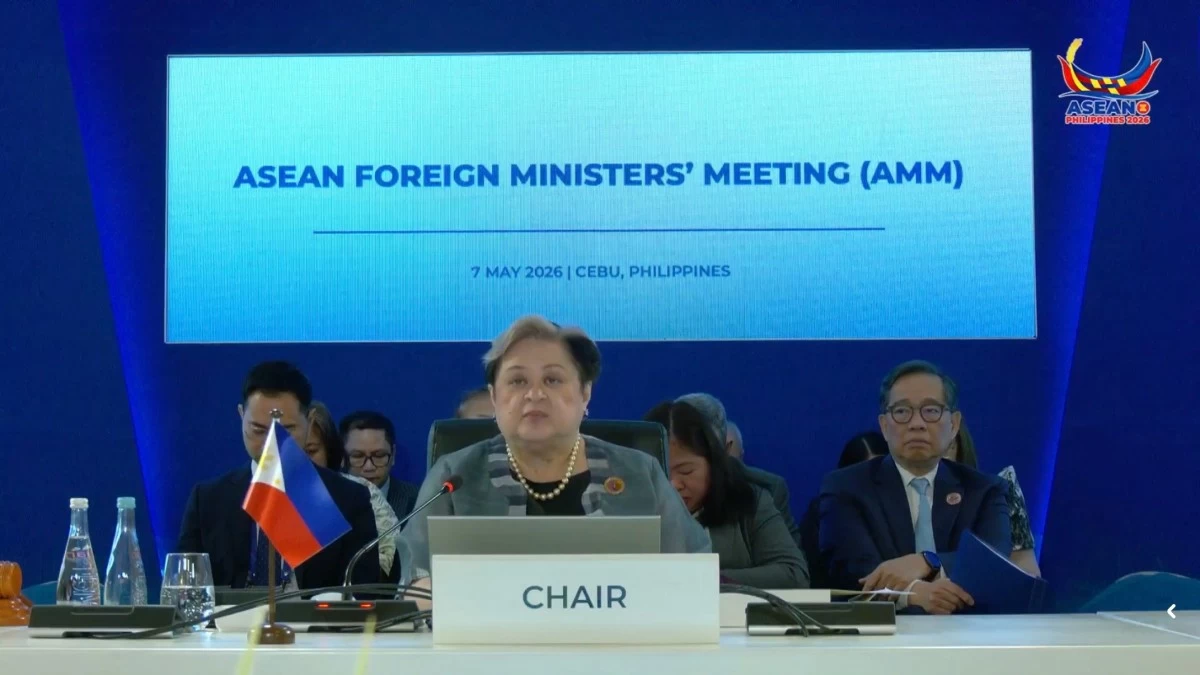
Department of Foreign Affairs Secretary Ma. Theresa Lazaro (ASEAN 2026 PH)

LAPU-LAPU CITY, Cebu — Department of Foreign Affairs (DFA) Secretary Ma. Theresa Lazaro on Thursday, May 7 called on ASEAN member-states to remain agile and united in responding to global crises, saying the ongoing conflict in the Middle East has exposed the region’s vulnerabilities in energy, trade, and food security.

Speaking at the opening of the ASEAN Foreign Ministers’ Meeting here, Lazaro said ASEAN must balance immediate crisis response with long-term regional goals under the ASEAN Community Vision 2045.

“Under the Philippines chairship theme, ‘Navigating Our Future, Together,’ we approach this meeting with the understanding that navigating uncertainty requires both agility in responding to immediate and pressing challenges and steadfast commitment in pursuing our long-term goals under the ASEAN Community 2045,” she said.

The DFA chief said the conflict in the Middle East has shown how developments outside Southeast Asia can immediately affect ASEAN economies and communities.

“As we convene today, we do so at a particularly consequential moment for our region,” she said.

“The ongoing crisis in the Middle East and its far-reaching repercussions, including the disruptions to energy flows, trade routes, food supply chain, and the welfare of our nationals, remind us that developments beyond our region can have immediate and profound effects on ASEAN,” she added.

Energy, food costs hit ASEAN

Lazaro noted that ASEAN imports around 66 percent of its crude oil, making the region vulnerable to spikes in fuel and energy prices caused by the conflict.

“For ASEAN, which imports about 66 percent of its crude oil, this crisis meant a significant increase in fuel and energy cost, which eventually led to higher prices for agricultural inputs, food, and basic commodities,” she said.

She added that the crisis also disrupted transportation and tourism while putting millions of ASEAN nationals working in the Middle East at risk.

“The crisis also caused disruptions in some sectors, including transportation and tourism and put at risk millions of ASEAN nationals in the Middle East,” Lazaro said.

ASEAN response

According to Lazaro, ASEAN foreign ministers have already held two special meetings to discuss a coordinated response to the crisis.

“Our discussions reflected ASEAN’s resolve to act with urgency, coordinate closely, and respond collectively to these emerging challenges,” she said.

The DFA secretary also stressed the need to improve ASEAN’s crisis coordination and institutional readiness.

“Taking stock, our experience and our discussions at the special meetings have pointed out that ASEAN needs to strengthen our crisis coordination and institutionalized readiness in times of crisis,” she said.

PH scaled down ASEAN hosting

Lazaro also disclosed that the Philippines had to recalibrate some of its ASEAN-hosting commitments after declaring a national energy emergency on March 24.

“This declaration necessitated a recalibration of our ASEAN hosting commitments this year including the shift to virtual modalities for the majority of our ASEAN meetings and scaling down of arrangements for meetings that would still need to be conducted in person such as this summit,” she said.

She explained the scaling down was done in consideration of prevailing global conditions and sensitivities surrounding the crisis.

Timor-Leste, ASEAN centrality

Despite the ongoing challenges, Lazaro said ASEAN remains committed to advancing key regional priorities, including the Treaty of Amity and Cooperation in Southeast Asia, which marks its golden jubilee this year.

She also cited Timor-Leste’s post-admission integration and efforts to uphold ASEAN centrality in relations with external partners.

“We’ll also continue to discuss matters related to ASEAN’s external relations ensuring that the partnership supports ASEAN centrality,” she said.

Myanmar briefing

Lazaro, who also serves as Special Envoy of the ASEAN Chair on Myanmar, said she would brief fellow foreign ministers on the situation in Myanmar and the implementation of the Five-Point Consensus.

“Finally, as special envoy of the ASEAN chair on Myanmar, I will provide a briefing on the updates on the situation in Myanmar and the implementation of the Five-Point Consensus,” she said.

Related Tags

DFA Ma. Theresa Lazaro Middle East conflict ASEAN 2026 ASEAN ASEAN Summit
ADVERTISEMENT
.most-popular .layout-ratio{ padding-bottom: 79.13%; } @media (min-width: 768px) and (max-width: 1024px) { .widget-title { font-size: 15px !important; } }

{{ articles_filter_1561_widget.title }}

.most-popular .layout-ratio{ padding-bottom: 79.13%; } @media (min-width: 768px) and (max-width: 1024px) { .widget-title { font-size: 15px !important; } }

{{ articles_filter_1562_widget.title }}

.most-popular .layout-ratio{ padding-bottom: 79.13%; } @media (min-width: 768px) and (max-width: 1024px) { .widget-title { font-size: 15px !important; } }

{{ articles_filter_1563_widget.title }}

{{ articles_filter_1564_widget.title }}

.mb-article-details { position: relative; } .mb-article-details .article-body-preview, .mb-article-details .article-body-summary{ font-size: 17px; line-height: 30px; font-family: "Libre Caslon Text", serif; color: #000; } .mb-article-details .article-body-preview iframe , .mb-article-details .article-body-summary iframe{ width: 100%; margin: auto; } .read-more-background { background: linear-gradient(180deg, color(display-p3 1.000 1.000 1.000 / 0) 13.75%, color(display-p3 1.000 1.000 1.000 / 0.8) 30.79%, color(display-p3 1.000 1.000 1.000) 72.5%); position: absolute; height: 200px; width: 100%; bottom: 0; display: flex; justify-content: center; align-items: center; padding: 0; } .read-more-background a{ color: #000; } .read-more-btn { padding: 17px 45px; font-family: Inter; font-weight: 700; font-size: 18px; line-height: 16px; text-align: center; vertical-align: middle; border: 1px solid black; background-color: white; } .hidden { display: none; }
function initializeAllSwipers() { // Get all hidden inputs with cms_article_id document.querySelectorAll('[id^="cms_article_id_"]').forEach(function (input) { const cmsArticleId = input.value; const articleSelector = '#article-' + cmsArticleId + ' .body_images'; const swiperElement = document.querySelector(articleSelector); if (swiperElement && !swiperElement.classList.contains('swiper-initialized')) { new Swiper(articleSelector, { loop: true, pagination: false, navigation: { nextEl: '#article-' + cmsArticleId + ' .swiper-button-next', prevEl: '#article-' + cmsArticleId + ' .swiper-button-prev', }, }); } }); } setTimeout(initializeAllSwipers, 3000); const intersectionObserver = new IntersectionObserver( (entries) => { entries.forEach((entry) => { if (entry.isIntersecting) { const newUrl = entry.target.getAttribute("data-url"); if (newUrl) { history.pushState(null, null, newUrl); let article = entry.target; // Extract metadata const author = article.querySelector('.author-section').textContent.replace('By', '').trim(); const section = article.querySelector('.section-info ').textContent.replace(' ', ' '); const title = article.querySelector('.article-title h1').textContent; // Parse URL for Chartbeat path format const parsedUrl = new URL(newUrl, window.location.origin); const cleanUrl = parsedUrl.host + parsedUrl.pathname; // Update Chartbeat configuration if (typeof window._sf_async_config !== 'undefined') { window._sf_async_config.path = cleanUrl; window._sf_async_config.sections = section; window._sf_async_config.authors = author; } // Track virtual page view with Chartbeat if (typeof pSUPERFLY !== 'undefined' && typeof pSUPERFLY.virtualPage === 'function') { try { pSUPERFLY.virtualPage({ path: cleanUrl, title: title, sections: section, authors: author }); } catch (error) { console.error('ping error', error); } } // Optional: Update document title if (title && title !== document.title) { document.title = title; } } } }); }, { threshold: 0.1 } ); function showArticleBody(button) { const article = button.closest("article"); const summary = article.querySelector(".article-body-summary"); const body = article.querySelector(".article-body-preview"); const readMoreSection = article.querySelector(".read-more-background"); // Hide summary and read-more section summary.style.display = "none"; readMoreSection.style.display = "none"; // Show the full article body body.classList.remove("hidden"); } document.addEventListener("DOMContentLoaded", () => { let loadCount = 0; // Track how many times articles are loaded const offset = [1, 2, 3, 4, 5, 6, 7, 8, 9, 10]; // Offset values const currentUrl = window.location.pathname.substring(1); let isLoading = false; // Prevent multiple calls if (!currentUrl) { console.log("Current URL is invalid."); return; } const sentinel = document.getElementById("load-more-sentinel"); if (!sentinel) { console.log("Sentinel element not found."); return; } function isSentinelVisible() { const rect = sentinel.getBoundingClientRect(); return ( rect.top < window.innerHeight && rect.bottom >= 0 ); } function onScroll() { if (isLoading) return; if (isSentinelVisible()) { if (loadCount >= offset.length) { console.log("Maximum load attempts reached."); window.removeEventListener("scroll", onScroll); return; } isLoading = true; const currentOffset = offset[loadCount]; window.loadMoreItems().then(() => { let article = document.querySelector('#widget_1690 > div:nth-last-of-type(2) article'); intersectionObserver.observe(article) loadCount++; }).catch(error => { console.error("Error loading more items:", error); }).finally(() => { isLoading = false; }); } } window.addEventListener("scroll", onScroll); });

Sign up by email to receive news.