








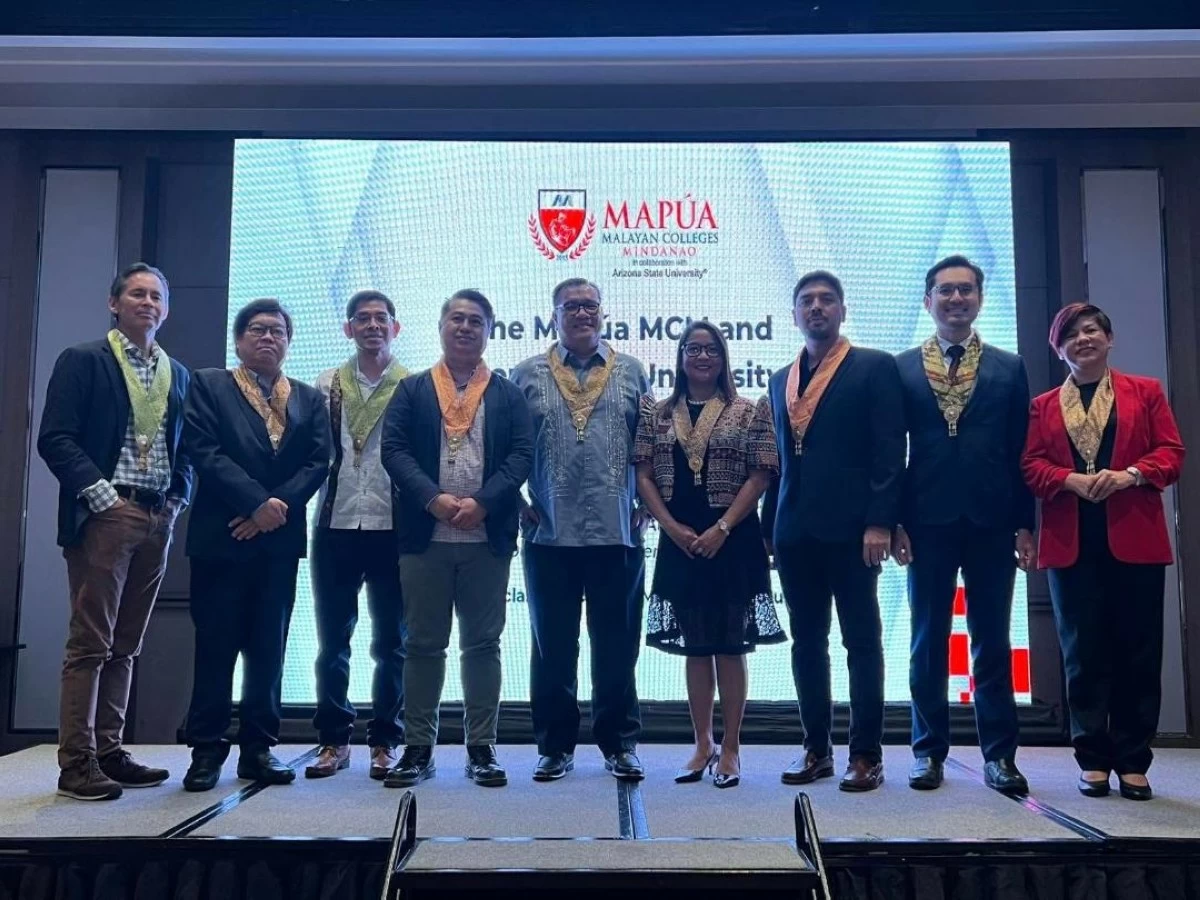
MAPUA Malayan Colleges Mindanao and Arizona State University signed a comprehensive academic partnership on Thursday, May 7, at Dusit Thani Davao Residence in Davao City, to expand access to globally aligned education and international learning opportunities in Davao and Mindanao. (Photo via Ivy Tejano)
DAVAO CITY – The Commission on Higher Education welcomed the expanded partnership between Mapúa Education Group and Arizona State University, which strengthens global ties in Philippine higher education and makes international opportunities more accessible to local students.
Mapua Malayan Colleges Mindanao and Arizona State University officially sealed their comprehensive academic partnership on Thursday, May 7, at Dusit Thani Davao Residence in Davao City, to expand access to globally aligned education and international learning opportunities in Davao and Mindanao.
ASU highlighted the benefits of the collaboration for students, including globally competitive education, access to international progression pathways, exposure to world-class faculty and innovation ecosystems, and enhanced employability in a rapidly changing economy.
CHED Chairwoman Shirley Agrupis, who congratulated both Mapua and ASU, described the collaboration as a form of "structural transformation" that goes beyond traditional exchange programs and ceremonial agreements, demonstrating what comprehensive internationalization truly means.
Agrupis said the partnership embeds globally benchmarked academic content, artificial intelligence-enabled learning, dual-degree pathways, accelerated master's programs, and strengthened research collaboration directly into the academic experience, which advances the CHED Achieve Agenda.
"This is the kind of internationalization that transforms systems, strengthens institutions, and empowers generations," Agrupis said in a video message, adding that the initiative supports CHED's push to make global education opportunities accessible to all students, not just those who can afford to study abroad.
Agrupis said impact-driven internationalization also requires measurable outcomes such as stronger curriculum relevance, improved research capabilities, increased innovation, and graduates who are globally competitive while remaining responsive to local needs.
"When artificial intelligence, digital transformation, and global disruption are reshaping education systems worldwide, institutions must act with foresight and courage," she said, adding that the collaboration between Mapua and ASU demonstrates that readiness.
The CHED official said such collaboration also sends a powerful message to Filipino students that they can access global-quality education in the country and that Philippine universities are capable of standing shoulder to shoulder with leading institutions worldwide.
Dr. Christopher Pio Pulido, supervising education program specialist at CHED-11, said the collaboration of the two universities also aligns with the CHED–Davao and the Davao Regional Development Plan's goal of building a competitive, future-ready workforce.
"It opens opportunities for students in Mindanao to access globally aligned learning and innovation-driven academic experiences without leaving the region," Pulido said, while recognizing MCM's board exam topnotchers, noting that their achievements reflect academic excellence in the Davao region.
Mapúa Education Group President and Chief Executive Officer Dodjie Maestrecampo said the partnership signals Mapúa's shift towards a group-wide global academic model focused on innovation, digital transformation, and lifelong learning to prepare future graduates better.
He said the partnership began between 2022 and 2025 through business and health science programs across Mapúa schools, leading to enrollment growth, new programs, faculty training, student certificates, global lectures, and pathways for dual degrees and accelerated master's programs.
Because of these results, Maestrecampo said Mapúa is now expanding the partnership in all schools, with Mapúa Malayan Colleges Mindanao serving as a key platform for expanding global education access in the Davao region and the whole of Mindanao.
Maestrecampo said the expansion will focus on seven areas: Sustainability leadership, AI-enabled education, online learning, research collaboration, microcredentials, internationalization, and new academic programs, which align with global academic trends.
"When you bring these pillars together: For students, higher degree value and real global mobility options; for industries, a stronger talent pipeline and deeper research and development collaboration; and for the country, global benchmarking that supports sustainable growth," Maestrecampo said.
Engr. Alejandro Palayao Jr., executive vice president and CEO of Mapua MCM, said the partnership ensures that students from across Mindanao can access globally competitive education without leaving the island, expanding higher learning opportunities locally.
Palayao said students will gain access to international academic content, global classrooms, faculty exchanges, certifications, and possible academic pathways while remaining grounded in Mindanao's workforce needs and regional development priorities.
Paul Tan, senior vice president for Southeast Asia at Cintana Education, introduced Cintana Education as ASU's global expansion platform and noted that it currently connects 34 universities worldwide. He said ASU has been ranked No. 1 in the US for innovation.
Through Cintana, Tan said, ASU partners with leading institutions worldwide to embed high-quality academic content, digital innovation, and global pathways into local systems, strengthening institutions rather than replacing them.
"Why Mapúa MCM? It is not only a top-quality Filipino institution but also a leader with vision and execution capability. It is a reputable institution in the Philippines, well known in Davao," Tan said. "This is not about importing a US model. It is about co-creating a globally relevant and locally grounded model."
In a video-recorded message, ASU President Michael Crow said that, through its relationship with Cintana, ASU looks forward to working closely with Mapúa MCM to strengthen educational opportunities in the Philippines, together with its allies in the United States.